Fermi Gas Model of Nucleus
Fermi Gas Model of the Nucleus
In this section, the Fermi gas model of the nucleus is introduced, drawing parallels with the electron gas model in metals. The concept of a Fermi gas as a collection of non-interacting fermion particles is explained.
Introduction to Fermi Gas Model
- The Fermi gas model resembles the electron gas model in metals, consisting of non-interacting fermion particles.
- Fermions such as electrons, protons, and neutrons adhere to Pauli's exclusion principle.
- Distinction between fermions and bosons:
- Fermions follow Pauli's exclusion principle limiting two particles per energy level with different spins.
- Bosons can have multiple particles occupying the same energy state without spin restrictions.
Characteristics of a Fermi Gas
- Definition of a "gas" in physics:
- Gaseous state implies minimal interactions among particles compared to liquids and solids.
- Application of Fermi gas model to nuclei:
- Contrast between assumptions in liquid drop and Fermi gas models for nuclear structure.
Nuclear Potential in Fermi Gas Model
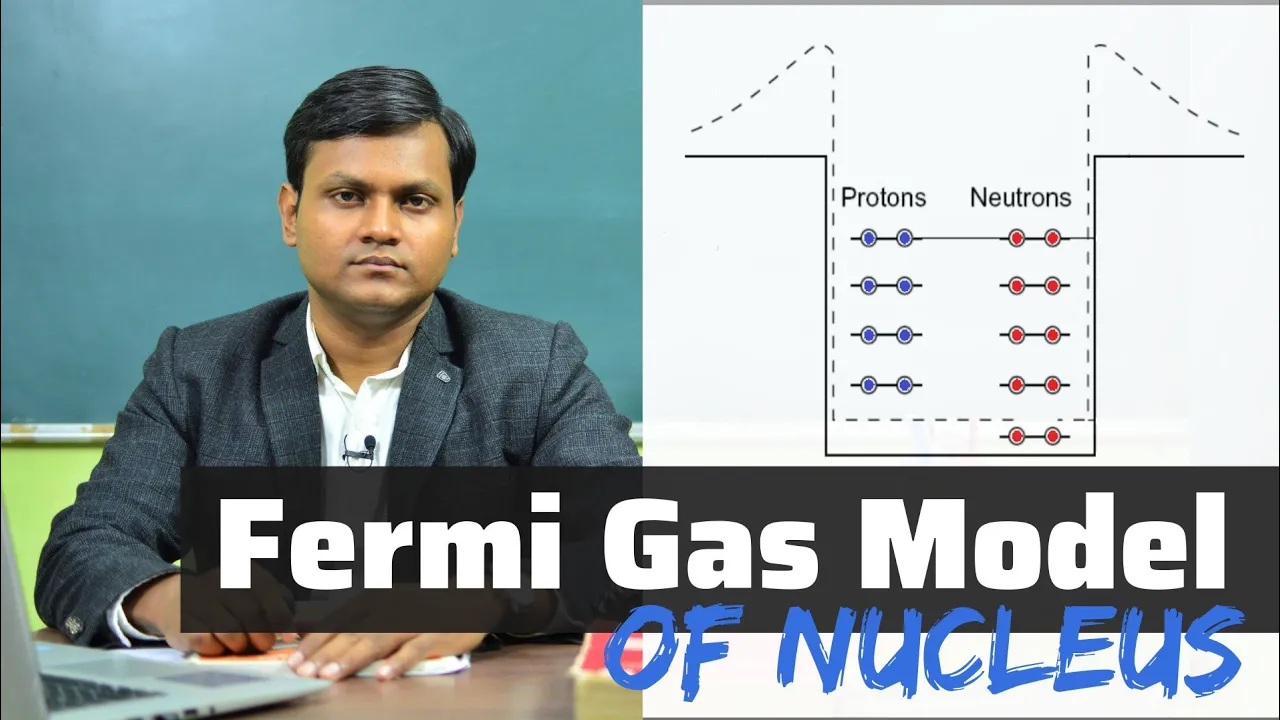
This section delves into how the general potential field within a nucleus is approximated using a square well potential in the context of the Fermi gas model.
Modeling Nuclear Potential
- Assumptions regarding nuclear mass density:
- Mass density remains constant within the nucleus but drops sharply near its boundary.
- Approximation using square well potential:
- The nuclear potential is represented by a three-dimensional finite square well due to distinct interactions between neutrons and protons.
Energy Levels and Particle Interactions
Exploring how neutrons and protons occupy energy levels within their respective potential wells based on being fermions, leading to specific configurations within nuclei.
Energy Level Occupancy
- Neutrons and protons as fermions:
- Limitation on occupancy per energy level due to being fermions.
- Ground state configuration:
- Distribution of particles across energy levels even at zero temperature for minimum energy configuration.
Particle Collisions Within Nucleus
Discussing collisions between quantum particles like neutrons inside nuclei, highlighting unique behaviors compared to classical particle collisions.
Quantum Particle Collisions
- Impact of collisions on particle energies:
- Exchange of energy levels when identical quantum particles collide within the nucleus.
- Conservation of system configuration:
Fermi Gas Model of Nucleus
In this section, the Fermi gas model of the nucleus is discussed, focusing on the energy levels and interactions of neutrons and protons within the nucleus.
Understanding Nucleus as a Fermi Gas
- Neutrons and protons in the nucleus are assumed to move independently without interacting with each other. This independence allows for considering the nucleus as a Fermi gas.
- The Fermi energy represents the energy difference between the highest occupied state and the lowest occupied state in a nuclear system. It helps calculate potential depth by adding binding energy per nucleon.
- Calculating Fermi energy involves assuming a three-dimensional finite square well potential for nuclear structure, leading to different Fermi energies for neutrons (around 43 MeV) and protons (around 33 MeV).
Significance of Fermi Energy
- The difference in neutron and proton densities in medium to large-sized nuclei results in varying Fermi energies. Neutron density being higher leads to a greater Fermi energy for neutrons compared to protons.
- Binding energy per nucleon, combined with Fermi energy, determines potential depth of nuclear potential well. For neutrons, this sums up to approximately 50 MeV, while for protons it is around 40 MeV due to differing numbers in nuclei.
Successes of Fermi Gas Model
This section explores the successes of the Fermi gas model concerning particle pairing, stability based on nuclear configurations, and its role in explaining beta decay processes.
Particle Pairing and Stability
- The model explains how neutrons and protons pair up due to their fermionic nature, occupying distinct quantized energy levels within even-even nuclei for enhanced stability compared to other configurations like even-odd or odd-even nuclei.
- Even-even nuclei with an equal number of protons and neutrons exhibit complete filling of energy levels, ensuring no unpaired particles for increased stability compared to configurations with unpaired particles like odd-even nuclei.
Role in Beta Decay Processes
Energy Configurations and Beta Decay Processes
The discussion revolves around energy configurations within nuclei and how they can lead to beta decay processes, where neutrons can convert to protons or vice versa to achieve a more stable overall energy state.
Energy Configurations and Beta Decay
- Neutrons can convert to protons or vice versa in beta decay processes based on their energy states.
- It leads to the possibility of beta decay processes where a neutron can be converted to a proton or vice versa.
- Converting neutrons to protons or vice versa helps balance the overall energy of the system by occupying lower energy states.
- Protons converting to neutrons balances the overall energy of the system.
- Unstable nuclear configurations with unequal Fermi energies allow for beta decay, changing protons into neutrons or vice versa.
- Unstable configurations with differing Fermi energies lead to beta decay processes for balancing particle energies.
Fermi Gas Model and Nuclear Interactions
- The Fermi gas model assumes neutrons and protons inside the nucleus move freely without interacting with each other directly.
- Neutrons and protons are assumed not to interact but move freely within the nucleus's volume.
- Interaction occurs through an overall nuclear potential resembling a square well potential in this model.
- This model explains nuclear energy levels, pairing effects for stability, and beta decay in unstable nuclear configurations deviating from stability.
Turn any video into a summary like this
YouTube links, meetings, lectures. With transcripts, search, and chat.