Lecture 12.2 Uni-, Bi-, and intermolecular reaction mechanisms
Understanding Molecularity and Reaction Mechanisms
Introduction to Molecularity
- The lecture focuses on the molecularity of reactions and detailed reaction mechanisms, aiming to identify molecularity from elementary steps.
- Goals include identifying molecularity for elementary reaction steps, writing balanced chemical equations, and deriving overall rate equations.
Defining Molecularity
- Molecularity is defined as the number of molecules that react in an elementary step.
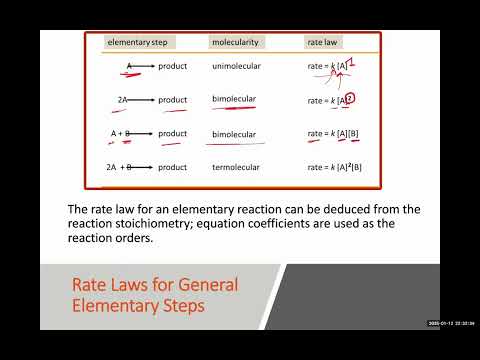
- Examples illustrate unimolecular (one molecule reacts) and bimolecular (two molecules react) reactions.
Types of Reactions
- Bimolecular reactions involve two different reactants or two moles of a single reactant; trimolecular reactions are rare but involve three reacting species.
- Most common reactions are unimolecular or bimolecular.
Example of Bimolecular Reaction
- A specific example shows one mole of Br2 reacting with two moles of NO2 to produce 2 moles of Br, illustrating a bimolecular process.
- The reaction occurs in two steps, both involving bimolecular interactions where intermediates form during the process.
Understanding Intermediates
- Intermediates appear during the reaction but do not show up in the final rate equation; they must be substituted with known species when writing overall equations.
Writing Rate Equations
- For unimolecular reactions, the rate law can be expressed as textRate = k[A] , indicating first-order kinetics with respect to A.
- In contrast, for bimolecular reactions involving two moles of A, it follows textRate = k[A]^2 , indicating second-order kinetics.
Key Differences Between Elementary Steps and Overall Reactions
- The order for elementary steps can be determined from stoichiometry; however, this does not apply to overall reactions which require experimental determination.
- This distinction is crucial: while elementary step orders derive from balanced equations, overall reaction orders cannot be inferred similarly.
Conclusion on Reaction Orders
- An example illustrates a bimolecular reaction between one mole each of A and B producing products; its rate law reflects direct concentration dependencies.
Understanding Reaction Mechanisms and Rate Laws
Overview of Reaction Orders
- The overall reaction order must be determined experimentally, not solely from the balanced equation.
- Example reactions include a ter-molecular reaction with two moles of A and one mole of B producing products, illustrating different molecularities.
Analyzing Elementary Steps
- Two proposed elementary steps involve NO2Cl gas producing NO2 gas and Cl gas, followed by a reaction with Cl gas to produce more NO2.
- The task is to write the overall balanced equation based on these steps and determine the molecularity for each step.
Writing Overall Balanced Equations
- To find the overall equation, combine both steps while canceling out species that appear on both sides (e.g., Cl gas).
- The resulting balanced equation shows 2 moles of NO2 produced alongside 1 mole of Cl2.
Determining Molecularity and Rate Laws
- Step one has unimolecular characteristics (one mole of NO2Cl), while step two is bimolecular (reacting one mole each of NO2Cl and Cl).
- The rate laws for these steps are expressed as K1 for step one (dependent on [NO2Cl]) and K2 for step two (dependent on [NO2Cl] and [Cl]).
Experimental Determination of Reaction Order
- For another example involving NO2 reacting with CO to produce N gas and CO2, the rate law can be expressed in terms of concentrations raised to specific powers.
- The order with respect to NO2 is determined as second-order, while CO shows zero-order behavior since its concentration does not appear in the rate law.
Intermediate Species in Multi-Step Reactions
- In a proposed mechanism where NO3 is formed as an intermediate from two moles of NO2, it plays a crucial role despite not appearing in the final reaction.
- The first step's rate law involves K1 dependent on [N]^2 due to two moles being present.
Identifying Rate Determining Steps
- Step one is identified as the slow or rate-determining step; thus, it governs the overall reaction speed.
- An analogy illustrates how an overall journey's pace can be limited by the slowest participant—in this case, akin to how a slow reaction step limits overall kinetics.
This structured overview captures key concepts related to chemical kinetics, focusing on determining rates through experimental means rather than theoretical assumptions.
Understanding Reaction Mechanisms and Rate Laws
Key Concepts in Reaction Rates
- The overall reaction rate is determined by the slowest step, known as the rate-determining step. This principle is analogous to a race where the speed of the slowest runner dictates the overall pace.
- In a proposed mechanism for ozone decomposition, two steps are involved:
- Step one involves Cl reacting with O3 to produce ClO and O2.
- Step two sees ClO react with another O3 molecule to yield additional O2.
Writing Rate Laws
- For each step in a reaction mechanism, it is essential to write the rate law:
- Step One: Rate = k1[Cl][O3]
- Step Two: Rate = k2[Cl][O3]
- Molecularity refers to the number of molecules participating in an elementary reaction:
- Both steps have a molecularity of two since they involve one mole of Cl and one mole of O3.
Identifying Intermediates
- To determine intermediates, combine both steps and cancel out species that appear on both sides:
- The overall balanced equation results in three moles of oxygen gas produced from two moles of ozone.
- The intermediates identified are ClO and Cl.
Analyzing Complex Reactions in Acidic Solutions
Proposed Mechanism Overview
- An acid solution mechanism involves NH4+ reacting with HNO2 to form N2, H2O, and H+.
- The proposed steps include various molecularities (two for some steps, one for others). Understanding these helps derive the rate law accurately.
Equilibrium Considerations
- Steps one and two are at equilibrium; thus, their forward and backward rates are equal.
- The slowest step (step three) determines the overall reaction rate according to established principles. This emphasizes how crucial it is to identify which step controls the kinetics of the entire process.
Substituting Intermediates
- Since intermediates cannot be present in the final rate equation due to their transient nature during reactions, they must be substituted with known concentrations from other reactants (NH4+ or HNO2). This substitution ensures that only stable species appear in the final expression for clarity and accuracy.
Understanding Rate Constants in Chemical Reactions
Defining Forward and Backward Rate Constants
- The forward rate constant is denoted as K2, while the backward rate constant is represented as K−2. This distinction is crucial for writing the rate equations.
- The rate of the forward reaction can be expressed as:
[ textRate_textforward = K2 times [textNH_4^+] ]
where [NH₄⁺] represents the concentration of ammonium ions.
Equilibrium and Concentration Relationships
- For a system at equilibrium, the rates of the forward and backward reactions are equal:
[ K2 times [textNH_4^+] = K_-2 times [textNH_3] times [H^+] ]
This relationship allows us to derive expressions for concentrations involved in both reactions.
- Rearranging gives us an expression for NH₃ concentration:
[ [textNH_3] = fracK2 times [textNH_4^+][H^+] ]
indicating how NH₃ concentration depends on other species' concentrations.
Step One Analysis
- In step one, we define another set of constants: K1 (forward) and K−1 (backward). The equilibrium condition leads to:
[ K1 times [textHNO_2] times [H^+] = K_-1 times [H_2O] times [N^+] ]
which helps establish relationships between these reactants and products.
- From this equation, we can express N⁺ concentration as:
[ [N^+] = fracK1times[textHNO_2]times[H^+]K_-1times[H_2O].]
This shows how N⁺ concentration relates to HNO₂ and H⁺ concentrations under equilibrium conditions.
Substituting Concentrations into Rate Equations
- By substituting derived expressions for N⁺ and NH₃ into a new equation (let's call it Equation Three), we can analyze overall reaction rates more effectively. This involves cleaning up previous calculations for clarity.
- The resulting equation incorporates all relevant constants (K3, K1, etc.) leading to a comprehensive understanding of how these factors influence reaction rates:
[ R_textoverall = k_textoverall[textHNO_2][H^+][NH_4^+]/([H_2O][H^+]).]
This highlights that water acts as a solvent in this context.
Finalizing Overall Reaction Rates
- After simplification, we find that certain terms cancel out (like H⁺), allowing us to focus on key reactants such as HNO₂ and NH₄⁺ along with water's role in facilitating reactions.
- Ultimately, this process confirms that our derived rate equation aligns with experimentally determined values, validating our mathematical approach through logical steps taken from elementary reactions to overall behavior observed in experiments. Thus ensuring no intermediates are present in the final rate expression.