BUSINESS INFORMATION SYSTEMS - Unit 1 Chapter Summary 1
Fundamentals of Information Systems
In this section, the speaker introduces the concept of systems and information systems. They discuss the components of a system, such as interactive conceptual or physical components, and the importance of having at least one goal. The speaker also explains the concepts of environment, boundary, and interface in relation to a system.
System Concept
- A system is a collection of interactive conceptual or physical components brought together to achieve at least one goal.
- Components can be conceptual or physical and must interact with each other.
- Other important concepts related to systems are environment (what stays outside the system) and boundary (the area that separates the system from its environment).
- Interface refers to the area that allows communication between system components and the environment.
Information System Concept
- An information system is a system that accepts data as input, processes it, and produces meaningful information as output.
- It stores data and information for future access.
- The fundamental goal of an information system is to transform data into information or knowledge.
- Data processing refers to transforming raw data into meaningful information.
- Information processing involves transforming information into knowledge.
Classification of Information Systems
- Information systems can be classified into five fundamental components: human, hardware, software, network, and data.
- Human component refers to people who interact with the system.
- Hardware includes physical devices like computers and servers.
- Software encompasses programs used by the system.
- Network refers to communication infrastructure connecting different components.
- Data represents raw facts or impressions that need processing.
Data, Information, Knowledge, Wisdom
- Data are raw unprocessed objective facts or impressions without meaning on their own.
- Information is organized and meaningful data with objective meaning.
- Knowledge is subjective and evaluated form of data and information produced through human experience and analytical skills.
- Wisdom deals with values, judgments, understanding, and intuitions of humans.
Hierarchy of Data, Information, Knowledge, Wisdom
- Data is at the bottom of the hierarchy.
- Information answers questions like what, who, when, and where.
- Knowledge answers the question of how.
- Wisdom addresses more philosophical questions related to why.
Classification of Information Systems Continued
In this section, the speaker continues discussing the classification of information systems. They introduce two classes: operation support systems and management support systems. The speaker provides an overview of each class and describes different types of systems within them.
Operation Support Systems
- Operation support systems provide support to operational managers in decision-making processes.
- Transaction processing system (TPS) is a fundamental type that records and stores data generated by routine operations.
- TPS can process data in real-time or in batches at specific time intervals.
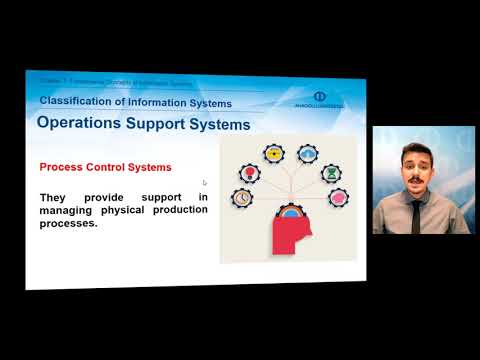
- Process control systems manage physical production processes and support employees' operations.
- Enterprise collaboration system enables communication among individuals within a business or across departments using tools like email, fax machines, video conferencing, etc.
Management Support Systems
- Management support systems provide support for managerial decision-making processes.
- Management information systems (MIS) produce summarized information for managers.
- MIS helps answer questions related to monitoring performance and making informed decisions.
Conclusion
The speaker concludes by summarizing the classification of information systems into operation support systems and management support systems. They highlight the role of transaction processing systems in recording and storing data for routine operations. Additionally, they mention management information systems as a key tool for providing summarized information to managers.
This transcript was provided in English language format.
New Section
This section discusses special requests and exceptional reports produced in times of crisis or disaster. It also introduces decision support systems and their role in complex decision-making.
Special Requests and Exceptional Reports
- Special requests are generated by special circumstances, such as crises, bankruptcies, or disasters.
- Exceptional reports are produced quickly during these times to provide necessary information for decision-making.
Decision Support Systems
- Decision support systems (DSS) assist decision-makers in complex decision-making processes.
- DSS are used when management support systems are insufficient to support the decision processes.
- DSS generate alternative scenarios for different cases to help answer "what if" questions.
New Section
This section further explores decision support systems and their components, including data measurement subsystems, model management subsystems, communication and collaboration features, and knowledge management subsystems.
Components of Decision Support Systems
- Decision support systems have five fundamental components:
- Data measurement subsystem: Provides data and transforms it into information for decision-makers.
- Model management subsystem: Offers statistical and analytical models for the measures provided by the management subsystem.
- Communication and collaboration: Facilitates interaction between the decision-maker and the DSS.
- Knowledge management subsystem: Enhances the knowledge level of decision-makers.
- Decision maker: Plays a key role in utilizing the DSS effectively.
New Section
This section introduces executive information systems (EIS) as a type of management support system. EIS provides support to executive managers who may have limited computer system experience.
Executive Information Systems
- Executive information systems (EIS) offer support to strategic managers who have limited contact with computer systems.
- EIS is designed with user-friendly graphical interfaces that are easy to use.
- Executive managers are not expected to have programming or coding knowledge.
New Section
This section discusses the classification of special processing systems under both operation support systems and management support systems. It also introduces four types of special processing systems: expert systems, knowledge management systems, function information systems, and surgical information systems.
Special Processing Systems
- Special processing systems serve specific purposes in business operations.
- They are classified under both operation support systems and management support systems.
- Four types of special processing systems:
- Expert Systems
- Knowledge Management Systems
- Function Information Systems
- Surgical Information Systems
New Section
This section concludes the first part of the first chapter. The next part will cover decision-making, knowledge management, and other related topics.
Conclusion
- The first part of the chapter has discussed various aspects of management support systems, decision support systems, executive information systems, and special processing systems.
- The next part will delve into decision-making processes and knowledge management.
Timestamps provided in the transcript have been used to associate relevant sections with their corresponding timestamps.