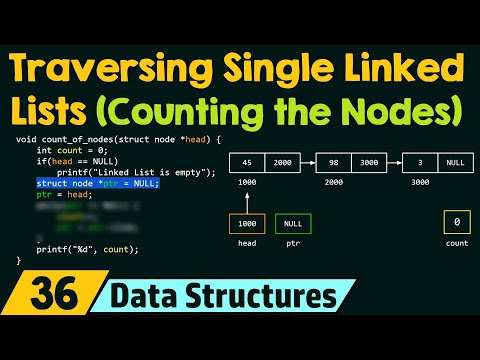
Traversing a Single Linked List (Counting the Nodes)
Introduction to Traversing a Single Linked List
In this section, we will learn about traversing a single linked list and its application in counting the number of nodes.
Meaning of Traversing a Single Linked List
- Traversing a single linked list means visiting each node of the list until the end node is reached.
- The goal is to visit every node in the list.
Example Scenario
- We have an existing linked list and our task is to traverse it and count the total number of nodes.
Program Structure
- The program requires
stdio.handstdlib.hheader files.
- It uses a struct called
node.
- The main function calls the
count_of_nodesfunction, passing the head pointer as an argument.
Understanding the Head Pointer
- The head pointer points to the first node of the linked list.
- It allows us to access every node in the list.
Creating and Calling Functions
- Before calling
count_of_nodes, we need to create a single linked list.
- Once created, we can call
count_of_nodesby passing the head pointer as an argument.
Exploring the count_of_nodes Function
In this section, we will analyze the code within the count_of_nodes function that counts the number of nodes in a linked list.
Code Explanation
- Declare and initialize a variable called
countwith zero. This variable keeps track of the number of nodes visited.
- Check if
headis equal to NULL:
- If true, print "Linked list is empty" because there are no nodes in the list.
- If false, continue with further code execution.
- Create a pointer called
ptrand initialize it with NULL.
- Assign the value of
headtoptr, makingptrpoint to the first node of the list.
- Enter a while loop that runs until
ptrbecomes NULL.
- Inside the loop, increment the value of
countby 1 for each node visited.
- Access the link part of the current node using
ptr.
- Update
ptrwith the address of the next node in the list.
- Once
ptrbecomes NULL, exit the loop and print the final count.
Understanding How Code Helps Traverse List
In this section, we will analyze how the code helps traverse a linked list and count its nodes.
Code Execution
- Initially, check if
ptris not equal to NULL (which is true).
- Enter the while loop and increment
countfrom 0 to 1.
- Access and update
ptrwith the address of the second node in the list.
- Repeat these steps until all nodes have been visited (i.e., until
ptrbecomes NULL).
Conclusion
In this presentation, we learned about traversing a single linked list and counting its nodes. We explored an example scenario and analyzed code that helps achieve this task. Traversing a linked list involves visiting each node until reaching the end node, and counting nodes requires keeping track of how many have been visited. By understanding these concepts and implementing them in code, we can effectively traverse a single linked list and determine its total number of nodes.
The provided transcript was limited in content, so some details may be missing or incomplete.
New Section Understanding Pointer Manipulation in C
In this section, we will explore how pointer manipulation works in C and understand the process of accessing and modifying linked list nodes.
Pointer Manipulation Process
- The
ptrvariable is assigned the value ofptr->link, which represents the link part of a node in a linked list.
- This assignment can be replaced by assigning the value 3000 to
ptr, effectively making it point to the third node in the list.
- We then check if
ptris equal to NULL. If not, we increment the count variable by one.
- The count variable can be replaced by the value three since we have encountered three non-null nodes so far.
- We access
ptr->link, which contains NULL, and replace it with NULL. Now,ptralso contains NULL.
- We check again if
ptris equal to NULL. Since it is indeed NULL, we exit the loop as this condition becomes false.
- Finally, we print the value of count, which is three.
Alternative Code Approach
- Instead of writing out this entire code block, there is an alternative way to achieve the same result that will be covered in a future lecture.
The transcript provided does not include any timestamps beyond 0:05:41s.