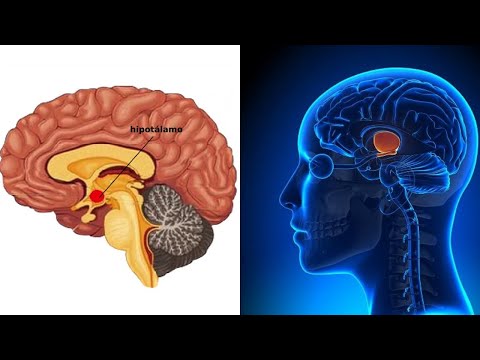
El HIPOTÁLAMO explicado: sus partes, hormonas, funciones, enfermedades🧠
The Hypothalamus
This section provides an introduction to the hypothalamus, its location, and its functions.
Introduction to the Hypothalamus
- The hypothalamus is a small brain structure located below the thalamus.
- It forms part of the floor of the third ventricle of the brain.
- The name "hypothalamus" comes from Greek words meaning "under" (ὑπό) and "thalamus" (θάλαμος).
- It is cone-shaped and projects downward from the brain, ending in the pituitary gland.
Functions of the Hypothalamus
- The hypothalamus performs important functions by integrating a wide variety of information.
- It helps maintain homeostasis in the body by correcting imbalances.
- Some physiological functions controlled by the hypothalamus include thirst, hunger, sleep, temperature regulation, mood, and sexual desire.
- It is also involved in metabolism, growth, and certain involuntary behaviors.
Location of the Hypothalamus
- The hypothalamus is located centrally inside our brain.
- It establishes relationships with many brain areas due to its central location.
- In humans, its size is similar to that of an almond.
- It is part of the diencephalon and is surrounded by structures such as the thalamus and choroid plexus.
Divisions of the Hypothalamus
Anterior or Supraoptic Region
- Located above the optic chiasm.
- Prominent nuclei in this region include paraventricular and supraoptic nuclei.
- Other nuclei present are preoptic, anterior hypothalamic, and suprachiasmatic nuclei.
- Functions include secretion of hormones like oxytocin, vasopressin, somatostatin, and corticotropin-releasing hormone.
- Control of circadian rhythms, body thermoregulation, sweating, and development of sexual characteristics.
Middle or Tuberal Region
- Located in the tuber cinereum.
- Divided into medial and lateral parts.
- Medial nuclei include dorsomedial and ventromedial nuclei that influence feeding impulse control.
- Dorsomedial nucleus is related to appetite while ventromedial nucleus regulates the sensation of fullness or satiety.
- Arcuate nucleus blocks milk production by inhibiting prolactin release.
- Functions associated with this region include blood pressure, heart rate, and gastrointestinal activity.
Posterior or Mammillary Region
- Divided into medial and lateral parts.
- Medial zone includes mammillary and posterior nuclei involved in functions like blood pressure regulation, tremors, energy balance, hunger, sleep, activation, memory, and learning.
Functions of the Hypothalamus
- The main function of the hypothalamus is to maintain homeostasis throughout the body.
- It receives input from almost the entire nervous system and is involved in autonomic nervous system functions.
- Endocrine functions: Acts as an intermediary between the nervous system and endocrine system. Controls pituitary gland to release hormones at necessary moments. Modulates other endocrine glands through the hypothalamic-pituitary axis.
The transcript does not provide timestamps for all sections.
New Section
This section discusses the hormones released by the hypothalamus and their functions.
Hormones Released by the Hypothalamus
- Corticosteroids (cortisol): Important for metabolism and the immune system. Low levels can lead to tiredness, weakness, hypoglycemia, lack of sexual desire, and decreased body hair.
- Antidiuretic hormone (arginine vasopressin): Controls fluid balance, glucose, and salts in the blood. Affects urine concentration and quantity.
- Gonadotropin-releasing hormone: Essential for sexual reproduction. Stimulates the release of follicle-stimulating hormone (FSH) and luteinizing hormone (LH) from the pituitary gland.
- Growth hormone-releasing hormone (somatocrinin): Secretes growth hormone for proper body size, composition, healthy bones, muscle mass, and fat distribution. Also releases growth hormone-inhibiting hormone (somatostatin).
- Oxytocin: Linked to sexual reproduction, orgasm, childbirth, milk production from mammary glands.
- Prolactin-releasing hormone: Stimulates breast milk production.
- Hormone-stimulating thyroid hormones: Regulate energy levels, development, and metabolism. The hypothalamus receives signals to increase or inhibit their production when necessary.
New Section
This section explores additional functions of the hypothalamus.
Additional Functions of the Hypothalamus
- Regulation of vital functions: Heart rate, blood pressure, body temperature; fluid and electrolyte levels; thirst; appetite; weight.
- Control of circadian rhythm: Regulates sleep, activity, and hunger patterns.
- Reproductive, attachment, and parenting behaviors: Influences sexual appetite, recognition, protection, and feeding of young.
- Learning and memory: Involved in retrieving stored information from memory and simple associations.
- Emotions: Related to emotional expression through the production of various chemical substances in the hypothalamus.
New Section
This section discusses diseases and symptoms related to hypothalamic dysfunction.
Diseases and Symptoms
- Hypothalamic disease causes: Physical head injury, malnutrition, inflammation (meningitis or encephalitis), neoplasms, cerebrovascular accidents, infections.
- Common manifestations: Sleep and appetite disorders due to hypothalamus regulation; difficulty distinguishing hypothalamus lesions from pituitary gland lesions.
- Hypothalamus-pituitary disorders example: Hypopituitarism or panhypopituitarism where the hypothalamus inhibits hormonal secretions from the pituitary gland affecting vital functions and growth.
- Symptoms of hypothalamic damage: Sleep-wake cycle disruption; sight loss; precocious puberty or developmental delay; macrocephaly (excessive head size); vasopressin production blockage leading to diabetes insipidus; memory and emotional expression problems; hyperthermia caused by anterior nucleus lesion; malnutrition or radiotherapy affecting fluid conservation.
The transcript is already in English language format
New Section
This section discusses hypothalamic obesity disorder and its relationship to thyroid hormones.
Hypothalamic Obesity Disorder
- Hypothalamic obesity disorder may occur in patients who have unevenness in thyroid hormones.
- Patients with this disorder experience an increase or decrease in weight.
- Pertinent tests are conducted to verify the reason for their obesity.