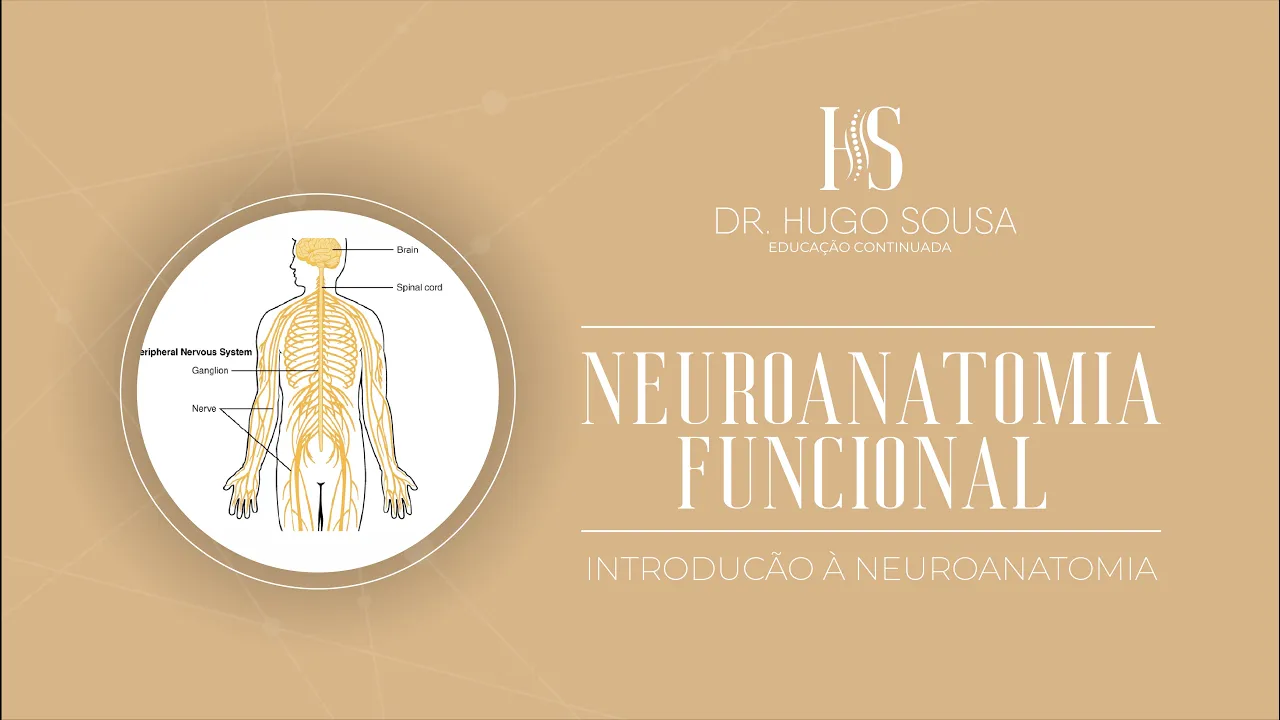
INTRODUÇÃO À NEUROANATOMIA - PARTE 2
Understanding the Nervous System
Functional Division of the Nervous System
- The nervous system is divided into somatic and visceral systems, with each having distinct functional criteria related to physiology.
- Both divisions include an afferent pathway for information capture and an efferent pathway for response execution, which will be explored further in clinical cycles.
Somatic Nervous System Insights
- Afferent components of the somatic nervous system involve conscious sensations such as touch and temperature, allowing individuals to report stimuli accurately.
- Efferent components can be tested through muscle contractions, particularly in skeletal muscles, indicating normal function based on movement patterns observed.
Visceral Nervous System Characteristics
- The visceral nervous system's afferent pathways are generally unconscious due to their involuntary nature, linked to vital functions like homeostasis and cardiovascular control.
- Conscious awareness of visceral sensations occurs in specific situations (e.g., bladder fullness), highlighting a rare instance where individuals recognize visceral stimuli.
Autonomic Nervous System Functionality
- The autonomic nervous system serves as the effector division of the visceral system, managing involuntary actions without conscious control over glandular functions.
- It consists of sympathetic and parasympathetic components; sympathetic activity accelerates heart functions while parasympathetic activity conserves energy by maintaining rest states.
Structural Organization of the Nervous System
- The organization levels within the nervous system reflect both segmental characteristics (e.g., spinal cord nerves) and supra-segmental aspects that lack clear segmentation.
Overview of the Nervous System Structure
Connections in the Nervous System
- The cerebellum and brain do not exhibit proper neuronal connections, unlike the spinal cord and brainstem.
- The optic nerve (cranial nerve II) projects directly to the brain, establishing connections with structures in the brainstem; similarly, the olfactory nerve (cranial nerve I) also projects directly to the brain.
- There are 10 cranial nerves originating from the brainstem, while spinal nerves originate from the spinal cord, indicating a segmented nervous system.
Types of Cells in the Nervous System
- The nervous system comprises two main cell types: glial cells and neurons. Glial cells outnumber neurons significantly.
- Glial cells provide support, form blood-brain barriers, protect neural tissue, and can assist in neuronal growth and repair.
Functions of Neurons vs. Glia
- Neurons have unique properties such as irritability (response to stimuli) and conductivity (rapid transmission of signals), which glial cells lack.
- Neurons possess diverse functions that enable them to transmit information quickly through synaptic connections.
Synapses: Mechanisms of Communication
Chemical Synapses
- A chemical synapse involves a presynaptic membrane releasing neurotransmitters into a synaptic cleft that bind to receptors on a postsynaptic membrane.
- This process triggers depolarization events that facilitate rapid information transfer between neurons.
Structure of Neurons
- Neurons consist of three main parts:
- The pericaryon (cell body), which is responsible for metabolic functions,
- Dendrites for receiving stimuli,
- Axons for conducting neural impulses.
Types of Synapses
- Two primary types of synapses exist: chemical synapses (predominant in humans), which utilize neurotransmitters for communication, and electrical synapses that connect via ionic channels without a synaptic cleft.
Advanced Synaptic Connections
Axonal Communication
- Axons can establish various types of synaptic connections:
- Axon-dendrite,
- Axon-soma,
- Axon-to-Axon connections (axoaxonic).
Neuroanatomical Terms
Understanding the Structure of the Central Nervous System
Overview of Brain Structure
- The cortex can be superficial, forming a layer over the brain, or deeper within white matter, where nuclei are located. Nuclei consist of neuron cell bodies amidst white matter in the central nervous system.
- The cortex is a 4 to 6 mm thick layer made up of gray and white matter found on the surface of either the brain or cerebellum, referred to as cerebral or cerebellar cortex depending on its location.
Types of Neural Fibers
Projection Fibers
- Projection fibers extend beyond a specific area or organ; for example, motor fibers from area 4 in the cerebral cortex connect to cranial nerve nuclei in the brainstem.
- These fibers establish connections with motor nuclei responsible for functions such as swallowing and eye movement and project towards the spinal cord for muscle control related to locomotion.
Association Fibers
- Association fibers connect different segments within the central nervous system, allowing reflex actions like walking and scratching due to communication between various spinal levels.
- They also exist in other areas like the brainstem and cerebellum, facilitating integration among cranial nerve functions.
Fiber Arrangement in Spinal Cord
Communication Between Segments
- In terms of practical application, association fibers enable communication across different spinal segments (cervical, thoracic, lumbar), which is crucial for reflexes.
- Conversely, projection fibers leave the spinal cord to communicate with higher centers like the brainstem and cerebral regions.
Tracts and Fascicles
Definitions and Functions
- Tracts are bundles of nerve fibers sharing origin, function, and destination; they play a significant role in transmitting afferent (sensory) and efferent (motor) information throughout CNS structures.
- Fascicles are more compact bundles compared to tracts but serve similar purposes regarding information transmission.
Funiculus Structure
- Funiculi refer to cord-like structures formed by white matter containing tracts and fascicles; they are essential for organizing neural pathways within regions like the spinal cord.
Additional Structures: Lemniscus & Commisures
Lemniscus Functionality
- Lemnisci consist of short fiber condensations that carry information from areas such as the brainstem to thalamic regions; understanding these can clarify their roles during studies.
Commisures vs. Decussations
Turn any video into a summary like this
YouTube links, meetings, lectures. With transcripts, search, and chat.