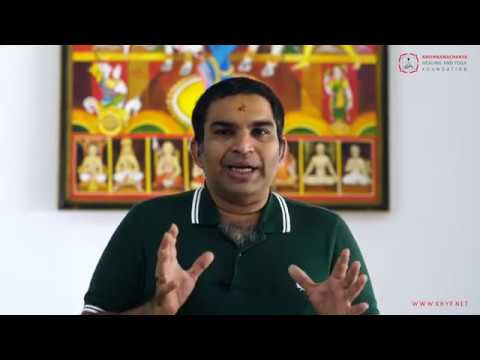
Patanjali's Yogasutra | Dr. Kausthub Desikachar | II.19 | 24 Feb 2018
Introduction and Overview
The speaker introduces themselves and mentions the topic of discussion, which is related to Prakruti and Purusha in yoga philosophy.
Speaker's Introduction
- The speaker greets the audience and introduces themselves as Madam Prabhavati.
- They mention that they will be discussing the concept of Prakruti and Purusha in yoga philosophy.
Chanting of Mantra
A mantra is chanted by the speaker.
Chanting of Mantra
- The speaker chants a mantra related to yoga practice.
Discussion on Charity
The speaker briefly mentions charity.
Mention of Charity
- The speaker briefly talks about charity but does not provide further details.
Mention of Different Forms
The speaker mentions different forms or versions.
Mention of Different Forms
- The speaker refers to different forms or versions, possibly related to prakruti (nature).
Explanation of Sutra Prakasha Crias Treaty Serum
The speaker discusses the Sutra Prakasha Crias Treaty Serum from Patanjali's Yoga Sutras.
Explanation of Sutra Prakasha Crias Treaty Serum
- The previous week, the speaker completed explaining the Sutra Prakasha Crias Treaty Serum.
- This Sutra defines what prakruti (nature) is, which is important for understanding suffering caused by confusion between prakruti and purusha.
- Patanjali defines prakruti in this sutra, providing clarity on the concept.
Confusion between Prakruti and Purusha
The speaker discusses the confusion between prakruti and purusha in yoga philosophy.
Confusion between Prakruti and Purusha
- Patanjali states that the cause of suffering is the confusion between prakruti (nature) and purusha (consciousness).
- Prior to this sutra, there was no clear understanding of what prakruti and purusha are.
- Patanjali aims to clarify this confusion by defining prakruti in the previous sutra.
Summary of Sankhya Philosophy
The speaker explains how Patanjali summarizes Sankhya philosophy in one sentence.
Summary of Sankhya Philosophy
- Sankhya philosophy is the basis of yoga philosophy.
- Patanjali summarizes most of Sankhya philosophy into one sentence in this sutra.
- This sutra simplifies complex concepts for those who find it difficult to understand Sankhya philosophy easily.
Purpose of the Sutra
The speaker discusses the purpose of the sutra from a different perspective using an analogy with movies.
Purpose of the Sutra
- The purpose of this sutra is to differentiate between prakruti and purusha.
- An analogy with movies is used to explain how makeup artists can transform actors into different roles, making it difficult for viewers to recognize them as the same person.
- Similarly, prakruti manifests in various forms or versions, making it challenging to differentiate between them.
Hollywood Movies Analogy
The speaker continues the analogy with Hollywood movies to explain the concept of prakruti and purusha.
Hollywood Movies Analogy
- The makeup artists in Hollywood movies are skilled at transforming actors into different roles.
- Viewers may find it challenging to recognize that the same actor is playing multiple characters due to the convincing makeup.
- Similarly, prakruti shows up in various versions or forms, making it difficult to differentiate between them.
Differentiating Prakruti and Purusha
The speaker explains how Patanjali emphasizes the need to differentiate between prakruti and purusha.
Differentiating Prakruti and Purusha
- Patanjali states that prakruti is like an actor who appears in different forms or versions.
- It is essential to understand that purusha (consciousness) is separate from any of these twenty-four versions of prakruti.
- Patanjali highlights the importance of recognizing this distinction.
Four Categories of Prakruti
The speaker discusses how Patanjali categorizes prakruti into four different categories.
Four Categories of Prakruti
- Prakruti manifests in at least four different categories or types according to Sankhya philosophy.
- These twenty-four forms fit into these four categories, as explained by Patanjali.
- It is crucial not to dismiss something as not being prakruti just because it does not fit into one category; it may belong to another category within these four types.
Evolution of Prakruti
The speaker explains how prakruti evolves from one form to another.
Evolution of Prakruti
- Prakruti evolves from Linga to A Linga, Linga to Abhisha, and finally to Vichy Asia.
- Patanjali presents the evolution of prakruti in reverse order in this sutra for better understanding by beginners.
- The second chapter of the Yoga Sutras is designed for those who are new to these concepts and need a gradual understanding.
Analogy with Personal Evolution
The speaker uses an analogy with personal evolution to explain the concept of prakruti evolving through different stages.
Analogy with Personal Evolution
- The speaker uses the example of personal evolution to simplify the concept.
- They explain that each individual has a specific form and name (Rupa nama), which defines them uniquely (Vishay).
- Prior to having a specific form, individuals exist in a nonspecific manner (Vitiation).
- Before that stage, individuals exist as a seed form (Linga), potent but without fully developed characteristics.
Nonspecific Form of Existence
The speaker explains the stage where individuals exist in a nonspecific form.
Nonspecific Form of Existence
- Before having a fully formed body and name, individuals exist as a blob of flesh and blood without specific features.
- This stage is characterized by being nonspecific (Vitiation).
Seed Form of Existence
The speaker discusses the stage where individuals exist as a seed form.
Seed Form of Existence
- Prior to existing in a nonspecific form, individuals exist as seeds.
New Section
In this section, the speaker discusses the concept of Linga and its connection to prakruti. Linga is described as a state of prakruti that lacks consciousness. The speaker also introduces the idea of mula prakruti, which is the original form of prakruti.
Four Stages of Evolution
- The four stages of evolution in Sankhya philosophy are explained: Linga, Avyakta, Mahat, and Ahamkara.
- All matter evolves through these stages, with each stage having specific characteristics and forms.
- Prior to taking a specific form, all entities exist in a nonspecific manner as potential manifestations from the fundamental source.
- Prakruti undergoes different forms of evolution based on gunas (qualities), but it only manifests or mutates when connected to purusa (consciousness).
New Section
In this section, the speaker explains how purusa and prakruti come together to initiate evolution. The concept of mula prakruti is further explored.
Prakruti's Transformation
- Purusa and prakruti initially exist separately without any relationship.
- Prakruti can change on its own based on gunas but changes differently when connected to purusa.
- Mula prakruti refers to prakruti in its raw form devoid of connection to purusa. It has the capacity to manifest or mutate only according to gunas.
- A Linga represents a state where prakruti lacks the capacity to become alive and reproduce.
- When purusa and prakruti unite, prakruti gains the capacity to regenerate itself and undergo further evolution.
New Section
This section delves into the concept of Mahat or Buddhi, which is the first mutation of prakruti when purusa is hosted in matter.
Purusha's Attribute of Knowledge
- Mahat or Buddhi represents the first mutation of prakruti when purusa is present in matter.
- Knowledge is an attribute of purusa, not prakruti. The mind has memory but not knowledge.
- Satyam, Jnanam, Anantam (Existence, Knowledge, Bliss) are attributes of purusha, not prakruti.
- Purusha has qualities of Jana Gana (knowledge), while Ananda (bliss) is also an attribute of purusha.
New Section
In this section, the speaker emphasizes that enjoyment and attributes like Ananda are qualities of purusha, not prakruti.
Attributes of Purusha
- Enjoyment is attributed to purusha and not to the senses or mind.
- Prakruti undergoes further mutations as purusha identifies what it can become.
- Budi represents the knowledge already present in matter when it fuses with purusha.
Identification and Evolution of Matter
This section discusses the concept of identification and how matter evolves based on that identification. It introduces the terms "Asmita" and "Ahankara" used by Yoga philosophers and Sankhya philosophy respectively to describe the state of identity. The evolution of matter is influenced by this identification, leading to the development of fundamental elemental structures.
Evolution of Matter
- The Purusha influences matter to develop based on its identified form.
- The non-specific form of evolution includes five tan matras (shabda, sparsa, rupa, rasa, gandha) and asmita (identity).
- Asmita and tan matras branch off into sixteen further tattvas, including the elements that make up the body, senses, and mind.
- These evolving elements form specific structures such as senses of perception and action.
Categories of Prakruti
This section explains the four categories of prakruti (matter) in its evolutionary process. It introduces terms like mahat-tattva and mula prakruti as part of this categorization.
Categories of Prakruti
- There are four categories: vishay (non-specific), bhutas (elements), indriyas (senses), and mind.
- These categories collectively form 22 components before reaching mahat-tattva or buddhi.
- The 23rd component is mula prakruti, followed by purusha as the 25th component.
Reality and Change
This section explores the concept of reality and its relation to change. It discusses different philosophical views on reality, including the belief that everything is a manifestation of the mind (cheetah) versus the belief in the existence of external reality (sat vada).
Reality and Change
- The Sutra emphasizes that each stage of creation has its own reality.
- Patanjali challenges the view that reality is solely a manifestation of the mind.
- He refutes the idea that something doesn't exist just because it cannot be perceived.
- Patanjali argues for the existence of reality regardless of perception, using examples like deafness and blindness.
- The school of satvatas believes in the existence of reality, even if it is not specific or permanent.
Establishing Reality
This section highlights Patanjali's intention to establish the existence of reality through his teachings. It mentions his affiliation with the school of citta vada and parinamavada, which acknowledge both change and reality.
Establishing Reality
- Patanjali aims to establish that reality exists in various forms.
- He challenges the notion that truth must be unchanging, emphasizing that changing forms can still hold truth.
- Patanjali's teachings align with citta vada and parinamavada schools, acknowledging both change and reality.
The Seed and the Possibility of Change
This section discusses how a seed, such as a mango seed, is a reality but also has the potential to change. It explains that the changes in Prakruti (nature) are consistent with the evolution of gunas (qualities). However, these changes are limited by the boundaries set by the gunas.
Existing Seed and its Potential for Change
- A seed, like a mango seed, is a reality but has the possibility to change.
- The second part of the Sutra emphasizes that this change is consistent with the evolution of gunas.
- Gunas create changes in Prakruti.
Limitations within Guna Constraints
- Prakruti can change within the limitations of gunas.
- A mango seed can go through four stages: Linga, Linga-wish-a, wish-a-wish-a-ja.
- However, these changes are within what the gunas allow.
- The fact that it is a mango cannot be changed.
Boundaries Set by Guna
This section explains how gunas define our possibilities and set boundaries for our existence. It highlights that we cannot change what we cannot be due to these boundaries. It also mentions that freedom and liberation lie in expressing our potential within our Dharma (nature).
Boundaries Set by Guna
- We cannot change what we cannot be due to the boundaries set by gunas.
- For example, a male cannot become a mother because it goes against their inherent qualities defined by gunas.
Freedom and Liberation within Dharma
- Our freedom lies in expressing our potential within our Dharma (nature).
- Freedom is not about doing whatever we want but staying within certain boundaries.
- Liberation comes from being true to ourselves and not trying to be like someone else.
The Illusion of Unlimited Possibilities
This section discusses the misconception that we can do everything and highlights the importance of understanding our limitations. It emphasizes that suffering arises from unrealistic expectations and entitlement.
Understanding Our Limitations
- We cannot do everything because we have boundaries set by gunas.
- Expecting to do everything leads to suffering.
- Entitlement and societal pressure contribute to this misconception.
Freedom within Boundaries
- Freedom is compared to a river flowing within its banks.
- Our liberation lies in expressing our potential within our Dharma (nature).
- Comparing ourselves with others or trying to be like them is futile.
Embracing Our Unique Journey
This section emphasizes the importance of embracing our uniqueness and individual journey. It highlights that each person has different qualities, potentials, and purposes in life. Spiritual evolution is a personal journey that cannot be replicated by others.
Embracing Individuality
- Each person is unique with different qualities, potentials, and purposes.
- Twins also have distinct differences.
- Our freedom lies in being ourselves, not trying to be like someone else.
Personal Spiritual Evolution
- Spiritual evolution is a lonely journey even when we are part of a community.
- Each person's personality and potential differ.
- Patanjali warns against following others blindly; hard work and effort are necessary for growth.
Evolution within Guna Constraints
This section explains how evolution occurs within the framework of gunas. It mentions that while some individuals may expand beyond these limitations, it is rare. Patanjali gives a warning about relying solely on inherent qualities without putting in effort.
Evolution within Guna Framework
- Evolution occurs within the limitations of gunas.
- It is challenging to expand beyond these limitations.
- Patanjali mentions individuals without a gross body (sukshma sharir) who may have more flexibility.
Warning against Complacency
- Patanjali warns against relying solely on inherent qualities.
- Hard work and effort are essential for growth and evolution.