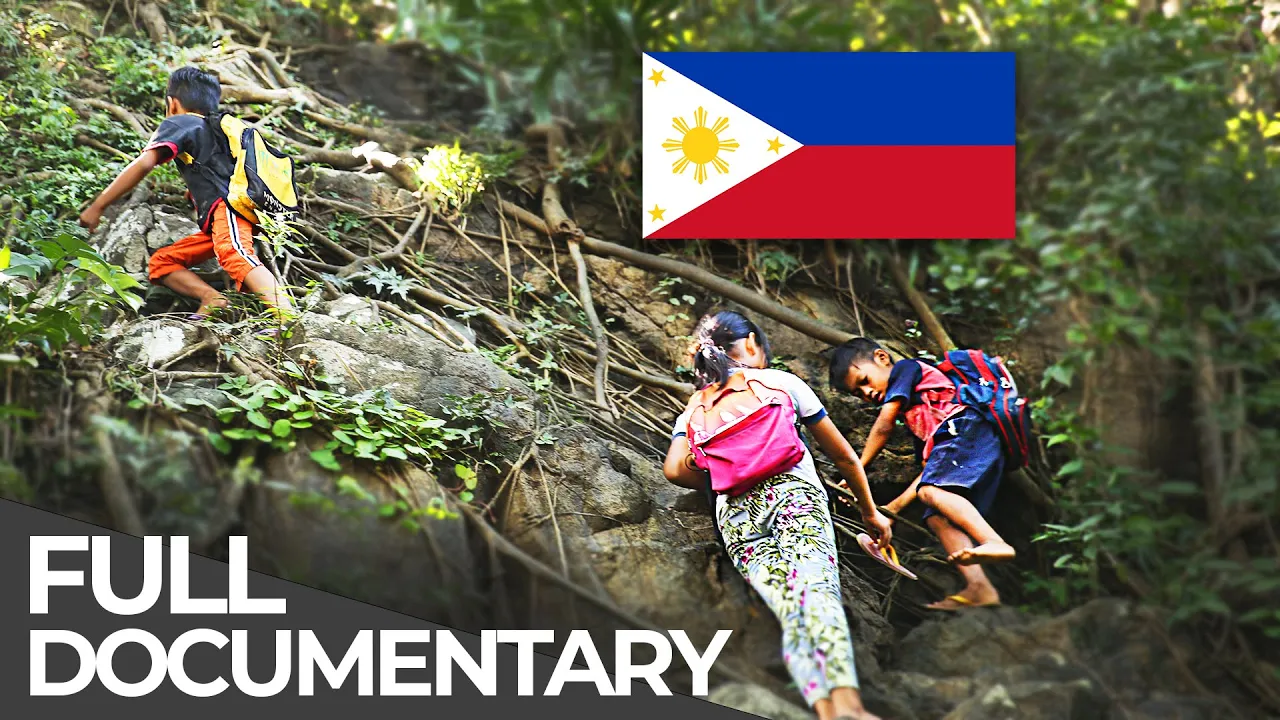
Most Dangerous Ways To School | PHILIPPINES | Free Documentary
The World's Most Dangerous Ways to School
This section introduces the topic of dangerous ways to school in the Philippines, specifically focusing on a school located deep in the mountains.
The Challenging Journey to School
- Students face extraordinary challenges to get an education.
- Some students have to walk for hours through the jungle.
- Others must climb steep rock faces and boulders every day.
- These difficult journeys are undertaken for the hope of a better future.
Life in Zamboanga
- Zamboanga is located in the northwest of Mindanao, the second largest island in the Philippines.
- The coastal strip gives way to sharply rising mountains.
Madiba Bo: A Fishing Settlement
- Madiba Bo is a tiny fishing settlement where one of the most dangerous ways to school begins.
- Ivy, an eleven-year-old girl, has to walk uphill through the jungle every day.
Auto Elementary and High School
- Auto Elementary and High School is located centrally but requires students from scattered mountain slopes, coastlines, and woods to travel long distances.
- Ryan, a twelve-year-old student, lives high up on a summit and helps his grandmother raise pigs for survival.
Dreams of a Better Life
- Ryan dreams of having a better life than his parents who live 500 miles away in Manila.
- His father works as a motorbike taxi driver but struggles financially.
- Ryan's grandmother wants him to have more opportunities and supports his education.
Determination Despite Challenges
- Despite facing isolation and long distances, Ryan remains determined to go to school every day.
- Ivy also faces her journey alone since her older brothers have graduated and moved away for work.
Concerns for Safety
- Ivy's mother used to accompany her on her journey but can no longer do so due to physical limitations.
- Her mother worries about Ivy's safety while climbing the steep path to school.
Limited Access to Medical Care
- The closest town with medical care is approximately twelve miles away from Madiba Bo.
Life in Madiba Bo
This section provides more details about life in Madiba Bo and the challenges faced by students on their way to school.
Daily Routine in Madiba Bo
- The day begins early in Madiba Bo, with the break of dawn.
- Ivy's family lives in poverty and can only afford basic meals like rice, fish, and Moringa.
- Ivy helps her mother prepare breakfast before getting ready for school.
The Long Journey to School
- Ivy walks alone through the jungle every day to reach Auto Elementary and High School.
- The journey involves descending steep paths and navigating unspoiled nature.
- Ryan also faces a long journey to school, walking for over two hours each day.
Dreams of a Brighter Future
- Both Ivy and Ryan have dreams of a better future through education.
- Ivy aspires to become an engineer and earn enough money to reunite with her parents.
- Ryan hopes that education will lead him to a prosperous life beyond his current circumstances.
Challenges Faced by Students
This section highlights the challenges faced by students on their dangerous journeys to school.
Isolation and Lack of Social Interaction
- Ryan lives in a small cottage with his grandmother, far away from other students.
- He has few friends and spends most of his time playing alone.
Financial Struggles
- Ryan's father sends a monthly support check of about 17 US Dollars, which is not much even in the mountains of Mindanao.
- The money is barely enough for basic meals like rice and instant noodles.
Determination Despite Difficulties
- Despite the hardships, Ryan remains dedicated to his studies and helps his grandmother with household chores.
- Ivy also shows determination by navigating the challenging path to school on her own.
Concerns for Safety and Well-being
This section focuses on the concerns for safety and well-being of students on their way to school.
Emotional Impact on Parents
- Ivy's mother worries about her daughter's safety while climbing the steep wall to school.
- She recalls a past accident where she was able to hold onto Ivy when she slipped.
Limited Support System
- Ivy used to have her older brothers accompany her on the journey, providing guidance and support.
- However, they have graduated and moved away, leaving Ivy to find her own way.
The Importance of Education
This section emphasizes the significance of education in these students' lives despite the challenges they face.
Sacrifices for Education
- Students like Ryan and Ivy make daily sacrifices in order to attend school.
- They understand that education is their best chance at a better future.
Hopes for a Better Life
- Both Ryan and Ivy dream of escaping poverty and achieving success through education.
- They believe that education will open doors to opportunities beyond their current circumstances.
New Section
This section discusses the challenges faced by children in getting to school, including the dangerous route over a steep face and the lack of transportation options.
The Dangerous Route to School
- Children from a certain area have to take a shortcut through the jungle to get to school.
- This shortcut involves crossing a steep face called "pom pom" which is like a huge wall with a 90-degree slope.
- The rock is slippery due to moss and roots, posing risks of falling and injuries.
- To mitigate these risks, children prefer going together in groups.
Lack of Transportation Options
- Many families cannot afford motorbike taxis, which cost one US dollar per ride.
- Going around would mean walking for hours, so children have been taking the shortcut through the jungle for decades.
- Walking along the coast first and then uphill makes the journey twice as long.
New Section
This section highlights the financial constraints faced by families in affording transportation to school and explores why children opt for the dangerous shortcut through the jungle.
Financial Constraints
- Motorbike taxi rides cost one US dollar, which many families cannot afford.
- Going around would require walking for hours, which is not feasible for most people.
Opting for the Shortcut
- Children from Anniebago have been taking the shortcut through the jungle for decades due to its convenience.
- The shortcut saves time compared to going around.
- Despite its dangers, such as slippery rocks and steep slopes, children prefer going together in groups for safety reasons.
New Section
This section discusses Ryan's encounters with snakes on his way to school and highlights their potential danger.
Encounters with Snakes
- Ryan has encountered snakes multiple times while playing or running up hills.
- One time, a snake bit him on the calf, but it was a non-poisonous variety.
- The region is also home to the highly poisonous Filipino spitting cobra.
New Section
This section follows Ryan's journey through the coconut fields and highlights the importance of coconuts as a crop in the region.
Coconut Fields
- Ryan reaches the coconut fields on his way to school.
- Coconut farmers climb up trees using notches they cut with machetes to harvest coconuts.
- Coconuts are one of the most important crops in the region, along with rice and mangoes.
New Section
This section focuses on Ibe's experience at a dangerous part of the route called "Pom Pom" and reflects on her mother's heroic act that saved her life.
A Dangerous Part of the Route
- Ibe faces a steep and challenging part of the route known as "Pom Pom."
- She recalls how her mother saved her from falling off this dangerous slope in the past.
Conclusion
The transcript provides insights into the challenges faced by children in reaching school, including taking a dangerous shortcut through the jungle due to financial constraints and lack of transportation options. It also highlights encounters with snakes along the way and showcases important aspects such as coconut farming in the region.
New Section
This section provides an introduction to the Sulu Sea and the challenges faced by fishermen in the area.
The Shallow Coast and Deep Ocean Floor
- The Sulu Sea, located in the Pacific Ocean, is shallow along the coast, allowing fishermen to walk hundreds of yards out to their boats.
- However, further into the sea, the ocean floor drops off sharply to a depth of up to four and a half miles.
New Section
This section highlights the concerns of a fisherman named Ben regarding his daughter's education.
Sending His Daughter to School
- Ben reflects on his daughter's journey to school and wonders if it is right to send her on such a dangerous path.
- He used to be able to afford a motorbike taxi for his children, but due to worsening fishing conditions, this luxury has become rare.
- Despite being a fisherman himself, Ben wants his children to learn something useful and believes that education is important.
New Section
In this section, we see how Ben's limited income affects his ability to provide safer transportation for his daughter.
Insufficient Income for Safer Transportation
- Due to not being able to sell fish regularly, Ben doesn't have enough money to spare for safer transportation options for his daughter.
- As a result, he cannot afford the risky journey that she must undertake every day.
New Section
Frederick, a teacher from Madibago who came from a fisherman's family himself, emphasizes the importance of education as a way out of poverty.
Education as an Escape from Poverty
- Frederick serves as an example and role model for children in Madibago.
- He believes that education is a path worth taking, no matter how difficult it may be.
- Madibago has one primary and one secondary school, with Frederick teaching various grade levels.
New Section
Ryan, a student from Madibago, faces challenges in reaching school on time due to distractions along the way.
Ryan's Delayed Journey
- Ryan's break under a palm tree lasts longer than planned, and he realizes he might be late for class.
- Instead of hurrying to school, he takes the time to enjoy a coconut he scavenged.
New Section
Ryan reflects on his family and expresses his longing for them during his journey to school.
Thoughts of Family
- As Ryan walks along the lonely path over the mountain ridge, he thinks about his parents and siblings.
- He misses them greatly and wishes they were with him during this challenging journey.
New Section
Ibe Kumari and Chanel face difficulties climbing the steep part of their journey to school.
Climbing Challenges
- The children encounter the steepest part of their journey where accidents are more likely to happen.
- They rely on roots growing out of wet soil as support while climbing up the crag.
- Following the 3-point rule, they maintain concentration by seeking new support with only one arm or leg at a time.
New Section
Ibe Kumari's mother walks along the road to her job while reflecting on her daughter's climb up Pom Pom.
A Mother's Reflection
- Ibe Kumari's mother walks to her new job as a teacher in a kindergarten located on the coast.
- She remembers how her daughter used to be shy but has now become courageous and confident due to the challenging journey to school.
- The lack of a school on the coast means that even the youngest children will have to take the dangerous path.
New Section
Ibe Kumari leads younger children up the crag, facing exhaustion and slippery conditions.
Leading Younger Children
- Ibe Kumari guides seven and eight-year-old children up the crag, which requires strength and concentration.
- Climbing takes a toll on their energy, especially for the two boys.
- They need to maintain their focus as it is particularly slippery that day.
New Section
The children reach safety but still have a distance to cover before reaching school on time.
Journey Not Over Yet
- After an arduous ascent, Ibe Kumari leads the boys to safety.
- However, they still need at least 40 minutes to reach school before it starts.
- Time is running out, and they must hurry to avoid being late.
New Section
Students from surrounding villages gather at the school early in order to clean the grounds before classes begin.
Preparing for School
- Students from surrounding villages arrive early at the school every morning to clean the grounds before classes start.
- However, some children who live far away often come late due to their long journey.
- The principal understands their situation and offers additional review sessions in the afternoon for those who missed material during class.
[t=0:32:13s] Daro Elementary School
This section provides information about the Daro Elementary School, which is a village school attended by the narrator. The school has three rooms and three teachers, with one room and teacher shared by first and second grade, and another room for third and fourth grade.
Description of Daro Elementary School
- The narrator attended Daro Elementary School from kindergarten to fourth grade.
- The school also has a kindergarten.
- There are only three rooms and three teachers.
- First and second grade share one room and one teacher.
- Third and fourth grade have their own room.
[t=0:32:43s] Lack of Secondary School
In this section, it is mentioned that there is no secondary school in the village. As a result, students like Ryan have to travel to another location for further education.
Lack of Secondary School
- There is no secondary school in the village.
- Ryan has to travel to another location for further education.
- Many former classmates of the narrator have stopped going to school because the journey is too long for them.
[t=0:33:23s] Arrival at School
This section describes the arrival of two boys, including an 11-year-old named Ryan, at the school grounds just in time. It also mentions that many children from the surrounding area are already present.
Arrival at School
- Two boys, including 11-year-old Ryan, arrive at the school grounds just in time.
- Many children from the surrounding area are already present.
[t=0:34:09s] Happy Children for Madiba Go
This section highlights that children attending Madiba Go are happy when they manage to beat the bell signaling the start of school.
Happy Children for Madiba Go
- Children attending Madiba Go are happy when they manage to beat the bell signaling the start of school.
[t=0:34:27s] School Begins with Flag Ceremony
This section mentions that school begins at 8 o'clock sharp with a traditional flag ceremony. It is noted that some students are usually missing at this time, but the national anthem is still sung.
School Begins with Flag Ceremony
- School begins at 8 o'clock sharp with a traditional flag ceremony.
- Some students are usually missing at this time.
- The national anthem is sung despite the absence of some students.
[t=0:35:17s] Ryan's Late Arrival
In this section, it is mentioned that Ryan often misses the start of school and arrives late. Despite his efforts to be on time, he frequently misses the first class.
Ryan's Late Arrival
- Ryan often misses the start of school and arrives late.
- He tries to be on time but almost always misses the first class.
[t=0:36:48s] Children's Classes and Subjects
This section provides information about the children's classes and subjects taught in Madiba Go. The subjects include math, English, social studies and science, Filipino language, and local dialects.
Children's Classes and Subjects
- The children attend classes for math, English, social studies and science, Filipino language, and local dialects.
[t=0:37:01s] Difficulty Concentrating for Some Students
This section highlights that some students find it difficult to concentrate in class due to exhaustion from the climb up to school. Specific students like Jean-Marie and Janelle are mentioned as having trouble focusing.
Difficulty Concentrating for Some Students
- Some students have difficulty concentrating in class due to exhaustion from the climb up to school.
- Students like Jean-Marie and Janelle struggle to focus.
[t=0:37:42s] Break Time and Food Options
This section mentions the long break at 11:30, during which food is sold in the pavilion. Various food options such as doughnuts, polenta, eggs, and chicken are available for purchase.
Break Time and Food Options
- There is a long break at 11:30.
- Food is sold in the pavilion during this break.
- Food options include doughnuts, polenta, eggs, and chicken.
[t=0:38:31s] Learning About World War II
In this section, it is mentioned that the students have been learning about World War II. The narrator's classmate Ibe prepared a report about Spain's participation in the war due to the historical influence of Spanish colonization on the Philippines.
Learning About World War II
- The students have been learning about World War II.
- Ibe prepared a report about Spain's participation in the war.
- Spanish colonization has had a historical influence on the Philippines.
[t=0:39:06s] Ryan's Difficulty Concentrating
This section highlights Ryan's difficulty concentrating in class despite being intelligent. It is noted that he often misses the first class due to his long walk to school.
Ryan's Difficulty Concentrating
- Ryan has difficulty concentrating in class despite being intelligent.
- He frequently misses the first class due to his long walk to school.
[t=0:40:26s] Transportation After School
This section mentions that after school ends at 3:30, motorbike drivers wait near the pavilion to offer transportation services. Some students take motorbike taxis home if they can afford it.
Transportation After School
- After school ends at 3:30, motorbike drivers wait near the pavilion.
- Some students take motorbike taxis home if they can afford it.
[t=0:40:55s] Free Time and Basketball
This section describes how students spend their free time after school. Many teenagers play basketball together, which is the national sport of the Philippines.
Free Time and Basketball
- Students have free time after school.
- Teenagers often play basketball together during this time.
[t=0:41:49s] Ryan's Journey Home
In this section, it is mentioned that Ryan does not waste time on his way home due to an approaching storm. He manages to find a ride with a farmer, saving him a lot of time.
Ryan's Journey Home
- Ryan does not waste time on his way home due to an approaching storm.
- He finds a ride with a farmer, saving him a lot of time.
[t=0:42:27s] Rainy Weather Challenges for Ibe
This section highlights the challenges faced by Ibe during rainy weather on her way home from school. The slippery terrain makes climbing down more difficult and dangerous for her.
Rainy Weather Challenges for Ibe
- Rainy weather poses challenges for Ibe on her way home from school.
- The terrain becomes slippery and climbing down becomes more difficult and dangerous.
[t=0:43:06s] Concern for Ibe's Safety
In this section, Ida, Ibe's mother, expresses her concern for Ibe's safety during rainy weather. She recalls a previous incident where Ibe slipped but was saved in the nick of time.
Concern for Ibe's Safety
- Ida, Ibe's mother, is concerned about her safety during rainy weather.
- Ida recalls a previous incident where Ibe slipped but was saved in the nick of time.
These are the main sections and key points from the transcript.
New Section
The video shows the daily routines of two children, Ida and Ryan, as they go to school in a challenging environment.
Ida's Concern for Her Daughter
- Ida is worried because her daughter hasn't returned home yet.
- She tries to keep a lookout for her daughter without showing her concern.
- Despite wanting to embrace her daughter, Ida knows that she needs to focus on doing homework.
Ryan's Dreams and Determination
- Ryan dreams of becoming a police officer and putting criminals in jail.
- He diligently does his homework while eating dinner, despite being tired.
- His biggest wish is to have enough money someday to go to Manila and help his parents.
Bedtime for Ida and Ryan
- Exhausted from the day, eleven-year-old Ida goes to bed early.
- Similarly, Ryan also goes to bed early like always.
Starting the Journey Again
- Both children wake up at dawn to start their journey along one of the world's most dangerous ways to school.
The transcript provided was already in English.