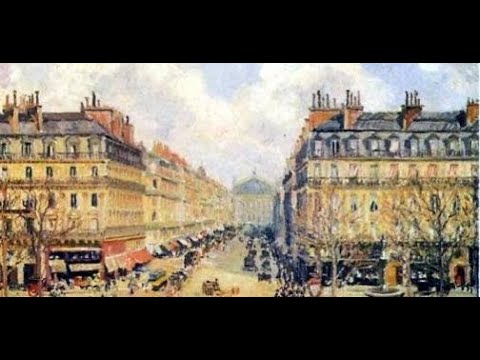
PARIS. LAS REFORMAS DEL BARON DE HAUSSMANN
The Transformation of Paris: Haussmann's Vision
The Urban Development of Paris
- Paris, known as the "City of Light," owes its urban development to Emperor Napoleon III and his trusted prefect, Georges-Eugène Haussmann.
- Haussmann was viewed as a destroyer for his radical changes; he transformed the city through a colossal project from 1853 to 1870, creating new avenues and infrastructure.
- His work included the construction of 63 kilometers of new roads and 40,000 buildings, fundamentally altering the city's layout and aesthetics.
- The transformation also introduced 2,000 hectares of green spaces and improved sanitation with extensive aqueducts and sewer systems.
- However, this reurbanization came at a cost; many lower-class residents were expropriated from their homes during this process.
The Scale of Change
- Haussmann's grand vision led to the demolition of over 20,000 homes and doubled street widths from an average of 12 meters to 24 meters.
- Before these changes, mid-19th century Paris was characterized by medieval conditions with narrow streets that contributed to unsanitary living environments.
- Overcrowding resulted in dire public health issues like cholera outbreaks that claimed tens of thousands of lives across all social classes in Paris.
Urgency for Reform
- The cholera epidemic highlighted the urgent need for intervention in Paris’s urban planning; it was lagging behind cities like London and New York.
- Napoleon III recognized this need for reform as an opportunity not only to improve public health but also to stimulate economic growth by providing jobs through large-scale projects.
Implementation Strategy
- Upon becoming president in 1848, Napoleon III envisioned a network of wide boulevards reminiscent of those in Bordeaux where he had lived previously. He aimed for well-aligned buildings along these new avenues.
- The first major project initiated was Rue de Rivoli, which served as a model for future developments—broad streets lined with uniform architecture revitalized the cityscape.
Challenges Faced
- Achieving these ambitious plans required significant sacrifices; land expropriation became necessary under laws passed after Napoleon III seized power in December 1851. This marked an unprecedented level of state intervention in urban development within Paris.
Urban Transformation of Paris under Haussmann
Initial Plans and Vision
- In June 1853, the project to expand the Rue de Rivoli was inherited, aiming to create a principal east-west axis in Paris. A north-south axis through the city center was also planned.
- The initial network aimed to facilitate movement across the city, cutting through dense urban fabric while allowing for construction in backyards and garden spaces.
Architectural Style and Regulations
- Haussmann sought to replace old Parisian buildings with what would become known as "Haussmannian constructions," inspired by styles already emerging in the capital.
- Although not an original concept, he systematically employed a uniform architectural style along new avenues, ensuring buildings were aligned but allowed stylistic freedom.
- Specific regulations were imposed: ground floors had commercial spaces with basements; second floors featured continuous balconies designed meticulously for symmetry and grandeur.
Design Considerations for Light and Air
- Upper floors were required to have similar balcony designs, with top floors slightly recessed to create an oblique line that maximized sunlight reaching the streets.
- This design aimed at promoting air circulation along avenues while ensuring adequate light from above.
Urgency of Construction
- Haussmann faced pressure due to the upcoming 1855 Universal Exposition, necessitating rapid progress on transforming Paris into a grand host city for global royalty.
Challenges in Demolition and Construction
- The demolition of old structures began manually without modern machinery; workers used basic tools like picks and shovels to clear areas around significant landmarks like the Louvre.
- The extensive labor force employed reflected both a need for manpower in reconstruction efforts and Napoleon III's vision of public works benefiting lower classes.
Navigating Topographical Obstacles
- An unexpected challenge arose when encountering medieval monuments like the Tower of Saint-Jacques, which required adjustments in street elevation plans.
- To address this issue, Haussmann needed to fill in parts of Rue de Rivoli but faced complications due to existing topography affecting transportation logistics.
Financial Implications of Urban Planning
- Resolving elevation issues led to further complications requiring expropriation of adjacent lands and additional costs estimated at 30 million francs over budget.
Innovative Surveying Techniques
- A lack of accurate topographical maps hindered planning; thus, triangulation methods were utilized for precise mapping—an ancient technique newly applied to Paris.
Finalizing Urban Layout
Urban Transformation: Haussmann's Vision for Paris
Development of Methodology
- Haussmann developed a methodology that is still in use today, emphasizing the importance of understanding all parameters of the terrain before starting large-scale urban projects.
Financial Challenges and Solutions
- Shortly after taking office, Haussmann faced financial challenges as the state could not fund all construction works. He needed private investors to finance projects, which were not readily available.
- To address this issue, he turned to the Pérez brothers, who had recently gained prominence in French finance by funding the first passenger railway line in Paris. Their innovative approach allowed them to amass significant wealth.
Urban Development Strategies
- The Pérez brothers purchased land, developed it into urban areas, constructed buildings using capital from financial markets, and then sold these properties to investors. This cycle transformed central Paris into a massive construction site.
- The Rue de Rivoli was one of the first major projects completed under Haussmann’s vision, featuring recognizable limestone facades that contributed to a uniform urban landscape in Paris.
Architectural Innovations
- The introduction of zinc roofing marked a significant architectural innovation; its durability and efficiency allowed for new building profiles while creating a distinctive gray-beige color scheme in modern Parisian architecture.
- The completion of Rue de Rivoli created an impressive three-kilometer avenue that showcased aligned buildings with balconies and setbacks on upper floors—an architectural marvel at the time.
Public Reception and Impact
- Upon its inauguration, Rue de Rivoli became a popular thoroughfare for Parisians due to its aesthetic appeal and practical design; it revolutionized how people navigated through the city.
- Despite ongoing construction elsewhere (e.g., Boulvard de Sebastopol), the success of this project solidified confidence in Haussmann’s plans for further urban development across Paris during the mid-1850s.
Revitalization Projects
- In 1850, Haussmann initiated another project aimed at revitalizing an important area near Saint Just Church that had been used as an unorganized market since the 12th century; this was part of Napoleon III's vision for modernization.
- Architect Victor Baltard was assigned to replace this chaotic market with functional infrastructure symbolizing modernity; however, initial designs were met with public disapproval due to their imposing nature.
Successful Implementation
- After revising his plans based on feedback from Napoleon III regarding aesthetics (suggesting large umbrellas), Baltard quickly began constructing new pavilions designed for functionality and air circulation while utilizing iron structures instead of heavy stone walls or columns—this led to immediate success upon completion in 1853.
The Transformation of Paris: Architectural Innovations
The Role of Iron in Architecture
- The integration of iron pillars with glass and iron frames allowed for larger spaces, enhancing light and transparency in architecture.
- The use of iron from the Leal market enabled the project to cover 40,000 square meters, making it one of Paris's most ambitious projects since its inception in 1853.
- Emile Zola described Leal as a "stomach" for Paris, likening it to a steam engine that met the city's needs through an extensive structure made from metal, wood, and glass.
Urban Challenges and Solutions
- The central markets created traffic issues due to horse-drawn transport; thus, they were integrated into a new urban scheme to serve as a central supply hub for other markets across Paris.
- In 1969, the original iron and steel masterpiece designed by Victor Baltard was demolished as part of relocating the market outside Paris.
Expansion Plans Under Hausmann
- In 1858, after Hausmann approved new projects on the left bank, plans were set to construct major roadways and railway stations to expand Paris's infrastructure.
- A second network was proposed using secondary routes to connect densely populated districts with the city center while creating new neighborhoods needing access.
Financial Implications of Urban Development
- To finance this expansion plan, Hausmann incurred a debt of 180 million francs; despite financial risks, this led to increased property values and resources for city growth.
- Napoleon Hausmann aimed for revolutionary changes that would double the capital's area while increasing its population significantly from one million to approximately 1.7 million residents.
Monumental Architecture as Orientation Points
- New monuments became focal points guiding residents through the transformed city; notably, the Opéra de Paris served as an iconic landmark within this urban layout.
- Hausmann’s obsession with placing monuments throughout Paris influenced architectural feats like Saint-Augustin Church—an engineering marvel often overlooked by locals.
Challenges in Monument Placement
- Hausmann relocated structures like the dome of the commercial tribunal to align them aesthetically with new boulevards.
Architectural Innovations in Paris: The Legacy of Victor Baltard
The Grand Design of San Agustín
- Victor Baltard aimed to create a grand and visible monument, overcoming challenges such as limited space and the need for structural support without traditional buttresses.
- He designed a central metal vestibule with tension-resistant steel arches that distributed the weight across cast iron columns, allowing for an elevated structure filled with light.
- The invisible metal gallery supports an imposing volume while using minimal materials; surrounding stone adds a solemn and imperial air to the design.
- This hybrid architecture combines modern techniques of the time, relying on cast iron to prevent collapse, showcasing Baltard's genius in structural innovation.
- Unlike traditional stone domes, San Agustín's dome is structurally autonomous and was completed in 1869, becoming an emblematic feature of Paris.
Symbolism and Urban Integration
- San Agustín contributes significantly to understanding Paris’s image by connecting various boulevards and monuments, enhancing visitors' sense of place within the city.
- Although it was not intended as Napoleon III's mausoleum, San Agustín stands out as one of Baltard's most impressive technical achievements amidst urban development.
Haussmann’s Vision for Paris
- The Arc de Triomphe was commissioned by Napoleon I to commemorate France's victory at Austerlitz in 1805; its completion marked a significant architectural milestone in 1836.
- Georges-Eugène Haussmann envisioned a grand plaza radiating twelve avenues from the Arc de Triomphe, transforming Paris into a more cohesive urban landscape reminiscent of Rome’s monumental spaces.
Urban Planning and Public Spaces
- Haussmann designed elegant districts around this new plaza with low-rise buildings that did not overshadow the Arc de Triomphe while integrating greenery through tree planting for aesthetic enhancement.
- His plazas served as vital communication hubs within an expanding cityscape, aiming to unify diverse neighborhoods through thoughtful urban design.
Modernization Efforts
- Urban furniture became essential during this transformation; benches and tree grates were standardized throughout Paris to create visual harmony across districts.
- Haussmann conceptualized Paris as an indivisible whole, ensuring uniformity in public spaces despite ongoing expansion efforts.
Transformation of Paris: Haussmann's Vision
Controversial Urban Development
- The residents of the city were shocked by the public works, viewing Haussmann as a destroyer who disregarded historical significance to build a new city. Some labeled him a modernizer while others saw him as a destructor.
- The transformation of the Cité was one of the most controversial aspects of Paris's public works, highlighting both progress and its darker implications.
Engineering Challenges and Solutions
- The construction of the Richelieu vault, an underground structure built between 1860 and 1862, spanned 1,700 meters and was off-limits to the public. This project was part of broader urban development efforts.
- Haussmann faced challenges with mobility across Paris due to the San Martin Canal, which complicated troop movements during emergencies. To address this, he decided to cover the canal and create a new artery called Boulevard Richard Lenoir.
Labor Conditions and Social Impact
- Thousands of workers were involved in these massive engineering projects; however, many suffered serious accidents while working at great heights or handling heavy materials. Their sacrifices were significant for realizing Haussmann's vision for Paris.
- Emile Zola noted in 1868 that urban reforms marginalized poorer populations, pushing them further into suburbs as boulevards expanded through their neighborhoods. This reality was acknowledged by Haussmann himself in correspondence with the emperor.
Class Disparities in Urban Design
- While bourgeois residents enjoyed prime apartments on upper floors, servants lived cramped in attics accessed via hidden staircases—symbolizing stark social inequalities within newly constructed buildings. This dual-access design reflected class divisions prevalent during this era.
- Despite being an age dedicated to progress, not all benefited equally from these developments; many paid a high price for what became known as "the beautiful city." By completing 26 kilometers of new roads by the late 1860s, Haussmann continued his ambitious plans for urban reform with even more extensive networks projected until 1926.
Water Supply Innovations
- A lesser-known aspect of Haussmann’s reforms included establishing an underground water supply system that continues functioning today—providing clean drinking water sourced from uncontaminated springs through extensive tunneling efforts initiated in the early 1870s.
- Engineers designed complex systems involving aqueducts over long distances using innovative mechanisms like pumps and siphons to transport water efficiently throughout Paris—a monumental task achieved through collective labor efforts that remain sustainable today.
Lasting Legacy
- One major achievement was constructing Mont-Souris reservoir with a capacity for one billion liters—an essential infrastructure piece demonstrating sustainability within Haussmann’s vision for Paris alongside enduring architectural designs and comprehensive sewage systems established during his tenure as prefect.