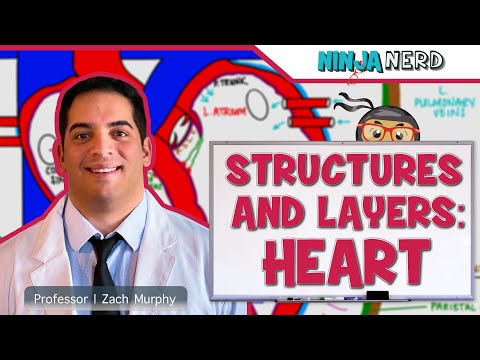
Cardiovascular | Structures and Layers of the Heart
Anatomy of the Heart and its Position
In this section, we will discuss the anatomy of the heart and its position within the thoracic cavity.
Anatomy of the Heart
- The heart is located within a special cavity called the mediastinum in the thoracic cavity. There are different components of the mediastinum, including superior, central, anterior, and posterior mediastinum.
- The heart is shifted about two-thirds to the left of the mid sternal line. The apex of the heart points towards the left hip, while the base points towards the right shoulder.
- The average weight of the heart is approximately 200 to 300 grams, which is about the size of a fist.
Chambers of the Heart
In this section, we will explore the different chambers of the heart.
Atria
- The top two chambers of the heart are called atria. On the right side, it is known as the right atrium, and on the left side, it is called left atrium.
- The right atrium receives blood from three major vessels: inferior vena cava (IVC), superior vena cava (SVC), and coronary sinus.
- The IVC brings blood from beneath diaphragm and lower appendages. The SVC brings blood from head, neck, and upper limbs. The coronary sinus returns blood from a part of a heart back to right atrium.
- Scar tissue known as fossa ovalis replaces foramen ovale after birth.
Specialized Nodal Cells
- There are specialized nodal cells responsible for generating action potentials in setting sinus rhythm.
- These include sinoatrial (SA) node and atrioventricular (AV) node.
Left Atrium and Pulmonary Veins
In this section, we will focus on the left atrium and the pulmonary veins.
Left Atrium
- The left atrium receives blood from the pulmonary veins.
- The pulmonary veins bring oxygenated blood from the lungs to the left side of the heart.
Pulmonary Veins
- The pulmonary veins are responsible for bringing oxygenated blood from the lungs to the heart.
- The left pulmonary veins bring blood from the left lung, while the right pulmonary veins bring blood from the right lung.
This summary covers only a portion of the transcript.
New Section
This section discusses the tricuspid valve and the bicuspid/mitral valve, their structure, and their function in separating the atria from the ventricles.
Tricuspid Valve
- The tricuspid valve is located on the right side of the heart.
- It separates the right atrium from the right ventricle.
- Another name for it is the right atrioventricular valve.
- The valve is layered with collagen, elastic tissue, and spongy tissue.
- It consists of three individual layers: zona spongiosa, zona fibrosa, and zona ventricular.
- The valve is surrounded by an endothelial lining.
Bicuspid/Mitral Valve
- The bicuspid/mitral valve is located on the left side of the heart.
- It separates the left atrium from the left ventricle.
- Another name for it is the left atrioventricular valve.
- Similar to the tricuspid valve, it has layered structure with collagen and elastic tissue.
- It also has chordae tendineae (collagen cords) that anchor it in a tight position.
New Section
This section explains how chordae tendineae play a crucial role in keeping valves tightly closed to prevent backflow.
Chordae Tendineae
- Chordae tendineae are collagen cords that connect to and anchor valves in a taut position.
- They prevent valves from ballooning back into atria or allowing backflow of blood into chambers during contraction.
- Papillary muscles protrude out from specific areas and attach to these chordae tendineae to keep them anchored tightly.
New Section
This section highlights papillary muscles' role in anchoring chordae tendineae and the consequences of their dysfunction.
Papillary Muscles
- Papillary muscles are muscles that attach to chordae tendineae.
- They play a crucial role in anchoring the valves and keeping them tightly closed.
- During a myocardial infarction (heart attack), ischemia can affect these muscles, causing weakness or inability to contract.
- If papillary muscles cannot hold onto chordae tendineae tightly, valve flaps become loose.
- This can lead to valve regurgitation when the right ventricle contracts, pushing the valves back up.
New Section
This section identifies the left ventricle as an important pumping chamber of the heart.
Left Ventricle
- The left ventricle is a pumping chamber located on the left side of the heart.
- It receives blood from the left atrium and pumps it out to the rest of the body.
- Collagen cords (chordae tendineae) and papillary muscles also exist in this chamber, similar to those on the right side.
Structure of the Heart
In this section, the instructor discusses the structure of the heart, including the valves and septums.
Valves of the Heart
- The pulmonary semilunar valve separates the right ventricle from the pulmonary trunk. It is called "semilunar" because it looks like half of a moon.
- The aortic semilunar valve separates the left ventricle from the aorta. It also looks like half of a moon.
- The purpose of these valves is to prevent backflow and ensure one-way blood flow.
Septums in the Heart
- The interventricular septum separates the right ventricle from the left ventricle. It is important for maintaining separate blood circulation in each ventricle.
- There is also an interatrial septum between the left atrium and right atrium, which helps maintain separate blood flow between them.
Great Vessels
- The pulmonary trunk carries deoxygenated blood from the right ventricle to both lungs. It splits into two branches known as left and right pulmonary arteries.
- The ascending aorta carries oxygenated blood from the left ventricle to various parts of systemic circulation. It leads to an arch called the aortic arch, which gives rise to important vessels such as brachiocephalic artery, left common carotid artery, and left subclavian artery.
Layers of the Heart
- The innermost layer of the heart is called the endocardium, which lines the chambers and valves. It is made up of endothelial tissue.
- The middle layer is the myocardium, consisting of cardiac muscle tissue responsible for contraction.
- The outermost layer is the epicardium, also known as visceral pericardium, which covers the surface of the heart. [No timestamp provided]
Timestamps are approximate and may vary slightly depending on the source video.
Left Ventricular Myocardium
This section discusses the difference in thickness between the left ventricular myocardium and the right ventricular myocardium.
Left Ventricular Myocardium
- The left ventricular myocardium is thicker than the right ventricular myocardium.
- The left ventricle has to pump blood to the entire body, while the right ventricle only pumps blood to the lungs.
- The thicker myocardium of the left ventricle allows for more powerful pumping.
Layers of the Heart Wall
This section explains the different layers of the heart wall.
Epicardium/Visceral Layer of Serous Pericardium
- The outer blue layer is called either epicardium or visceral layer of serous pericardium.
- It provides a protective covering for the heart.
Pericardial Cavity and Fluid
This section discusses the pericardial cavity and its fluid.
Pericardial Cavity and Fluid
- The space between the epicardium and parietal layer is called the pericardial cavity.
- It contains serous fluid that helps reduce friction between layers.
- Friction between layers can lead to pericarditis, a severe stabbing pain condition.
Parietal Layer of Serous Pericardium
This section explains the parietal layer of serous pericardium.
Parietal Layer of Serous Pericardium
- The green layer is known as the parietal layer of serous pericardium.
- It is continuous with the epicardium/visceral layer.
- The parietal layer covers the walls of the pericardial cavity.
Fibrous Pericardium
This section discusses the fibrous pericardium.
Fibrous Pericardium
- The brown layer is called the fibrous pericardium.
- It is made up of dense irregular connective tissue.
- Functions of the fibrous pericardium include anchoring the heart to surrounding structures, protecting the heart from trauma, and preventing overfilling of blood in the heart.
Summary and Conclusion
This section concludes the discussion on cardiovascular anatomy and histology.
Summary and Conclusion
- The mitral valve and aortic semilunar valve are also covered by endocardial lining.
- Understanding the layers of the heart wall is essential for studying cardiovascular anatomy and histology.
Turn any video into a summary like this
YouTube links, meetings, lectures. With transcripts, search, and chat.