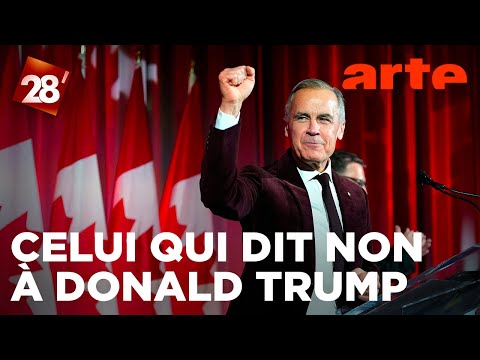
Le Canada peut-il être un "phare pour un monde à la dérive"? | 28 minutes | ARTE
Davos Forum: Canada’s Stand Against Trump
Canadian Prime Minister's Bold Stance
- The Canadian Prime Minister received a standing ovation at the Davos Economic Forum for calling on medium powers to unite against Donald Trump, emphasizing that if they are not at the table, they risk being on the menu.
- He highlighted the choice for medium powers: compete for favor from larger nations or collaborate to create a significant third path.
Media Reactions and Implications
- The Prime Minister's remarks were seen as a direct affront to Trump, who has threatened Canada with new tariffs. This tension is illustrated by Trump's social media posts featuring European leaders in the Oval Office.
- Marc Harnet advocates for pragmatic alliances and trade agreements among medium powers, citing recent agreements between India and the EU as examples of strategic partnerships outside U.S. influence.
Strategic Alliances in a Changing World
- As global order shifts, questions arise about whether medium powers can ally against not only the U.S. but also China and Russia. Is Canada becoming a beacon of hope in this turbulent landscape?
Expert Insights on Canada's Position
Perspectives from Experts
- Frédéric Arnoude notes that Canada's stance could inspire other countries facing similar challenges with dominant superpowers like the U.S.
- Nathalie Joiseau emphasizes that multilateralism is struggling; thus, dialogue among medium powers is essential to redefine international relations in an increasingly transactional world.
Historical Context of Canada-U.S. Relations
- Historian Floriant Louis discusses how Canada is attempting to salvage its transatlantic relationship amidst difficulties while recognizing Marc Harnet's pragmatic approach towards potential partnerships with countries like China.
Historical References and Their Significance
Lessons from History
- The discussion references Thucydides, highlighting his insights into power dynamics where strong nations impose their will on weaker ones—paralleling current tensions involving Trump.
Analyzing Canada's Break from Tradition
- Louis argues that Canada's distancing from traditional ties with the U.S. marks a significant shift in their historical partnership characterized by shared destiny and civilization.
The Courage of Speaking Out
Acknowledging Risks in Leadership
- Experts agree that it takes courage for leaders like Marc Harnet to vocalize such breaks given economic dependencies—over 3 million barrels of oil flow daily from Canada to the U.S., underscoring complex interdependencies.
Inspiration for Other Nations
- There’s potential inspiration for other nations seeking alternative paths amid pressures from superpowers; navigating these relationships may lead to innovative diplomatic strategies.
This structured summary captures key discussions surrounding Canada's position at Davos regarding its relationship with Donald Trump and broader implications for international relations among medium powers.
Discussion on European Union and Global Politics
Critique of Political Discourse
- The speaker expresses skepticism about the French passion for political speeches, referencing Dominique de Villepin's address at the UN as an example of grand rhetoric that may not translate into effective action.
Changing Times and EU Response
- Acknowledges a shift in global dynamics, emphasizing that recent events have prompted the EU to adapt its strategies, particularly in light of aggressive stances from neighboring countries.
Trade Agreements and Coercion
- Discusses the EU's decision to delay ratifying a trade agreement with the U.S. due to concerns over American actions regarding Greenland, highlighting a cautious approach towards international agreements.
Trump’s Influence and Reactions
- Notes how Donald Trump's behavior aligns with definitions of coercion, suggesting that his retreat from aggressive posturing was influenced by diplomatic efforts from European leaders like Emmanuel Macron.
Historical Comparisons and Future Implications
- Compares recent speeches at Davos to Winston Churchill's historical addresses, indicating that current discussions reflect significant geopolitical shifts and potential future conflicts involving U.S. influence over Europe.
Proposing Alternatives Amidst Challenges
- Highlights the importance of offering solutions rather than merely identifying problems; emphasizes Canada's role as a middle power while cautioning against viewing Europe solely as a collection of smaller nations.
The Role of Europe in Global Power Dynamics
- Argues that while individual European nations may be seen as middle powers, collectively, the EU has substantial potential to assert itself on the global stage compared to other powers like Russia.
Caution Against Misinterpretation
- Warns against misinterpreting Canadian perspectives on global issues; stresses that while there are shared challenges, Europe's context is distinct from Canada’s geographical proximity to the U.S.
Impact of Recent Speeches
- Reflects on Trump's immediate reaction to Carnet's speech at Davos, indicating jealousy and defensiveness regarding perceived threats posed by new alliances formed by Canada with other nations.
Navigating Complex Realities
- Concludes with an acknowledgment of complex realities in international relations; emphasizes pragmatic approaches despite idealistic aspirations for cooperation among nations.
European Trade Agreements and Global Dynamics
The Importance of European Trade Agreements
- Discussion on the necessity of the European project, especially during challenging times, highlighting a perceived disconnect in leadership.
- Critique of anti-free trade sentiments in Europe, noting that such attitudes are puzzling to the global community.
- Reference to the EU-Canada trade agreement (CETA), which was initially met with skepticism but has proven beneficial for the EU.
Recent Developments: EU-India Trade Agreement
- Announcement of a new trade agreement between the EU and India after two decades of negotiations, emphasizing its significance.
- Description of the agreement's scale, impacting 2 billion people and representing a quarter of global GDP; it focuses on reducing tariffs significantly.
Key Features of the Agreement
- Specific tariff reductions outlined: car tariffs from 110% to 10%, wine from 150% to 20%, and complete removal for pasta and chocolate.
- The EU is expected to save €4 billion annually due to reduced tariffs while India will benefit from tax exemptions on precious stones, leather, and textiles.
Implications for Global Trade Relations
- Analysis on whether this type of alliance could reshape global commercial order; acknowledgment that it's not an alliance in military terms but rather a limited commercial agreement.
- Emphasis on Europe's strength in commerce versus its weaknesses in military alliances; caution against relying solely on trade agreements as substitutes for security partnerships.
Future Considerations
- Warning about potential complacency within Europe regarding hard power capabilities amidst changing global dynamics led by figures like Trump.
- Reflection on protectionism trends among nationalists in Europe; assertion that free trade agreements are essential despite rising anti-globalization sentiments.
European Union's Strategic Moves and Global Alliances
Trade Relations and Military Partnerships
- Discussion on the impact of tariffs on wines and spirits, highlighting Emmanuel Macron's influence in opening new markets with India, particularly in security and defense partnerships.
- Emphasis on India's non-alignment stance, maintaining close ties with Russia while acknowledging the EU's strategic shift towards military exports to India due to reduced Russian military supplies.
- Mention of a current EU naval operation in the Indian Ocean aimed at combating piracy, involving both European and Indian vessels.
Security Concerns and NATO Dynamics
- Analysis of NATO Secretary General Marc Rutte’s relationship with Donald Trump, noting his firm stance against European sovereignty aspirations.
- Reflection on North American military dependence; concerns about potential threats from Trump’s administration leading to increased rearmament efforts within Europe and Canada.
The Role of Middle Powers
- Discussion on how middle powers like Turkey are forming their own alliances independent of Western influences, questioning the relevance of these coalitions against U.S. dominance.
- Commentary on Europe's proactive alliance-building through the EU as a response to global power dynamics without waiting for external validation.
Transatlantic Relations and Digital Sovereignty
- Critique of Rutte’s comments regarding transatlantic relations; perceived failure to support European self-sufficiency in security matters amidst rising tensions.
- Highlighting Europe’s digital dependency on American platforms (e.g., Teams, Zoom), raising questions about future sovereignty initiatives led by France.
Challenges in Achieving Digital Independence
- Acknowledgment that despite good intentions for creating an independent digital infrastructure, Europe remains heavily reliant on U.S. technology companies.
- Inquiry into why alternatives to major payment systems like Visa or Mastercard have not been developed over two decades, emphasizing challenges faced by Europe in establishing its financial independence.
This structured summary encapsulates key discussions from the transcript while providing timestamps for easy reference.