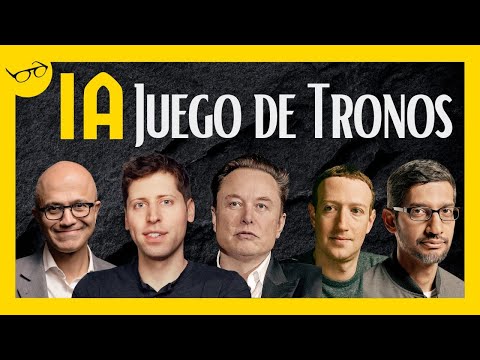
La fascinante historia del Juego de Tronos de la IA
The Epic Battle for Artificial Intelligence
The introduction sets the stage for a narrative surrounding the intense competition among inventors, scientists, entrepreneurs, and tech giants to achieve General Artificial Intelligence (AGI), highlighting the potential societal transformations and uncertainties that come with this pursuit.
The Key Players in the AI Saga
- A small group of individuals, characterized by their capabilities, limitations, egos, wealth, and influence, are at the forefront of the race towards AGI.
- Notable figures like Sam Alman (CEO of OpenAI) and Elon Musk play pivotal roles in shaping the AI landscape through their actions and conflicts.
- Instances of manipulation and instability within the sector lead to crises such as those involving OpenAI and its partners.
- Personal conflicts between influential figures like Elon Musk and Larry Page impact industry dynamics and alliances significantly.
The Cast of Characters in the AI Drama
- Alongside major players like Mark Zuckerberg, Satya Nadella (Microsoft COO), and Sundar Pichai (Google COO), secondary figures also wield substantial influence in shaping AI developments.
- Various settings, including Bill Gates' home where ideas like GPT emerge, contribute to the intricate web of interactions driving AI innovation.
Origins of Modern Artificial Intelligence
Delving into the inception of contemporary AI endeavors around 2010 led by two engineers convinced about achieving AGI soon after significant advancements in computing power and digital knowledge availability.
Unveiling AGI Aspirations
- Historical context from 1950 highlights early efforts to imbue machines with human-like cognitive abilities underpinning AGI aspirations.
- Demis Hassabis and Mustafa Suleyman's belief in seizing the moment for AGI development aligning with exponential computational growth sets a new trajectory for AI evolution.
- Collaboration with Silicon Valley visionary Eliezer Yudkowsky marks a crucial step towards realizing ambitious goals for leveraging AI to address global challenges.
Convergence of Minds in Pursuit of AGI
- Yudkowsky's vision attracts attention from influential figures like Peter Thiel who recognize the transformative potential of advanced AI applications beyond conventional boundaries.
The Birth of Deep Mind and the Rise of AI Giants
This section delves into the inception of Deep Mind through a strategic encounter between Demis Hassabi and Peter Till, leading to significant investments from influential figures like Elon Musk.
The Strategic Encounter with Peter Till
- Demis Hassabi captivates Peter Till with a metaphor about the tension between the bishop and knight in chess, sparking interest in their conversation.
Formation of Deep Mind
- Hassabi secures $2.5 million from Till for an AI startup, initiating the birth of Deep Mind.
- The aim is to teach machines to defeat humans in strategic games like Pong, Space Invaders, and Breakout, marking the beginning of modern AI.
Elon Musk's Involvement
- Elon Musk becomes interested in investing after a visit to SpaceX where Hassabi highlights the goal of Mars colonization and potential risks posed by advanced machines.
The Tech Titans' Interest in Deep Mind
This segment explores how investments from key figures like Peter Till, Elon Musk, and Larry Page propel Deep Mind into prominence within Silicon Valley's tech landscape.
Larry Page's Fascination
- Larry Page witnesses Deep Mind's prowess in Atari games, prompting him to invest in the company.
- The collaboration among Musk, Till, and Page sets off tensions but also attracts attention from tech giants like Microsoft, Baidu (China), and Facebook.
Talent Acquisition Phase
- Silicon Valley tech giants recognize the importance of recruiting top talent for AI development.
- A pivotal moment occurs at a conference where Jof Hinton auctions his team electronically; Google secures them for high prices akin to NBA stars.
New Section
This section discusses the acquisition of Deep Mind by Google and Facebook, highlighting the conditions set by Deep Mind's founders and the subsequent events leading to Google's ownership.
Acquisition of Deep Mind
- The founders of Deep Mind set two conditions for potential buyers: no military use of technology and supervision by an independent council of technologists and philosophers.
- Google offered $650 million, while Facebook offered more but refused to accept the conditions set by the Deep Mind team.
Transition to Google Ownership
- Larry Page and Sergey Brin acquired Deep Mind within months, along with its pioneering AI researchers.
- Mark Zuckerberg, after acquiring Oculus, a virtual reality startup, focused on building a future strategy around it.
New Section
The section discusses the initial conditions set by the founders of a pioneering AI company for its acquisition by Google, leading to an ethical oversight committee meeting.
Founders' Conditions for Acquisition
- The founders of the AI company required Google to establish an ethical oversight committee for the sale.
- The committee included Larry Page, Sergey Brin, Eric Schmidt, Demis Hassabis, and Mustafa Suleiman.
- The primary agenda was the impact of AI on jobs, with Suleiman presenting a concerning view that AI would eliminate many professions.
New Section
This part delves into the potential consequences of AI advancements on employment and public perception towards companies like Google.
Impact of AI on Employment
- DeepMind's leadership in the AI revolution could lead to public blame on Google for job losses.
- Suleiman proposed that Google should provide a universal basic income to all humans to counteract job loss concerns.
- Elon Musk supported Suleiman's idea, while Eric Schmidt reacted with disbelief at the proposal.
New Section
Elon Musk's growing concerns about collaborating with Google due to differing visions and his evolving perspective on their impact on humanity are highlighted.
Elon Musk's Concerns
- Musk began questioning collaboration with Larry Page and Google due to differing visions.
- He believed that Google posed a risk to humanity and started planning to counteract Page's ambitions.
- Musk's personal crisis intensified following a significant breakup experience professionally or personally.
New Section
The breakthrough moment when AlphaGo defeated a world champion in Go sparked widespread interest in AI capabilities beyond traditional tasks.
AlphaGo Breakthrough
- DeepMind's AlphaGo defeating world champion Lee Sedol marked a significant milestone in AI history.
- This victory startled tech enthusiasts and academia as it showcased AI surpassing human expertise in complex strategy games like Go.
New Section
Sam Altman’s role as CEO of Y Combinator and his connection with Elon Musk as they navigate discussions around artificial intelligence is explored.
Sam Altman and Elon Musk Collaboration
- Sam Altman, CEO of Y Combinator, had a rapid rise driven by intellectual brilliance and networking skills within Silicon Valley.
- Altman envisioned collaborating with Musk on an AI venture post-Musk’s departure from DeepMind due to trust issues with Larry Page.
Elon Musk, OpenAI, and the Evolution of AI
This section delves into the early stages of a lawsuit involving Elon Musk, Alman, and OpenAI in March 2024. It explores how Elon Musk's involvement played a significant role in shaping the trajectory of OpenAI.
Elon Musk's Influence on OpenAI
- Elon Musk's pivotal role in the early days of OpenAI attracted attention from Alman, leading to significant hirings that boosted the startup.
- The recruitment of Ilas Suk, who was persuaded by his kever to leave Google for this new project in 2015, marked the beginning of conflicts surrounding the impact of powerful technologies on society.
- Tensions arose within DeepMind as OpenAI emerged as a formidable opponent following disagreements and ego clashes. Meanwhile, Facebook and Microsoft faced challenges in navigating the AI landscape.
Impactful Events in AI Development
- The initial phase saw conflicts akin to those in "Game of Thrones," hinting at a turbulent future for AI development.
- The onset of an "AI winter" in 2016 highlighted manipulation through artificial intelligence during events like the 2016 presidential elections, revealing Cambridge Analytica's data exploitation tactics.
Advancements in AI Technology
This section discusses notable advancements and shifts within AI technology that shaped its trajectory during this period.
Technological Progress and Manipulation
- Cambridge Analytica's manipulation during the 2016 elections underscored AI's potential for influencing public opinion through data exploitation.
- Platforms like TikTok showcased significant algorithmic advancements that revolutionized user engagement through tailored content selection.
Key Publication Driving Innovation
- A groundbreaking document unveiled crucial advancements in AI over five decades, laying the foundation for transformative technologies like GPT models.
- The introduction of transformers revolutionized machine learning by converting text into numerical components called tokens, enhancing computational capabilities significantly.
The Role of Individuals in Shaping Modern AI
This segment highlights key individuals whose contributions were instrumental in shaping modern AI developments and industry dynamics.
Influence of Jensen Huang
- Jensen Huang's pivotal role in utilizing graphics cards for training AI models reshaped modern AI capabilities and computational requirements significantly.
The Evolution of Open AI and Microsoft Partnership
The transcript discusses the collaboration between Open AI and Microsoft, detailing key events and tensions within the partnership.
Open AI's Challenges with Chatbot Testing
- Open AI faced challenges with chatbot testing, leading to disastrous outcomes.
Microsoft's Observations from Seattle
- Microsoft, based in Seattle, observed Open AI's struggles with chatbots and talent acquisition.
Satya Nadella's Strategic Observation
- Satya Nadella from Microsoft strategically observed developments in Silicon Valley, waiting for the right opportunity.
Microsoft's Investment in Open AI
- In 2019, Satya Nadella attended a tech conference where he met Sam Altman from Open AI. This encounter led to Microsoft investing $1 billion in Open AI.
Internal Tensions at Open AI
- The shift towards financial dependence on Microsoft caused internal tension at Open AI. Some team members opposed this change.
Detailed Overview of the Transcript
The transcript discusses the advancements in artificial intelligence, particularly focusing on OpenAI and Microsoft's strategic moves in the AI landscape.
Bill Gates Impressed by Chelsea Boss at Casa de Bill Gates
- Chelsea Boss, a biology Olympiad medalist, impresses Bill Gates by answering 60 questions with only one mistake.
- Gates considers GPT-4 a historic technological leap after witnessing Boss's performance.
- Microsoft expands its involvement in OpenAI's commercial subsidiary up to 49%, leading to significant consequences for AI projects.
Evolution of AI Projects and Investments
- Anthropics receives substantial investments from figures like Sam Bman Freed and Google, aiming to diversify their AI initiatives.
- Mustafa Suleiman leaves Google to establish Inflection AI with other investors, emphasizing the high costs associated with purchasing chips for training models.
Launch of Chat GPT 3.5 as a Strategic Move
- OpenAI faces pressure to release an advanced version of GPT amidst competition.
- The launch of Chat GPT 3.5 as a research demo garners unexpected popularity, surpassing initial expectations.
Satya Nadella's Vision for Microsoft's AI Integration
- Satya Nadella unveils plans to pivot Microsoft products towards AI integration during a board meeting.
- Three key priorities are identified: applying AI to cybersecurity products, transforming Bing into a question-answer platform, and redefining Office's value proposition with "The Copilot" concept.
Unveiling Microsoft's Groundbreaking Project
- Microsoft organizes a secretive product launch event on February 7th, generating anticipation among media personnel.
- Despite efforts to maintain secrecy, details leak out about Microsoft's significant announcement.
Insights into Tech Industry Strategies
This section delves into strategic maneuvers within the tech industry involving OpenAI, Google, and Microsoft.
Collaboration Between OpenAI and Microsoft
- Sam Altman proposes taking a selfie with Satya Nadella at an event in Seattle as part of an unconventional idea.
New Section
This section discusses the competitive dynamics between Microsoft and Google in the realm of search engines, focusing on a strategic move by Microsoft to challenge Google's dominance.
Strategic Move by Microsoft
- Microsoft strategically launched a new project on February 7th that garnered significant attention from global media and technology influencers.
- Satya Nadella, Microsoft's CEO, emphasized the importance of search engines as a lucrative software business, signaling a direct challenge to Google's stronghold in this domain.
- Google attempted to preempt Microsoft's announcement by hurriedly presenting its own chatbot, Bard, which backfired due to errors in its demonstration at an event in Paris.
- The public unveiling of Bing AI by Microsoft led to a major blunder by Google when errors in Bard's responses were not rectified but instead used in promotional materials, tarnishing Google's reputation significantly.
New Section
This section delves into the repercussions faced by Google following Microsoft's strategic moves and how internal challenges impacted their artificial intelligence initiatives.
Repercussions for Google
- Following the launch of Bing AI and subsequent mishaps with Bard, Google faced a crisis of confidence as it transitioned from being perceived as an industry leader in talent and technology to appearing vulnerable and indecisive.
- Notable figures within the field of artificial intelligence, such as Geoffrey Hinton, distanced themselves from Google amid shifts in their perspectives on AI capabilities over time.
- The closure of Bart (Google's chatbot) due to its inability to compete with Chat GPT marked another setback for Google, prompting Sergey Brin to reengage actively in developing a new chatbot model.
New Section
This segment explores Facebook's response to emerging challenges posed by advancements in artificial intelligence technologies and their impact on the company’s strategic direction.
Facebook’s Response
- Amid Facebook’s focus on metaverse projects, concerns arose regarding their recognition within the AI domain compared to competitors like OpenAI and Google.
Desarrollo Tecnológico en 2023
In this section, the discussion revolves around technological advancements and strategic decisions made by prominent tech companies in 2023.
Zuckerberg's Strategic Shift
- Meta (formerly Facebook) decides to prioritize AI projects.
- Zuckerberg's decision leads to Meta's resurgence as a leading innovator.
- Meta's focus extends beyond the metaverse to long-term AI projects.
Musk's AI Ventures
- Elon Musk ventures into AI with his company XAI.
- Musk acquires GPUs from Nvidia for XAI project.
- XAI aims to enhance humanity's understanding of the universe.
Microsoft and OpenAI Collaboration
- Microsoft collaborates with OpenAI on ChatGPT through a joint venture.
- Tensions arise within OpenAI leading to unexpected dismissals.
- Sam Alman plays a pivotal role in navigating the collaboration challenges.
Strategic Alliances and Innovations
This segment delves into strategic alliances, company acquisitions, and technological innovations shaping the tech landscape in 2024.
Microsoft's Diversification Strategy
- Microsoft invests in Mistral, a French AI company with open-source language models.
- Suleiman, an influential figure from DeepMind, joins Microsoft post-acquisition of Inflection Ai.
Tech Industry Dynamics
- Inflection Ai integrates into Microsoft Cloud post $600 million investment.
- The alliance between Microsoft and OpenAI positions them favorably for future developments.
Future Technological Landscape
- Nvidia emerges as a key player driving AI technology advancements.
The Future of Tech Giants in the Era of Artificial Intelligence
The discussion delves into the current landscape of tech giants, focusing on Apple, Microsoft, Google, and Meta (formerly Facebook), exploring their strategies and potential in the realm of artificial intelligence.
Apple's Strategy and Potential
- Apple has been overshadowed by Microsoft in market valuation. The narrative questions if Apple is dormant or planning a surprise move to reclaim its dominance.
Google's Position and Challenges
- Despite having resources and talent, Google is yet to dominate AI. The company faces the challenge of cannibalizing its existing business to excel in AI.
- Google's success hinges on strategic decisions it makes in the next few years, determining its future as a tech giant.
Meta's Role in AI Development
- Mark Zuckerberg's language models are widely adopted by startups globally. Meta aims to revolutionize revenue streams through virtual assistants powered by AI.
Competition Among Tech Giants
- Microsoft, OpenAI, Google, and Meta are equipped with robust AI capabilities aiming for global domination. Each firm has distinct strategies for technological advancement.
- Amazon maintains a neutral stance but harbors ambitious plans for AI-driven consumer products. Apple's absence raises questions about its relevance in the evolving tech landscape.
Apple's Historical Innovation Patterns
This segment explores Apple’s historical approach to innovation, highlighting its strategic patience and calculated market entries across different technological eras.
Evolution of Apple’s Innovation Strategy
- In past eras like PC dominance and internet revolution, Apple strategically timed its product launches for maximum impact rather than early adoption.
Apple’s Preparatory Approach
- Despite being associated with innovation, Apple tends to wait for opportune moments before introducing groundbreaking solutions that cater to consumer needs effectively.
Future Prospects in AI for Apple
- With significant acquisitions in AI companies recently, Apple seems poised for advancements in the field. Speculation arises about how these efforts will shape its future direction amidst fierce competition.
Potential Tech Leaders Shaping the Future
This part discusses emerging contenders like Tesla alongside established players such as Nvidia and AMD who are pivotal in shaping the technological landscape with their infrastructure advancements.
Tesla’s Disruptive Potential
- Leveraging vast data from vehicles worldwide, Tesla stands out as a key player poised to redefine industries beyond traditional realms like chatbots using image-based training models.
Infrastructure Powerhouses: Nvidia & AMD
- Nvidia and AMD lead the foundational technology space crucial for upcoming innovations. Their cloud services will likely incubate transformative applications driving substantial value shifts akin to past internet booms.
Detailed Overview of the Transcript
The transcript discusses the emergence of major companies in the second wave of technological advancements, particularly focusing on the genesis of modern artificial intelligence and its significance compared to past innovations like the PC and internet. It delves into the intertwined narratives of egos, contrasting visions for humanity's future, and chance occurrences that have shaped the development of AI technologies.
Emergence of Major Companies in Technological Advancements
- Some major winners in the second wave are likely newly created companies or do not exist today.
- The narrative is filled with egos and conflicting visions about humanity's future akin to science fiction, involving skilled individuals capable of playing three-dimensional chess.
Significance of Modern Artificial Intelligence
- The evolution surpasses previous technological milestones such as the advent of personal computers and the internet.
- Chance plays a pivotal role in this narrative, where technology initially designed for gaming transforms into a key component for training intelligent systems.
Key Takeaways
- The story highlights how chance occurrences and diverse perspectives have influenced AI development.
Turn any video into a summary like this
YouTube links, meetings, lectures. With transcripts, search, and chat.