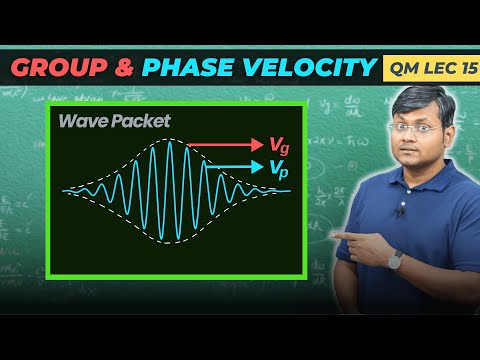
Group & Phase Velocities of Wave packet in Quantum Mechanics
Introduction to Wave Packet
In this section, we introduce the concept of a wave packet in quantum mechanics and its significance in describing the dynamics of particles. We discuss how particles exhibit both particle-like and wave-like properties.
Wave Packet as an Entity Embracing Particle and Wave Aspects
- The wave packet is a localized wave constructed by superposing a large number of plane wave solutions.
- It represents the presence of a particle in a specific region with non-zero amplitude.
- The wave packet incorporates both particle aspects and wave aspects of microscopic or quantum mechanical particles.
Construction of Wave Packet
- A wave packet is constructed by adding together plane waves with different amplitudes, frequencies, and phases.
- Plane waves are sinusoidal variations in space described by the Schrodinger's equation for a free particle.
- The superposition of these plane waves results in a localized wave packet.
Properties of Wave Packet
- The wave packet introduces the idea that particles can be associated with multiple waves rather than one standard frequency, amplitude, and wavelength.
- It indicates that there is a higher probability of finding the particle within the region where the wave packet has non-zero amplitude.
Motion Analysis and Velocity Correlation
In this section, we analyze the motion of the wave packet and explore how its velocity can be correlated with physical quantities such as momentum and energy.
Mathematical Expression for Wave Packet
- The mathematical expression for a wave packet involves a linear superposition of plane waves with varying amplitudes and frequencies.
- The expression includes parameters such as the wave number, angular frequency, and normalization term.
Velocity of Wave vs. Velocity of Wave Packet
- We examine the velocities associated with the wave and the wave packet.
- The velocity of a wave can be determined by multiplying its frequency with its wavelength.
- The velocity of the wave packet is related to the motion of its envelope or modulation, which determines where the amplitude is large or small.
Group Velocity and Phase Velocity
- Group velocity refers to the velocity at which the maximum amplitude or envelope of a wave packet propagates.
- Phase velocity represents the speed at which the phase of a single plane wave component travels.
- These velocities can be different from each other and have correlations with physical quantities like momentum and energy.
Conclusion
In this transcript, we explored the concept of a wave packet in quantum mechanics. We discussed how it combines particle-like and wave-like properties, as well as its construction through superposition of plane waves. Additionally, we analyzed the motion of a wave packet and examined how its velocity correlates with physical quantities such as momentum and energy.
Wave Velocity and Dispersive vs Non-Dispersive Mediums
In this section, the speaker discusses the relationship between wave velocity, wave number, and angular frequency. They explain that this relationship holds true for waves propagating in non-dispersive mediums, where all frequencies travel at the same speed. However, in dispersive mediums, different frequencies may travel at different speeds.
Wave Velocity and Non-Dispersive Mediums
- In a non-dispersive medium, the velocity of a wave is related to its wave number and angular frequency.
- All waves with different frequencies travel at the same velocity in a non-dispersive medium.
- Examples of non-dispersive mediums include light waves traveling through vacuum and sound waves traveling through air.
Dispersive vs Non-Dispersive Mediums
- In dispersive mediums, different frequencies may travel at different speeds.
- Light propagating through a dispersive medium or deep ocean water waves are examples of dispersive mediums.
- The relationship between angular frequency (Omega) and wave number (K) may be more complex in dispersive cases.
Taylor Series Expansion for Wave Packet Construction
- To create a wave packet composed of multiple plane wave solutions, a Taylor series expansion can be used.
- The speaker assumes a highly localized wave packet where quadratic terms and higher-order terms can be neglected.
- This simplifies the expression for angular frequency (Omega) as Omega K ≈ Omega naught + (K - K naught) * dOmega/dk at K naught.
Shape of Wave Packet
This section focuses on the shape of a wave packet and how it is determined by the modulation function. The speaker introduces an assumption that allows for simplification when dealing with highly localized wave packets.
Highly Localized Wave Packet Assumption
- For a highly localized wave packet, the speaker assumes that quadratic terms and higher-order terms can be neglected.
- This assumption simplifies the expression for angular frequency (Omega) in the wave packet construction.
Simplified Expression for Angular Frequency
- The simplified expression for Omega K is approximately equal to Omega naught + (K - K naught) * dOmega/dk at K naught.
- Omega naught represents the value of angular frequency at a specific wave number, K naught.
Substituting into Wave Packet Expression
In this section, the speaker demonstrates how to substitute the simplified expression for angular frequency into the mathematical definition of a wave packet. This substitution allows for further analysis and simplification of the wave packet expression.
Substitution of Simplified Expression
- The simplified expression for Omega K is substituted into the mathematical definition of a wave packet.
- The resulting expression is used to analyze and simplify the wave packet further.
The transcript ends before providing further details on the analysis and simplification process.
New Section
In this section, the speaker discusses the wave function and introduces the concept of a plane wave solution and a modulating function.
Wave Function and Plane Wave Solution
- The wave function is represented as D Omega upon d k at a particular value of K naught.
- The wave function can be simplified as Phi K multiplied by e to the power Iota (K - K naught) X.
- The term K naught represents an arbitrary wave number at which the wave function is at its peak.
- Omega naught is the value of Omega at K naught.
Separation of Terms
- The wave packet can be written as a product of a plane wave solution and a modulating function.
- The plane wave solution is represented by e to the power Iota K naught X minus Omega naught T.
- The modulating function, denoted as f(X), determines the amplitude variation of the wave packet.
New Section
This section focuses on comparing the velocities of the plane wave solution and the modulating function in order to understand the nature of particle motion.
Velocity Comparison
- The velocity of the plane wave solution, also known as phase velocity, is given by Omega upon K or Omega naught upon K naught.
- Since Omega naught and K naught are arbitrary values at a given point in time, we can simplify it to Vp = Omega upon K.
- The velocity of the modulating function determines how it changes with time.
New Section
This section discusses the concept of group velocity and its difference from phase velocity. It explains how the wave packet, which represents a probability distribution of a particle, evolves with time and how the group velocity represents the velocity of the envelope of the wave packet.
Understanding Group Velocity
- The function f(x) is equal to 1 upon root 2 pi integration for minus infinity to plus infinity of Phi(k) e^(iK - K0)(x - D Omega / dkt) with respect to K.
- The expression represents an integration of a large number of plane waves.
- The velocity V in this expression is D Omega / dK at a particular point K0.
- We want a general expression for wave velocity for all times, known as group velocity (Vg), which is given by D Omega / dK.
Difference between Phase Velocity and Group Velocity
- The wave packet represents a probability distribution of the particle and evolves with time.
- The phase velocity (Vp) is given by Omega / K, representing the mathematical speed of the wave function.
- The group velocity (Vg) represents the velocity of the envelope or modulation function that determines where amplitude is non-zero in a small region.
- Phase velocity and group velocity can be different, indicating different motion characteristics.
Simulation Examples
- Simulation examples demonstrate different scenarios:
- Case 1: Group and phase velocities are equal, indicating both wave and envelope travel together at the same speed.
- Case 2: Group velocity is less than phase velocity, indicating slower movement of the envelope compared to the wave.
- Case 3: Group is at rest while phase moves forward, showing zero group velocity but positive phase velocity.
- Case 4: Opposite directions for envelope and wave velocities, indicating leftward movement of envelope but rightward movement of the wave.
- Case 5: Group velocity is greater than phase velocity, showing faster envelope movement compared to the wave.
- Case 6: Phase velocity is zero, indicating a stationary wave while the envelope moves.
Conclusion
- The phase velocity and group velocity represent different aspects of the wave packet.
- Phase velocity represents the mathematical speed of the wave function, while group velocity represents the particle's motion.
- The wave packet evolves with time, and its envelope or modulation function determines where amplitude is non-zero in a small region.
New Section
This section discusses the physical quantities of phase velocity and group velocity in relation to wave packets and particles.
Obtained Expressions
- Phase velocity is equal to Omega upon k.
- Group velocity is equal to D Omega upon d k.
Planck Postulate
- The Planck postulate states that E equals H Nu, which can be written as E equals H upon 2 pi times 2 pi Nu.
- Differentiating this equation gives d e equals H cut D Omega.
- The de Broglie hypothesis states that p is equal to H upon Lambda or Lambda is equal to H upon P, which can be further written as Lambda equals H cut times 2 pi divided by K.
- Taking a differential gives DP equals H cut DK.
Relationship between Group Velocity and Particle's Energy and Momentum
- The group velocity (VG) of the waves is related to the particle's energy (E) and momentum (P) as VG equals DE upon DP.
- This shows the velocity of the particle's wave packet in terms of its energy and momentum.
Phase Velocity
- The phase velocity (VP) is given by VP equals Omega upon K multiplied by h cut.
- It can also be expressed as VP equals EF1P, where EF1P represents the energy divided by momentum.
New Section
This section explores the relationship between the group velocity of a wave packet and the particle's velocity in classical mechanics. A general relativistic case is considered for demonstration purposes.
Relativistic Case
- In a relativistic relationship, the energy (E) of a particle is given by M0^2C^4 plus P^2C^2, where M0 represents rest mass, C represents speed of light, and P represents relativistic momentum.
- Taking a differential on both sides of the equation gives 2E dE equals M0C^2 dM0 plus 2PdP C^2.
- Simplifying further, we have DE upon DP equals C^2 P upon E.
Group Velocity and Particle's Velocity
- DE upon DP represents the group velocity of the wave, while C^2 P upon E represents the phase velocity.
- The group velocity should be equal to the particle's velocity in classical mechanics.
- This demonstrates that the group velocity of the wave packet is equal to the particle's velocity.
New Section
This section continues discussing the relationship between group velocity and particle's velocity. The expressions for energy and momentum in terms of rest mass and gamma factor are explored.
Energy and Momentum Expressions
- Energy can be expressed as gamma M0 C^2, where gamma represents the gamma factor and M0 is rest mass.
- The relativistic momentum (P) is given by gamma M0 V, where V represents speed.
- Simplifying further, DE upon DP equals C^2.
Conclusion
- The group velocity of a wave packet is equivalent to the particle's velocity in classical mechanics.
New Section
This section discusses the concept of wave packets and their relationship to particle dynamics in quantum mechanics. It explains the significance of group velocity and phase velocity, using examples of light photons and relativistic particles.
Wave Packets and Particle Dynamics
- In quantum mechanics, a wave packet is an approximation used to study the dynamics of a particle.
- The wave packet represents the particle's movement, with its center tracing out a trajectory similar to that of a classical particle.
- The group velocity of the wave packet corresponds to the velocity of the particle itself.
- The phase velocity, on the other hand, does not have a direct physical interpretation.
Example: Light Photon
- For a light photon traveling through vacuum, the phase velocity is equal to the speed of light (C).
- The group velocity for a light photon is also equal to C.
- This means that both phase and group velocities are equal for light photons in vacuum.
Example: Relativistic Particle
- For a relativistic particle with mass traveling in space, the phase velocity (VP) can be calculated as E/P, where E is relativistic energy and P is relativistic momentum.
- The group velocity (VG) for this particle is equal to its actual velocity (V).
- The product of VP and VG is always equal to C^2 (the speed of light squared).
Significance of Phase Velocity
- While particles cannot travel faster than the speed of light due to special relativity, the phase velocity can be greater than C.
- However, it's important to note that the phase velocity does not represent any physical quantity.
- Wave packets and their associated velocities are mathematical constructs used in quantum mechanics.
New Section
This section further explores the concept of wave packets and their relationship with particle dynamics. It emphasizes that wave packets are mathematical functions and cannot be directly measured or observed.
Wave Packets as Mathematical Functions
- Wave packets, or wave functions, are complex mathematical solutions of the Schrödinger's equation.
- They represent the behavior and evolution of quantum mechanical systems.
- The velocity of plane waves associated with wave packets is a property of these mathematical solutions.
Limitations of Measuring Wave Packets
- While we can measure the velocity of particles through their group velocity, we cannot directly measure or observe the associated wave function.
- The wave packet is a construct created in mathematics to approximate and predict quantum mechanical systems' behavior.
- The focus should be on understanding the physical significance of group velocity rather than phase velocity.
New Section
This section highlights the limitations imposed by special relativity on particle velocities and clarifies that phase velocity does not have any physical meaning.
Phase Velocity vs. Group Velocity
- Special relativity imposes a speed limit on particles with rest mass, preventing them from exceeding the speed of light (C).
- As a result, phase velocity (VP) is always greater than C, while group velocity (VG) is always less than C.
- The product of VP and VG is equal to C^2.
Understanding Phase Velocity
- It's crucial to recognize that phase velocity does not represent any physical quantity.
- In quantum mechanics, it is essential to focus on the physical significance of group velocity for understanding particle dynamics accurately.
New Section
In this section, the concept of group velocity and phase velocity in dispersion is discussed. The relationship between these velocities depends on the circumstances.
Group Velocity and Phase Velocity
- The group velocity and phase velocity of a particle's wave packet may not be equal in certain situations when discussing dispersion.
- The group velocity can be greater than, equal to, or less than the phase velocity depending on the circumstances.
New Section
This section introduces the concept of wave packets in quantum mechanics and how it relates to the probabilistic interpretation of a particle's existence. It also mentions Heisenberg's uncertainty principle as a consequence of wave packet ideas.
Wave Packets and Quantum Mechanics
- Wave packets are studied in quantum mechanics to understand the probabilistic interpretations of a particle's existence.
- The concept of wave packets leads to Heisenberg's uncertainty principle, which is one of the foundational pillars of quantum mechanics.
New Section
This section explains that Heisenberg's uncertainty principle arises naturally from the concept of wave packets. It mentions that further discussion on this topic will be covered in the next class.
Heisenberg's Uncertainty Principle
- Heisenberg's uncertainty principle is a natural consequence of the concept of wave packets.
- Further details about this topic will be discussed in the next class.
New Section
Conclusion and closing remarks.
Conclusion
- End of transcript.