4 3 Relaciones Humanas Cooperación y Autoridad
New Section
The section introduces Chester Barnard, a significant figure in management known for his studies on cooperation and authority within organizations.
Chester Barnard's Background and Contributions
- Chester Barnard started as an engineer and translator at a well-known US telecommunications company called Fuente. He later progressed to become the general manager of Pennsylvania Bell and eventually the president of New Jersey Bell Telephone in 1927.
- Barnard authored a book titled "The Functions of the Executive," which provides valuable insights into his management philosophies and ideas for improving organizational objectives.
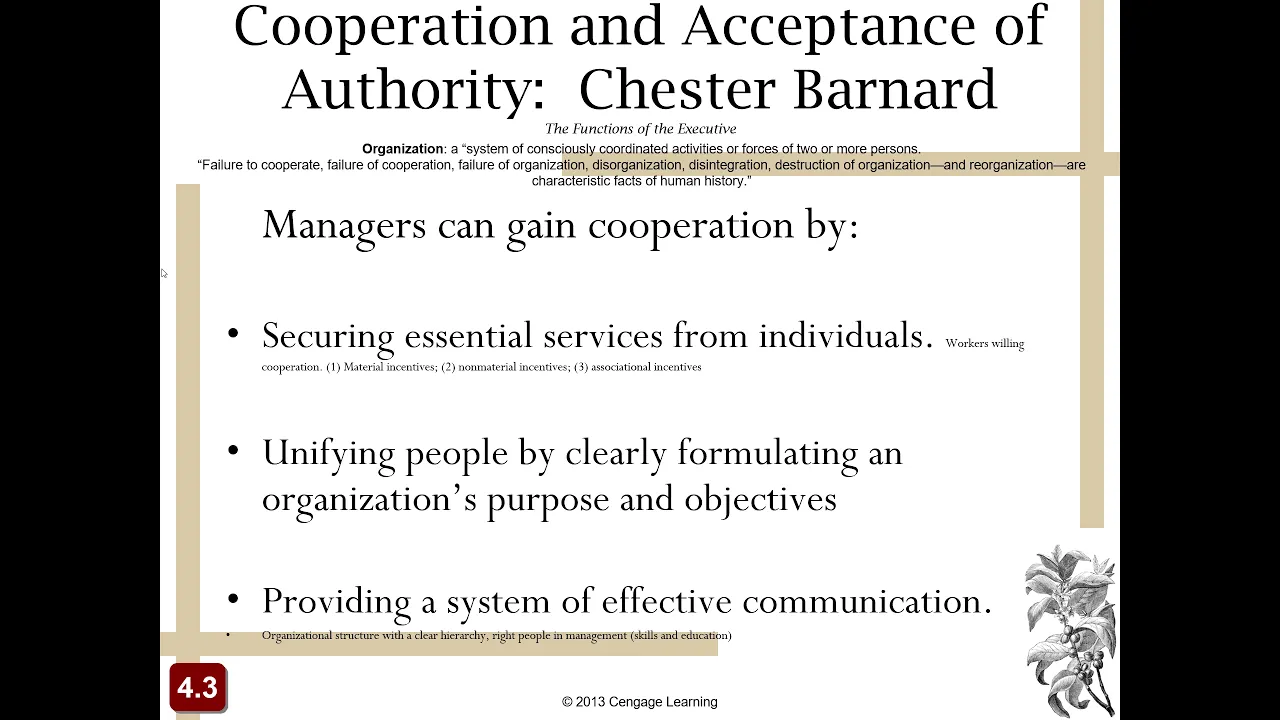
- Bernard developed a comprehensive theory on cooperation within organizations, emphasizing the importance of defining what constitutes an organization. He defined an organization as consciously coordinated activities or forces involving two or more individuals working towards a common purpose.
Importance of Cooperation in Organizations
- Cooperation, according to Barnard, is not the default state of human behavior. He believed that failure to cooperate leads to disorganization, disintegration, and ultimately destruction within organizations.
- Barnard highlighted that competent individuals play a crucial role in fostering cooperation within organizations by executing three key executive functions: ensuring essential services from individuals, formulating clear organizational purposes and objectives, and establishing effective communication systems.
Cooperation Strategies by Chester Barnard
This section delves into Chester Barnard's strategies for promoting cooperation among employees within organizations.
Strategies for Fostering Cooperation
- Managers can secure employee cooperation through material incentives like money or non-material incentives such as recognition, prestige, empowerment, improved working conditions, or personal satisfaction.
- Another approach advocated by Barnard is through associative incentives that involve engaging workers directly in critical organizational events or processes to enhance their involvement and commitment.
- Formulating clear organizational purposes and objectives is crucial for ensuring that every individual comprehends their daily tasks aligned with achieving the organization's goals. Clarity in objectives helps employees make informed decisions consistent with organizational priorities.
Significance of Clear Organizational Objectives
This part emphasizes the importance of defining precise organizational goals to drive employee alignment and foster effective cooperation.
Impact of Defined Objectives
- Clear organizational objectives enable employees at all levels to understand their roles clearly. When objectives are well-defined, individuals can prioritize tasks effectively based on organizational goals rather than personal interests.
Effective Communication and Authority in Organizations
In this section, the importance of effective communication and the concept of "zone of indifference" in organizational behavior are discussed. Additionally, the role of authority and cooperation within organizations is explored.
Establishing Effective Communication
- Chester Barnard introduced the concept of the "zone of indifference," where workers accept directives without much processing.
- Example: Workers automatically accepting management directives without questioning, leading to efficient task completion.
- Workers step out of the zone of indifference when tasks are personal or unrelated to their job roles.
Elements for Automatic Response
- Clear directives are crucial for automatic response from employees.
- Directives should align with organizational goals and be personally beneficial to employees.
- Compatibility with personal interests motivates individuals to cooperate.
- Tasks should be achievable by individuals without being overwhelming.
Authority and Cooperation in Organizations
This section delves into Chester Barnard's perspective on authority as a product of cooperation within organizations, emphasizing voluntary cooperation over imposed authority.
Fictional Superior Authority
- Managers gain authority not solely from their roles but through others' perception and voluntary cooperation.
- Authority is granted by workers based on belief rather than hierarchical positions.
Promoting Cooperation
Interesting Insights on Management Styles
In this segment, the speaker discusses the management style of Chester Barnard, emphasizing human relationships within organizations.
Chester Barnard's Management Style
- Chester Barnard's management style is highlighted as intelligent and based on human relationships within organizations.
- The speaker mentions that Barnard focused on understanding human behavior in organizational settings.