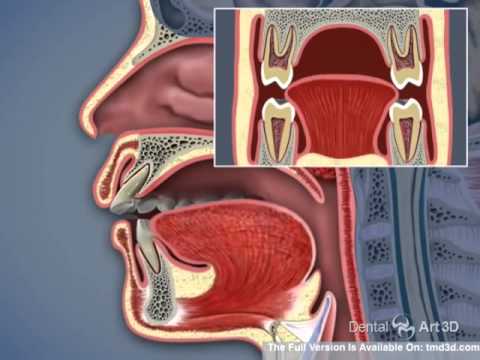
Airway and TMJ
Airway and TMJ: Understanding Breathing Mechanics
The Importance of Nasal Breathing
- The normal way to breathe is through the nose; however, allergens like pollen and cow milk can cause allergic reactions that lead to swollen tonsils and adenoids.
- Swollen tonsils and adenoids obstruct nasal breathing, leading to a shift towards mouth breathing as the primary method of air intake.
Effects of Mouth Breathing
- During mouth breathing, the lower jaw drops, and the tongue rests on the lower teeth instead of the palate, disrupting oral balance.
- This imbalance results in a deformation of the upper jaw from a U-shaped arch to a V-shaped arch due to improper pressure distribution.
Consequences on Oral Function
- Incorrect swallowing function occurs when the tongue rests against lateral teeth, hindering normal tooth eruption and causing lateral tongue thrust.
- An open mouth leads to over-eruption of incisors, resulting in deformities known as bicuspid drop-off in the lower arch.
Impact on Jaw Positioning
- Deformations in both arches create premature contacts during closure, shifting the lower jaw distally off its physiological trajectory.
- The narrowing of the upper arch pushes back the lower jaw, forcing TMJ condyle shifts that can lead to reciprocal clicking sounds during movement.
Long-term Effects on Muscles and Joints
- Incorrect positioning of the lower jaw may result in parafunctional activities such as clenching or grinding, leading to worn-down teeth over time.
- A distally shifted jaw restricts airway further; compensatory neck movements stress spinal structures causing neck pain.