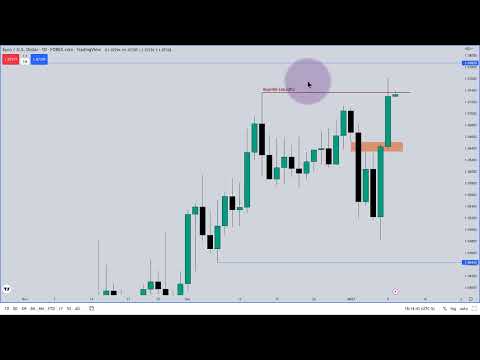
ICT Forex Review January 09, 2023

ICT Forex Review January 09, 2023

Forex Daily Chart Analysis

The speaker provides an analysis of the daily chart of the dollar index and shares some charts on Twitter. They discuss levels, liquidity, and value gaps.

Levels and Liquidity

  • The speaker discusses opening prices on the hourly chart for September 9th.
  • They mention a South Side liquidity pool and fair value gap on the daily chart.
  • On the 15-minute timeframe, they point out Buy South Dakota and South Side liquidity during a London session.
  • The New York open Killzone is discussed as a time when there was a drop in price.

Support and Resistance

  • A city outside of balance by side efficiency is mentioned.
  • The algorithm kicks in when it trades into the daily pair that you got one dollar Index.
  • The market turns at noon exactly how it's taught in core content.

Euro Dollar Daily Chart Analysis

The speaker analyzes the daily chart for Euro dollars, discussing levels, order blocks, and retracements.

Levels and Order Blocks

  • The speaker mentions bicycle here an old high back here we're looking for that as well and a Fair Aid Gap right here.
  • They discuss an order block on the hourly chart from September 8th.
  • On the 15-minute timeframe, they point out a cell solid coating pool during London open.

Retracements

  • A small little retracement is mentioned before rallying up to create a high up here.
  • The London open Killzone is discussed as a time when the South Side was taken and rallied up into 7 A.M beginning of New York open kill Zoom.
  • The speaker discusses how to look for a setup in London open and what to expect during the day.

# Understanding Price Movement

In this section, the speaker discusses how to understand price movement and use Fibonacci projections.

Using Closing Prices for Analysis

  • The speaker explains that closing prices are useful for analysis because they provide a clear picture of price movement without the interference of wicks.
  • The speaker suggests using Fibonacci projections to analyze price movement. These projections can be based on standard deviations such as 1, 1.5, 2.5, 3, and 3.5.

Homework Assignment

  • The speaker assigns homework to study how the London open Kill Zone is formed and how it continues into the New York open Kill Zone.
  • Students are instructed to measure the distance between the low and high of the day in London close and project their analysis up until the opening price in New York.

Overall, this section provides an introduction to analyzing price movement using closing prices and Fibonacci projections.

Video description

CFTC RULE 4.41 – HYPOTHETICAL OR SIMULATED PERFORMANCE RESULTS HAVE CERTAIN LIMITATIONS. UNLIKE AN ACTUAL PERFORMANCE RECORD, SIMULATED RESULTS DO NOT REPRESENT ACTUAL TRADING. ALSO, SINCE THE TRADES HAVE NOT BEEN EXECUTED, THE RESULTS MAY HAVE UNDER-OR-OVER COMPENSATED FOR THE IMPACT, IF ANY, OF CERTAIN MARKET FACTORS, SUCH AS LACK OF LIQUIDITY. SIMULATED TRADING PROGRAMS IN GENERAL ARE ALSO SUBJECT TO THE FACT THAT THEY ARE DESIGNED WITH THE BENEFIT OF HINDSIGHT. NO REPRESENTATION IS BEING MADE THAT ANY ACCOUNT WILL OR IS LIKELY TO ACHIEVE PROFIT OR LOSSES SIMILAR TO THOSE SHOWN Trading performance displayed herein is hypothetical. Hypothetical performance results have many inherent limitations, some of which are described below. No representation is being made that any account will or is likely to achieve profits or losses similar to those shown. In fact, there are frequently sharp differences between hypothetical performance results and the actual results subsequently achieved by any particular trading program. One of the limitations of hypothetical performance trading results is that they are generally prepared with the benefit of hindsight. In addition, hypothetical trading does not involve financial risk, and no hypothetical trading record can completely account for the impact of financial risk in actual trading. For example, the ability to withstand losses or to adhere to a particular trading program in spite of trading losses are material points which can also adversely affect actual trading results. There are numerous other factors related to the markets in general or to the implementation of any specific trading program which cannot be fully accounted for in the preparation of hypothetical performance results and all of which can adversely affect actual trading results. U.S. Government Required Disclaimer – Commodity Futures Trading Commission Futures and Options trading has large potential rewards, but also large potential risk. You must be aware of the risks and be willing to accept them in order to invest in the futures and options markets. Don’t trade with money you can’t afford to lose. This is neither a solicitation nor an offer to Buy/Sell futures or options. No representation is being made that any account will or is likely to achieve profits or losses similar to those discussed on this web site. The past performance of any trading system or methodology is not necessarily indicative of future results. Trade at your own risk. The information provided here is of the nature of a general comment only and neither purports nor intends to be, specific trading advice. It has been prepared without regard to any particular person’s investment objectives, financial situation and particular needs. Information should not be considered as an offer or enticement to buy, sell or trade. You should seek appropriate advice from your broker, or licensed investment advisor, before taking any action. Past performance does not guarantee future results. Simulated performance results contain inherent limitations. Unlike actual performance records the results may under or over compensate for such factors such as lack of liquidity. No representation is being made that any account will or is likely to achieve profits or losses to those shown. The risk of loss in trading can be substantial. You should therefore carefully consider whether such trading is suitable for you in light of your financial condition. If you purchase or sell Equities, Futures, Currencies or Options you may sustain a total loss of the initial margin funds and any additional funds that you deposit with your broker to establish or maintain your position. If the market moves against your position, you may be called upon by your broker to deposit a substantial amount of additional margin funds, on short notice in order to maintain your position. If you do not provide the required funds within the prescribed time, your position may be liquidated at a loss, and you may be liable for any resulting deficit in your account. Under certain market conditions, you may find it difficult or impossible to liquidate a position. This can occur, for example, when the market makes a “limit move.” The placement of contingent orders by you, such as a “stop-loss” or “stop-limit” order, will not necessarily limit your losses to the intended amounts, since market conditions may make it impossible to execute such orders.