Scott Aaronson - The TRUTH About Quantum Computing
Introduction to Quantum Computing
Acknowledgments and Introduction of Scott Ernson
- The speaker thanks the Dela Petra family for their support in hosting lectures at Stonybrook.
- Scott Ernson, a prominent figure in quantum computing and complexity theory, is introduced as the head of the Quantum Information Center at UT Austin.
- Ernson has received numerous accolades, including the Revvis Prize for outreach and election to the National Academy of Sciences.
Scott Ernson's Background and Purpose of Talk
- Ernson expresses gratitude for the introduction and shares his excitement about visiting Stonybrook for the first time.
- He mentions his blog started in 2005, which discusses various topics but became known for critiquing exaggerated claims about quantum computing applications.
The Reality of Quantum Computing Claims
Misleading Claims in Quantum Computing
- Companies often announce capabilities like using quantum computers for handwriting recognition or stock picking without fair comparisons to classical computers.
- The speaker highlights that adding "quantum" to a project attracts significant funding regardless of its feasibility or understanding by investors.
Challenges Faced by Researchers
- Ernson describes his efforts to counter misleading claims through blogging, likening it to pushing a boulder uphill with little impact on public perception.
- He notes that both skeptics and enthusiasts criticize him, indicating he occupies a unique position within the discourse on quantum computing.
Understanding Quantum Mechanics
Complexity of Explaining Quantum Concepts
- The speaker emphasizes that explaining quantum mechanics requires addressing its fundamental complexities rather than relying on oversimplified metaphors.
- Journalists frequently request concise definitions of quantum computers, which frustrates Ernson due to the depth required for accurate explanations.
Key Principles of Quantum Mechanics
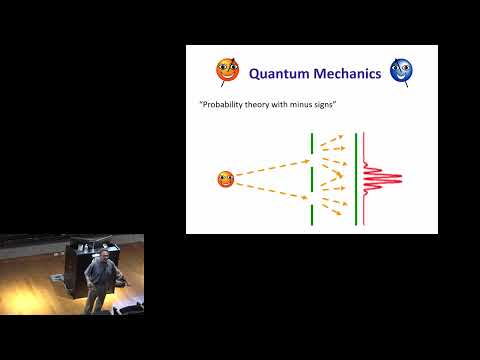
- He explains that quantum mechanics challenges traditional probability rules by introducing complex numbers called amplitudes instead of real-number probabilities.
- Amplitudes are assigned to every possible evolution path a physical system can take; measurement converts these amplitudes into observable probabilities.
Quantum Interference and Measurement
Two-Slit Experiment Illustration
- The two-slit experiment demonstrates how particles exhibit interference patterns based on amplitude calculations rather than straightforward probability addition.
- This phenomenon illustrates how certain paths can cancel each other out, leading to unexpected results in measurements.
Implications for Understanding Quantum Systems
- All peculiarities attributed to quantum behavior stem from this alteration in probability rules; understanding them requires recognizing amplitudes as vectors in complex number space.
Quantum Bits (Qubits)
Definition and Functionality
- A qubit represents a basic unit of quantum information capable of existing simultaneously in multiple states (superposition).
- Upon measurement, qubits collapse into one state based on their amplitude probabilities; repeated measurements yield consistent results if no changes occur between them.
Evolution Over Time
- Qubit states evolve according to linear equations governed by Schrödinger's equation while maintaining total probability integrity across all potential outcomes.
Entanglement and Multi-Qubit Systems
Entangled Qubits
- When dealing with multiple qubits, one must consider all configurations collectively rather than individually assigning amplitudes.
- Entanglement occurs when two qubits are correlated such that measuring one instantly informs about the other's state despite distance.
Limitations Imposed by Relativity
- Despite entanglement suggesting faster-than-light communication possibilities, actual message transmission remains impossible due to measurement constraints dictated by relativity principles.
Potential Applications and Future Directions
Current State of Research
- While early theorists recognized potential advantages from building quantum computers primarily for simulating other quantum systems, practical applications remain limited.
Challenges Ahead
- Many popular narratives inaccurately portray quantum computers as devices capable of parallel processing all solutions simultaneously; true utility lies in exploiting amplitude interference patterns effectively.
Quantum Computing: Applications and Implications
The Nature of Quantum Computing
- Quantum computing is likened to a unique tool provided by nature, prompting exploration of its potential beyond simulating quantum mechanics.
Main Applications of Quantum Computing
- The applications can be categorized into three main areas, with significant implications for number theory and cryptography stemming from Shor's algorithm discovered in 1994.
Shor's Algorithm and Cryptography
- Shor's algorithm efficiently factors large composite numbers by exploiting periodic functions, which classical methods cannot do quickly.
- This has dire implications for current encryption methods that rely on the difficulty of factoring, threatening the security of online transactions and cryptocurrencies like Bitcoin.
Economic Impact and Cybersecurity Concerns
- If scalable quantum computers are developed without transitioning to post-quantum cryptography, existing systems could be compromised, leading to significant financial losses.
- Approximately $100 billion worth of Bitcoin is at risk due to reliance on vulnerable elliptic curve cryptography.
Potential Benefits for Humanity
- Beyond threats, quantum computing may offer positive advancements in simulating quantum physics and chemistry for drug design, material science, and energy solutions.
General-Purpose Quantum Simulators
- A general-purpose programmable quantum simulator could revolutionize experimentation by allowing simulations instead of physical trials.
AI and Optimization Challenges
- Research continues into how quantum computers might assist with AI training and optimization problems; however, results remain mixed regarding practical advantages over classical algorithms.
Grover's Algorithm Overview
- Grover’s algorithm provides a speedup for search problems but offers only a modest advantage compared to Shor’s more dramatic improvements in factoring efficiency.
Theoretical Implications: P vs NP Problem
- The discussion touches on the complexity classes P (problems solvable in polynomial time), NP (problems verifiable in polynomial time), and NP-complete problems that are particularly challenging.
BQP Class Definition
- BQP (Bounded-error Quantum Polynomial Time) includes all problems solvable by a quantum computer within polynomial time. It encompasses classical P but raises questions about whether it contains problems outside classical capabilities.
Reality Check on Quantum Speedups
- Despite excitement around potential speedups from quantum algorithms like HHL for linear algebra tasks, practical applications remain elusive due to challenges in input preparation and output measurement.
Case Study: Recommendation Systems
- An attempt to prove an exponential speedup for recommendation systems led to findings that suggested similar performance could be achieved classically—highlighting the need for rigorous comparisons between classical heuristics and proposed quantum advantages.
Demonstrating Quantum Supremacy
- Efforts began around 2009 to demonstrate tangible evidence of quantum speedup through simpler systems like Boson sampling rather than full-scale programmable computers.
Google's Claim of Quantum Supremacy
- Google announced achieving a task using their superconducting qubit chip that would take an estimated 10,000 years on a classical supercomputer. This claim sparked debate over the actual feasibility compared to classical approaches.
Quantum Supremacy and Its Implications
Overview of Quantum Supremacy Experiment
- In 2024, a quantum supremacy experiment was repeated using a 103-qubit chip, revealing that simulating this chip would require approximately 10^25 years on the most powerful supercomputers.
- A significant challenge remains: verifying the correctness of results produced by the quantum machine also takes about 10^25 years.
Key Requirements for Quantum Computing
- Three essential properties are needed in current quantum supremacy experiments:
- Demonstrating superiority over classical computers to counter skeptics.
- Implementing solutions with existing technology due to impatience for results.
- Ensuring verifiable problems where answers can be checked either classically or through another quantum computer.
Achievements and Challenges
- Previous attempts achieved two out of three requirements but struggled with verification beyond around 50 qubits.
- Various startups offer near-term solutions without proving superiority over classical computing, while Shor's algorithm exemplifies a problem that allows verification.
Recent Developments in Quantum Computing
- New proposals from companies like Quantinuum and Google aim to meet all three requirements simultaneously, including methods involving out-of-time-order correlators (OTAs).
- Simulations related to complex models like the Fermi-Hubbard model are beginning to yield numbers previously uncalculable classically.
Innovative Approaches and Applications
- The concept of peaked quantum circuits was introduced, which generates seemingly random outputs concealing specific signals detectable only by quantum computers.
- Blue Cubit has implemented these peaked circuits successfully on their machines, although some have been compromised by classical methods.
Randomness Generation via Quantum Supremacy
- Quantum supremacy experiments may provide a method for generating provably random bits necessary for applications like cryptocurrencies.
- This involves sending challenges to the quantum computer and checking outputs against expected distributions to ensure randomness.
Experimental Validation of Quantum Properties
- A collaboration with Quantinuum demonstrated computations involving 12 qubits that proved an exponential separation between qubits and classical bits without relying on conjectures.
Future Directions in Quantum Computing
- Recent research suggests potential space savings in machine learning applications through quantum information supremacy rather than time savings alone.
Challenges in Building Scalable Quantum Computers
Technical Hurdles
- Building scalable quantum computers faces challenges primarily due to unwanted interactions with their environment; protection mechanisms are crucial.
Importance of Error Correction
- The discovery of quantum error correction in the mid-'90s is pivotal as it allows encoding logical qubits using multiple physical qubits, enabling recovery from errors.
Recent Milestones and Outlook
Progress Towards Practical Applications
- Achievements include sampling-based quantum supremacy and emerging verifiable advantages; future goals involve validating simulations relevant to scientific inquiries.
Long-Term Vision
- The ultimate aim is achieving commercially viable scalable fault-tolerant devices capable of addressing real-world problems while threatening public key cryptography.
Discussion on Fault Tolerance
Classical vs. Quantum Fault Tolerance
- Classical computers exhibit high fault tolerance; however, building reliable systems from unreliable components remains a concern similar to those faced in early computing history.
Understanding Non-Abelian Anyons
Conceptual Framework
- Non-Abelian anyons present unique statistics when particles are swapped; they could theoretically enable universal quantum computation through braiding techniques.
Industry Perspectives on Investment in Quantum Technologies
Corporate Interests
- CEOs invest billions into quantum technologies driven by fear of missing out on groundbreaking advancements rather than fully understanding every detail behind them.