Chapter 12 Cell Cycle Part 1
Cell Cycle Overview
In this section, the speaker introduces the cell cycle and discusses the process of cell division, highlighting key events such as chromosome changes and the formation of daughter cells.
Chromosome Changes during Cell Division
- The initial stages show chromosomes in a spread-out form in the nucleus.
- As cell division progresses, chromosomes condense and align on a spindle made of microtubules.
- Chromosomes must line up perfectly to ensure each daughter cell receives an identical set for genetic continuity.
Mitosis and Chromosome Separation
- During mitosis, chromosomes are separated by the mitotic spindle apparatus.
- Post-mitosis, chromosomes no longer appear discrete but spread out like spaghetti for accessibility to genetic information.
Importance of Cell Division
- Daughter cells are genetically identical to each other and the parent cell.
- Cell division serves various purposes like organism development, renewal, repair after injury, and immune response.
Significance of Cell Division
This part delves into why cells undergo division from both unicellular and multicellular perspectives, emphasizing its role in organism development, renewal, repair processes, and immune responses.
Role in Organism Development
- Cell division is crucial for creating a multicellular organism from a single fertilized egg through extensive cellular duplication.
Cellular Renewal and Repair
- Cells constantly undergo division to replace damaged or aged cells in tissues like skin, gut lining, and immune system components.
Immune Response Mechanisms
Cell Division and Signaling
The discussion delves into the importance of cell division control, the role of signaling in regulating division, and how cells communicate with each other to maintain a harmonious multicellular environment.
Cell Division Control and Signaling
- Cells must tightly regulate division control to prevent diseases like cancer caused by loss of control.
- Cells receive signals from extracellular matrix and other cells (mitogens) to determine if it's suitable to divide.
- Mitosis involves DNA condensation, partitioning, and decondensation during cell division.
- Mitogen signals from other cells prompt a cell to divide if acting appropriately.
- Mitogens stimulate mitosis while growth factors increase cell mass for proper cell cycle progression.
Cell Communication and Social Controls
Cells in multicellular organisms coordinate behavior through complex signaling mechanisms to ensure social responsibility within the organism.
Coordination Through Signaling
- Mitogens and growth factors work together to stimulate weight gain for cell division.
- Disruption in cell communication can be detrimental to the overall cooperative nature of multicellular organisms.
Social Controls in Cell Behavior
- Cells send, receive, and interpret signals to act in a socially responsible manner within the organism.
- Analogous examples like travel rules on a plane illustrate how cells follow social controls for coordinated behavior.
Programmed Cell Death: Apoptosis
Programmed cell death or apoptosis is crucial for maintaining tissue homeostasis by eliminating unwanted or damaged cells without triggering an inflammatory response.
Apoptosis Process
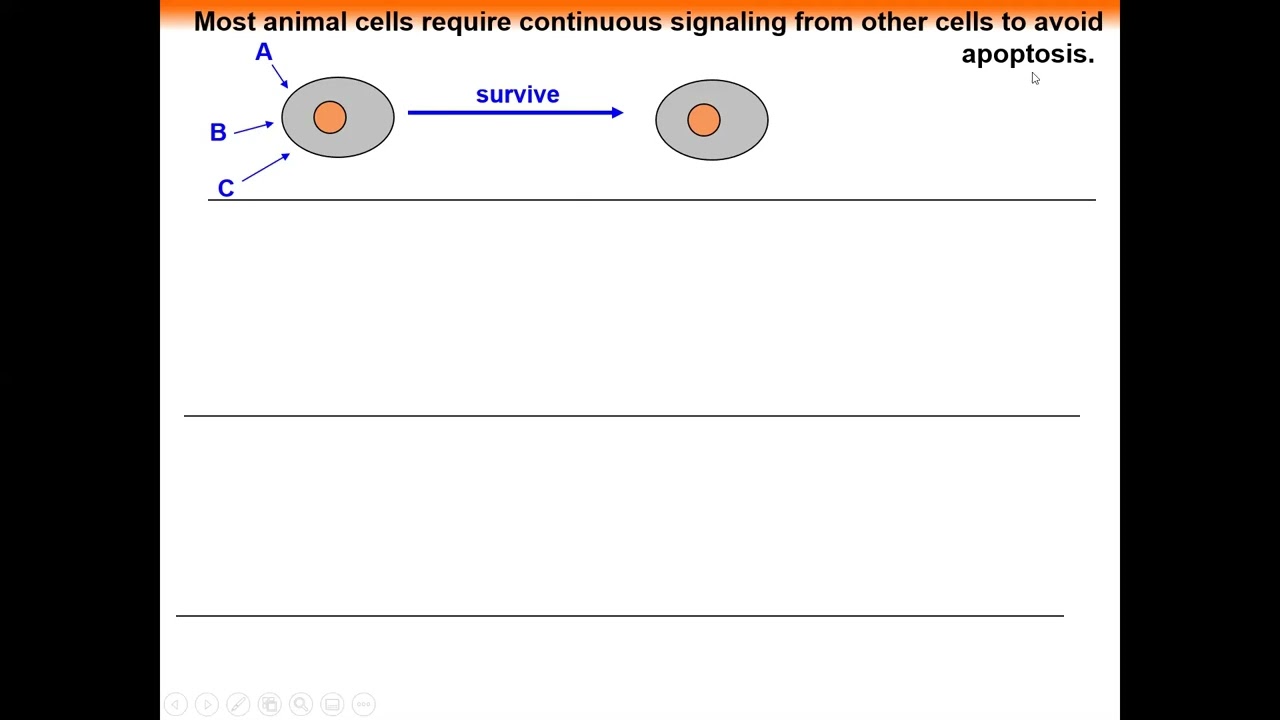
- Most animal cells require continuous signaling to avoid programmed cell death (apoptosis).
Cell Signaling and Behavior
In this section, the discussion revolves around cell signaling, its interpretation by cells, and how it influences cell behavior.
Cell Signaling Interpretation
- Cells receive signaling molecules for survival. The interpretation of these molecules serves as a signal for the cell to survive or rest.
- Combination of specific signaling molecules can lead to cytokines, instructing the cell on how to behave and divide.
Cell Differentiation
- Varying sets of signaling molecules prompt cells to differentiate rather than divide. Differentiation involves gene expression leading to distinct proteins determining cell function.
- Differentiated cells express unique genes, produce specific proteins, and serve different functions from their predecessors due to signaling cues.
Importance of Signaling in Cells
- Continuous signaling is crucial for animal cells; lack of signals triggers cellular responses like self-destruction for maintenance purposes when no external signals are received.
- Absence of signaling leads cells to undergo controlled self-destruction processes without causing inflammation or disturbance, akin to discreetly disposing of waste.
Cell Division: Mitosis and Meiosis
This segment delves into the significance of cell division in maintaining genetic fidelity through mitosis while highlighting meiosis as a specialized form promoting genetic diversity.
Mitosis and Genetic Reproduction
- Healthy cells respond appropriately to signals directing their behavior, ensuring controlled division; uncontrolled division may lead to conditions like cancer requiring multiple mutations.
- Cell division primarily results in two daughter cells with identical genetic information through DNA duplication followed by partitioning during mitosis.
Meiosis for Genetic Diversity
- Meiosis is a specialized form of cell division aiming at producing genetically diverse cells by creating variations among daughter cells unlike parent cells, enhancing genetic diversity within organisms.
Cell Division Mechanisms
This part elucidates the essential components involved in eukaryotic cell division encompassing mitosis for nuclear material separation and cytokinesis for cytoplasmic division.
Components of Eukaryotic Cell Division
- Eukaryotic cell divisions entail two key processes: mitosis involving nuclear material separation and cytokinesis focusing on cytoplasmic division ensuring each daughter cell receives an identical genome copy from the parent cell.
Mitosis vs Cytokinesis
- Successful completion of both mitosis (nuclear) and cytokinesis (cytoplasmic) ensures faithful reproduction of DNA content resulting in two identical daughter cells inheriting precise genomic information from the parent cell facilitating accurate cellular replication.
DNA Structure and Chromosomes
In this section, the speaker discusses DNA structure, chromosomes, sister chromatids, centromeres, histone proteins, chromatin formation, chromosome numbers in different species, karyotypes, and the process of chromosomal duplication.
DNA Molecules and Chromosomes
- The speaker introduces eukaryotic chromosomes as condensed structures containing DNA molecules.
- Sister chromatids are highlighted as two identical structures attached at the centromeric region.
- The centromere is explained as a crucial region for attaching chromosomes to the mitotic spindle during cell division.
Histone Proteins and Chromatin Formation
- Histone proteins are described as positively charged proteins that bind to DNA to form chromatin.
- Chromatin is defined as a complex of DNA wrapped around histone proteins to compactly fit within cell nuclei.
Chromosome Numbers and Karyotypes
- Different species have characteristic chromosome numbers in their somatic cells (e.g., humans have 46 chromosomes).
- The number of chromosomes in an organism is not indicative of intelligence based on examples like fruit flies with 8 chromosomes and guinea pigs with 64 chromosomes.
Karyotype Analysis
- A human karyotype is presented as a visual representation of chromosome pairs in a cell nucleus.
- Chromosomes are arranged based on size and designated numbers for gene location identification.
Chromosomal Duplication Process
- The speaker explains how chromosomes double before cell division to ensure each daughter cell receives a complete set of DNA.
Cycle of Chromosomal Duplication
The process of chromosomal duplication involves the creation of identical sister chromatids through faithful replication.
Chromosomal Duplication Process
- Sister chromatids are formed, being identical due to accurate duplication.
- Cohesins proteins tightly hold the double strands of DNA together along their length.