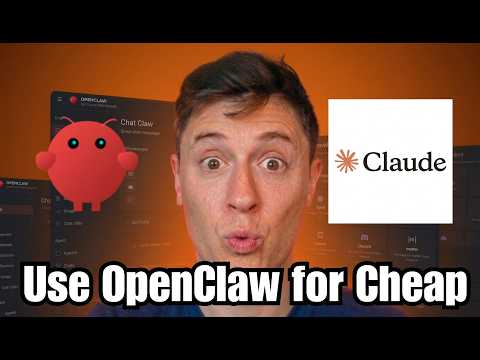
Anthropic just blocked OpenClaw. Here’s what you need to do immediately
Open Claw Banned: A New System for Cost-Effective Usage
Introduction to the Situation
- Anthropic has banned Open Claw from all subscriptions, affecting users who relied on it.
- Users can no longer purchase $200 or $20 subscriptions; API usage is now mandatory.
- The API model incurs costs per use, potentially leading to high daily expenses for frequent users.
Cost-Saving Strategy with Opus
- A new system allows continued use of Opus and clawed models without excessive spending.
- Utilizing a strong orchestrator like Claude Opus 46 means cheaper task executors can be employed effectively.
- This approach maintains quality output while significantly reducing costs by using less expensive models for tasks.
Importance of Model Selection
- Switching to alternatives like ChatGPT or other models may not yield the same performance as Opus.
- The speaker emphasizes loyalty only to the best-performing model, which currently is Opus for Open Claw.
Setup Recommendations
For Average Hardware Users
- The video will cover setups suitable for average hardware that cannot run local models efficiently.
Orchestration and Task Management
- Continue using Opus 46 as the orchestrator while paying per API usage; it excels in task validation and completion tracking.
Task Categorization and Model Utilization
Coding Tasks
- For coding tasks, ChatGPT 54 is recommended due to its superior capabilities compared to Opus in this area.
- Subscribing to ChatGPT offers more value with increased usage allowances compared to other options.
General Tasks (Research, Writing)
- Further details on handling general tasks such as research and writing are expected but not yet provided in this segment.
Choosing the Right AI Model for Your Setup
Recommendations for Pro Subscription Users
- For users on the $250/month Pro subscription of ChatGPT, it is recommended to use ChatGPT for most tasks due to its capabilities.
- However, ChatGPT 54 struggles with task completion; thus, using Opus as an orchestrator can enhance performance by ensuring tasks are completed effectively.
Alternatives for Budget Users
- If you are on a $20 subscription, consider using GLM 5.1 as a cost-effective alternative that performs well.
- Google subscriptions can also be utilized for various services if preferred over Chinese models.
Importance of Hardware in AI Performance
- Good hardware is essential; even if current hardware isn't top-tier, aiming for high-performance setups like Mac Studios or DJX Sparks is advisable.
- For orchestration tasks, Opus 46 is highlighted as the best option available.
Local Models and Their Benefits
- Using local models like Quen 35 on powerful machines allows unlimited usage and effective coding capabilities.
- Gemma 4 is suggested for web scraping and data collection tasks when run locally on robust hardware such as DJX Spark or Mac Studio.
Community Engagement and Content Creation
- The speaker expresses interest in creating more content about local models and their setup based on audience demand.
- A live boot camp will be held to assist users in setting up OpenClaw with different models, encouraging community participation.
Setting Up OpenClaw with Different Models
Initial Setup Steps
- To set up OpenClaw with Opus 46 API, begin by entering your API keys during onboarding.
Entering API Keys
- Users should locate their Anthropic API key through the Anthropic API console after signing up and entering payment information.
Cost Management Tips
- Purchasing discounted bundles from Anthropic can save costs; larger token purchases yield better discounts.
How to Maximize OpenClaw's Efficiency
Utilizing Discounted Bundles
- The speaker suggests purchasing discounted bundles through the Anthropic dashboard to optimize usage, emphasizing that they are not sponsored by Anthropic and do not support recent changes made by them.
Connecting Chad GBT Subscription
- The process of integrating the Chad GBT subscription with OpenClaw is introduced, allowing users to leverage their subscription for coding tasks.
- A specific prompt is provided: "I want to use my Chad GBT subscription for all coding tasks," which facilitates linking the subscription with OpenClaw.
Task Execution and Reliability
- Once linked, OpenClaw will create rules in its agent file to utilize Chad GBT for coding tasks instead of using anthropic tokens.
- Claude Opus is highlighted as a reliable model that checks the work done by Chad GBT, ensuring task completion while saving costs.
Setting Up Additional Models
- Users can connect other models (e.g., GLM, Quen) using similar prompts, enabling diverse functionalities like web searching or writing within OpenClaw.
Cost Analysis and Value Proposition
- The speaker explains how utilizing cheaper models under Opus’s decision-making can yield effective results without compromising quality.
- Despite potential price increases compared to previous subscriptions, spending on AI tools is framed as a significant value compared to traditional employee costs ($2,400/year vs. $100,000/year).
Performance Comparison and Future Considerations
- The speaker expresses dissatisfaction with Anthropic's pricing changes but acknowledges the necessity of using Opus for optimal performance at present.
- They remain open to switching models if better options arise in the future (e.g., Chad GBT 5.5), asserting loyalty only to superior performance.