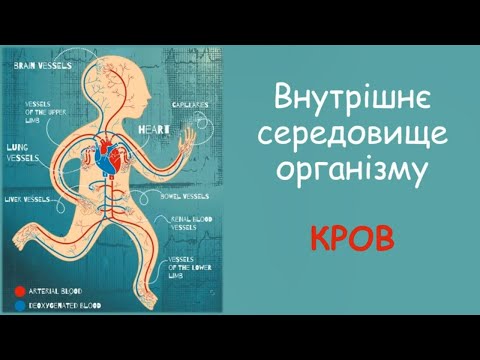
Внутрішнє середовище організму. Кров. Склад крові
Introduction to Blood and Circulation
Overview of the Internal Environment of the Body
- The lesson begins with a focus on blood and circulation, emphasizing that the human body is an open system where cells are formed from blood through plasma filtration via capillary walls.
- Nutrient exchange and waste removal occur through tissue fluid, which comprises about 90% of the interstitial fluid returning to the bloodstream; excess accumulation can lead to swelling.
Lymphatic System Functions
- Lymph, a clear fluid derived from tissue fluid, plays crucial roles in transporting water, proteins back to blood, absorbing fats and fat-soluble vitamins from intestines, and combating microorganisms.
- Movement of lymph occurs upward towards the thoracic duct due to muscle contractions and valves preventing backflow; lymph nodes along vessels serve immune functions.
Composition and Functions of Blood
Blood as Connective Tissue
- Blood consists of liquid connective tissue containing intercellular substances and formed elements (cells), performing vital functions such as nutrient distribution and waste removal.
- Oxygen delivery occurs via blood circulation through capillaries in lungs where carbon dioxide is released; hormones secreted by endocrine glands travel through blood affecting organ function.
Temperature Regulation
- Blood helps maintain body temperature by transporting heat generated by muscles and liver; total blood volume constitutes 7-8% of body mass, varying between children and adults.
Components of Blood
Plasma Composition
- When allowed to settle or centrifuged, blood separates into layers: plasma (about 50%), white blood cells (4%), red blood cells (approximately 41%).
- Key organs for blood cell formation include red bone marrow, spleen, thymus gland, tonsils, appendix, and lymph nodes.
Plasma Proteins
- Plasma contains approximately 92% water; major proteins include albumins (transporting hormones/medications), globulins (carrying glucose/iron), antibodies for defense (gamma globulin), and fibrinogen for clotting.
Osmotic Pressure in Plasma
Importance of Osmotic Balance
- Inorganic salts constitute about 0.99%, essential for osmotic pressure regulation critical for cellular function; normal pH level is around 7.36.
Effects on Red Blood Cells
- Erythrocytes placed in isotonic solutions remain unchanged; exposure to hypertonic solutions causes dehydration while hypotonic solutions lead to swelling or hemolysis due to water influx.
Characteristics of Erythrocytes
Structure and Functionality
- Erythrocytes have a biconcave shape with up to 5 million per milliliter; they mature in red bone marrow losing their nuclei as they fill with hemoglobin—essential for oxygen transport.
Hemoglobin Dynamics
- Hemoglobin binds oxygen forming oxyhemoglobin—a bright red compound easily releasing oxygen. Low nutrient levels can reduce hemoglobin leading to anemia.
Understanding Carbon Monoxide and Hemoglobin
The Dangers of Carboxyhemoglobin
- Carboxyhemoglobin is a stable compound formed when carbon monoxide binds to hemoglobin, contrasting with the more transient oxyhemoglobin.
- High levels of carbon monoxide can be life-threatening due to its poor dissociation from hemoglobin, especially in oxygen-rich environments.
Erythrocytes and Their Lifespan
- Erythrocytes (red blood cells) have an average lifespan of 120 days, after which they are destroyed in the liver and spleen.
- The sedimentation rate of erythrocytes (ESR), typically between 1 to 10 mm, can increase significantly during infections or inflammation.
Leukocytes: The Body's Defense Mechanism
Types and Functions of Leukocytes
- Leukocytes (white blood cells), numbering between 6,000 to 8,000 per millimeter of blood, exhibit amoeboid movement allowing them to traverse capillary walls.
- They are categorized into granulocytes (with granules in their cytoplasm) and agranulocytes (without granules). Neutrophils make up the majority at 50-70% and are crucial for pathogen defense.
Neutrophils and Inflammation Response
- Neutrophils circulate for about 8-12 hours before migrating to sites of infection where they release enzymes that contribute to inflammation.
Other Granulocyte Types
- Eosinophils account for 2-4% of leukocytes; they play roles in allergic reactions and combat helminths.
- Basophils are large leukocytes involved in rapid allergic responses like anaphylactic shock; they contain heparin which reduces blood clotting.
Monocytes and Lymphocytes: Key Players in Immunity
Monocyte Functionality
- Monocytes are the largest type of leukocyte, active phagocytic cells that transform into macrophages after circulating for four days. They help clear debris from inflammation sites.
Lymphocyte Roles
- Lymphocytes are essential for both humoral immunity (antibody production) and cellular immunity by interacting with infected host cells. They constitute about 40% of all leukocytes in adults.
Thrombocytes: Blood Clotting Agents
Characteristics of Thrombocytes
- Thrombocytes (platelets), the smallest blood cells, play a critical role in coagulation. Their count ranges from 250,000 to 400,000 per millimeter.
- Formed from megakaryocyte cytoplasmic fragments, thrombocytes lack nuclei and survive approximately 10–12 days. Proper clotting requires various proteins, vitamins, and minerals.