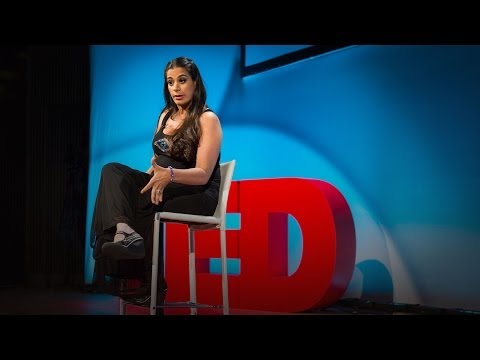
I got 99 problems... palsy is just one | Maysoon Zayid
Introduction and Personal Story
Maysoon Zayid introduces herself and shares her personal story of being born with cerebral palsy due to a difficult delivery. She emphasizes that CP is not genetic or a birth defect, but rather an accident that happened to her on her birth day.
- Maysoon Zayid introduces herself as a comedian with cerebral palsy.
- She shares the story of her difficult birth and how it led to her having cerebral palsy.
- Maysoon clarifies that CP is not genetic or a birth defect, but rather an accident that can happen to anyone.
Living with Cerebral Palsy
Maysoon talks about living with cerebral palsy and the challenges she faces. She humorously describes how she shakes all the time due to CP and compares herself to Shakira meets Muhammad Ali. She also addresses misconceptions about CP.
- Maysoon humorously demonstrates how she shakes all the time due to cerebral palsy.
- She compares herself to Shakira meets Muhammad Ali.
- Maysoon clarifies misconceptions about CP, stating that it's not genetic, a birth defect, or caused by curses or parental relationships.
Rejecting Inspiration
Maysoon rejects being seen as inspirational solely because of her disability. She encourages the audience not to feel sorry for her and highlights the common desire people have had at some point in their lives to experience disability.
- Maysoon asserts that she is not inspirational.
- She asks the audience not to feel sorry for her because everyone has dreamt of being disabled at some point in their lives.
The Parking Spot Analogy
Maysoon uses a humorous analogy involving parking spots for disabled individuals to highlight societal attitudes towards disability. She playfully suggests that people often wish they could have a little bit of disability to make their lives easier.
- Maysoon describes the frustration of seeing empty handicapped parking spots while searching for regular parking.
- She humorously suggests that people wish they could have a little bit of disability to make their lives easier.
Overcoming Challenges and Stereotypes
Maysoon talks about her upbringing and how her parents instilled in her the belief that she can do anything. She shares anecdotes about learning to walk, pursuing dancing, and challenging stereotypes.
- Maysoon discusses how her parents encouraged her to overcome challenges and believe in herself.
- She shares stories of learning to walk with her father's help and developing a strong sense of determination.
- Maysoon talks about pursuing dancing as a way to overcome physical limitations and challenge stereotypes associated with disability.
Navigating Identity
Maysoon reflects on growing up as one of the few Arabs in her town and addresses misconceptions about Muslims. She humorously mentions politicians using anti-Muslim rhetoric as campaign slogans.
- Maysoon talks about being one of the few Arabs in her town and jokes that nobody even noticed they weren't Italian.
- She mentions politicians using "I hate Muslims" as campaign slogans, highlighting the prejudice faced by Muslims.
- Maysoon humorously addresses concerns about fasting during Ramadan, emphasizing that she has enough fat to live off for three months.
Pursuing Dreams
Maysoon shares her passion for performing arts, particularly tap-dancing. She discusses how pursuing dance helped improve her physical abilities and allowed her to stand on stage despite having cerebral palsy.
- Maysoon reveals that she tap-danced on Broadway, which was made possible through dance lessons she took as therapy.
- She explains how learning to dance in heels improved her ability to walk.
- Maysoon humorously mentions spending summers in Palestine instead of the Jersey Shore to avoid growing up to be like Madonna.
The Power of Yoga
Maysoon discusses how practicing yoga has had a positive impact on her physical abilities. She humorously contrasts her previous career as a stand-up comedian who couldn't stand up with her current ability to do yoga poses.
- Maysoon shares that practicing yoga has improved her physical abilities.
- She humorously contrasts her previous career as a stand-up comedian who couldn't stand up with her current ability to do yoga poses.
Challenges in Pursuing Acting
Maysoon talks about facing challenges and stereotypes in pursuing acting, particularly when it comes to casting disabled characters. She shares an experience where she was not cast for a role she felt she was born to play because they didn't think she could perform the stunts.
- Maysoon discusses the history of able-bodied actors being cast in disabled roles in Hollywood.
- She shares an experience where she was not cast for a role about a girl with cerebral palsy, despite having CP herself.
- Maysoon questions the reasoning behind not casting her, pointing out that if she couldn't perform the stunts, neither could the character.
Conclusion
Maysoon Zayid's TED Talk highlights her personal journey living with cerebral palsy and challenges common misconceptions about disability. Through humor and storytelling, she encourages others to embrace diversity and reject stereotypes associated with disability.
New Section
In this section, the speaker discusses her realization that casting directors often only hire "perfect" actors and comedians. However, she also mentions exceptions to this rule.
Casting Directors' Preferences
- The speaker observes that casting directors typically do not hire actors who are fluffy, ethnic, or disabled.
- They tend to prefer individuals who fit a certain standard of perfection.
Exceptions to the Rule
- The speaker points out that there have been exceptions to this trend.
- She grew up watching comedians like Whoopi Goldberg, Roseanne Barr, and Ellen who were able to break through these barriers.
- Inspired by them, she pursued a career in comedy.
New Section
In this section, the speaker shares anecdotes about her experiences as a comedian performing in various venues and countries.
Driving Famous Comics
- The speaker recalls her first gig as a comic where she drove famous comics from New York City to shows in New Jersey.
- She vividly remembers the reaction of the first comic she ever drove when he realized he was being driven by someone with cerebral palsy.
Performing in Different Settings
- The speaker mentions performing in clubs across America as well as uncensored and uncovered shows in Arabic in the Middle East.
- She humorously highlights how people in the Arab world find women funny despite the stereotype that women aren't funny.
New Section
In this section, the speaker talks about starting the New York Arab-American Comedy Festival with Dean Obeidallah. Their goal was to change negative stereotypes about Arab-Americans and emphasize that South Asian and Arab identities are not synonymous.
Mainstreaming Arabs vs. Conquering Disability Stigma
- The speaker reflects on how mainstreaming Arabs through comedy was easier than challenging the stigma against disability.
- She acknowledges the difficulty in changing perceptions about disabilities in society and entertainment.
New Section
In this section, the speaker shares a memorable experience on the cable news show "Countdown with Keith Olbermann" and how it led to her becoming a full-time contributor.
Unexpected Chair Situation
- The speaker recounts being invited as a guest on "Countdown with Keith Olbermann" and being seated on a spinning, rolling chair.
- Despite requesting another chair, she was told they were already live on air.
- She had to hold onto the anchor's desk during the segment to avoid rolling off-screen.
Surprising Outcome
- The speaker initially believed she had blown her chance and would never be invited back.
- However, not only did Mr. Olbermann invite her back, but he also made her a full-time contributor and ensured her chair was taped down for stability.
New Section
In this section, the speaker discusses the negative comments she received online regarding her disability and highlights the need for more positive representations of disability in media.
Online Cruelty
- The speaker shares how people on the internet made derogatory comments about her disability when watching clips of her performances.
- Examples include calling her names like "retarded" or making offensive remarks about her appearance.
Adding Disability to Credits
- One commenter suggested that she should add her disability to her credits as a screenwriter and comedian.
Visual Nature of Disability
- The speaker emphasizes that disability is as visually apparent as race.
- She argues that if wheelchair users cannot play certain roles, then able-bodied actors should not portray characters with disabilities either.
New Section
In this section, the speaker highlights that people with disabilities are the largest minority in the world but remain underrepresented in entertainment.
Underrepresentation of Disabilities
- The speaker states that people with disabilities constitute the largest minority globally.
- However, they are significantly underrepresented in the media and entertainment industry.
New Section
In this section, the speaker reflects on defying doctors' expectations by walking despite their initial prognosis. She also discusses the impact of social media on her journey.
Defying Expectations
- The speaker mentions how doctors initially believed she would never walk, yet she stands before the audience as proof of their incorrect prognosis.
Impact of Social Media
- The speaker speculates that if she had grown up with social media, her experiences might have been different.
- She expresses hope for creating more positive images of disability in both media and everyday life to combat negativity online.
New Section
In this section, the speaker shares various accomplishments and highlights significant moments throughout her career.
Spectacular Moments
- The speaker recounts walking the red carpet alongside soap diva Susan Lucci and iconic figure Loreen Arbus.
- She mentions acting in a movie with Adam Sandler and working with her idol, Dave Matthews.
- Additionally, she toured as a headliner on "Arabs Gone Wild" and represented New Jersey at the 2008 DNC.
Maysoon's Kids Charity
- The speaker founded Maysoon's Kids, a charity aimed at providing Palestinian refugee children with opportunities similar to those given to her by her parents.
New Section
In this section, the speaker recalls a memorable moment when she performed for Muhammad Ali, who shared similarities with her due to both having Parkinson's disease.
Performing for Muhammad Ali
- The speaker describes performing for Muhammad Ali as one of the most significant moments in her career.
- She highlights their shared experience of having Parkinson's disease, which created a unique connection between them.
Turn any video into a summary like this
YouTube links, meetings, lectures. With transcripts, search, and chat.