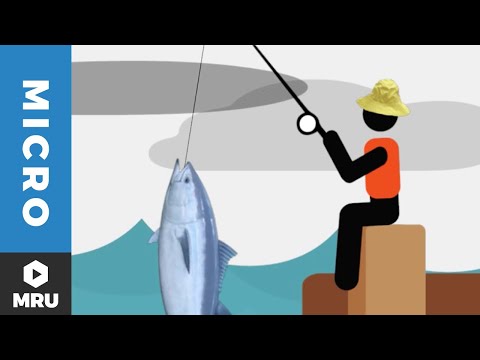
The Tragedy of the Commons
Introduction to Common Resources
In this section, Prof. Alex Tabarrok discusses common resources and the tragedy of the commons. He explores examples such as tuna in the ocean and explains why they are considered common resources.
Tragedy of the Commons
- Common resources are nonexcludable but rival, meaning they get depleted as more people use them.
- Tuna in the ocean is an example of a common resource.
- Tuna are nonexcludable because there are no property rights to fish in the ocean.
- Nonexcludable but rival resources often lead to a tragedy of the commons, where the resource gets overused and undermaintained.
- The stock of tuna has decreased by 75% since 1960, leading to concerns about their endangerment.
- Unlike chicken farming, tuna fishermen lack incentives to conserve because they don't own the stock of fish.
- The lack of incentives for conservation leads to the collapse of tuna stocks, resulting in a tragedy.
Examples and Solutions
- The tragedy of the commons can be observed in everyday situations like shared kitchens with roommates or larger environmental issues like deforestation and hunting endangered species.
- Three approaches to address the tragedy of the commons are command and control regulations, cultural norms, and creating property rights.
- Command and control regulations are often inefficient and ineffective in preventing the tragedy.
- Cultural norms can evolve to discourage overuse of common resources, but they require stable and small groups.
- Elinor Ostrom's research shows that sophisticated procedures for managing common resources can develop under certain conditions.
Conclusion
Common resources present challenges due to their nonexcludable but rival nature. The tragedy of the commons occurs when these resources are overused and undermaintained. Various solutions, such as command and control regulations, cultural norms, and creating property rights, have been explored to address this issue. However, finding effective solutions requires understanding the incentives and dynamics surrounding common resources.
New Section
In this section, the concept of creating property rights over common resources is discussed, using the example of New Zealand's innovative solution to the tragedy of the commons.
Creating Property Rights for Common Resources
- It is suggested to come to an agreement with roommates about keeping the kitchen clean, highlighting how long such agreements usually last.
- The idea of making a common resource excludable is introduced.
- By establishing property rights over common resources, they can behave more like private goods.
- New Zealand implemented tradable allowances in fish as a solution to the tragedy of the commons.
- Tradable allowances in fish were created through individual, transferable quotas (ITQs).
- ITQs grant a property right to a specific tonnage of fish and can be bought and sold.
- Unlike traditional fishing regulations, ITQ systems do not restrict boats or equipment, avoiding wasted resources on excessive capital stuffing.
- The implementation of ITQ systems has been successful in increasing total fishable catch in New Zealand.
Positive Effects of ITQ Systems
- Graph shows a significant increase in total catch after implementing ITQ system in 1986.
- Despite reducing individual catch limits, the overall catch increased due to preventing overfishing and preserving the fishery's value.
- The reversal of the tragedy of the commons is explained, where individual fishermen now have an incentive to preserve their property rights and ensure compliance with ITQs.
- Over time, this allows fishing stocks to recover and quotas to increase, resulting in a sustainable solution.
Challenges in Establishing Property Rights
- Creating property rights for migratory species like southern bluefin tuna requires multi-country agreements that are difficult to enforce.
- The Coase theorem highlights that the more parties involved in an agreement, the higher the transaction costs and the less likely an agreement will be reached.
- Most governments subsidize fishing, indicating a long way to go in solving these problems.
Narrator
The narrator provides options for further engagement with practice questions or moving on to the next video.
Next Steps
- Click "Practice Questions" for self-testing.
- Click "Next Video" to proceed.
Turn any video into a summary like this
YouTube links, meetings, lectures. With transcripts, search, and chat.