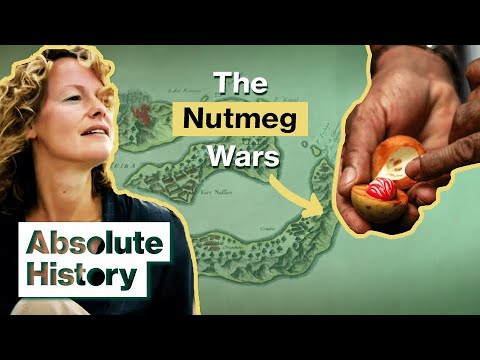
How Did Nutmeg Cause Wars In Indonesia? | The Spice Trail | Absolute History
Introduction
The introduction sets the stage for the documentary, which explores how spices shaped our modern world. It highlights the importance of spices in our favorite dishes and their impact on history.
Spices and Their Significance
- The world loves spice.
- Exotic ingredients in many of our favorite dishes have revolutionized the way we eat.
- Spices were treasured as exotic foods and medicine in 16th century Europe, thought to ward off the plague.
Finding the Spice Islands
This section discusses how finding nutmeg and cloves was a challenge due to their remote location, which accounted for their astronomical price.
Nutmeg and Cloves - The Ultimate Status Symbol
- Nutmeg and cloves were the ultimate status symbol in 16th century Europe, a kind of medieval bling.
- The only source of nutmeg and cloves was on a tiny cluster of remote islands surrounded by treacherous seas on the other side of the world.
Searching for Spice
- Private companies were set up by both Dutch and English to search for spice, with both nations wanting to secure monopoly on trade in this region.
- These maverick merchants were heavily armed and ready to kill any rivals who stood in their way but they still needed help from locals who knew exact location of these islands that Europeans wanted so badly to find.
Journey to Indonesia
This section follows the narrator's journey to Indonesia, where he explores the Bandar Islands, home of nutmeg and cloves.
The Bandar Islands
- The narrator is heading east to find the home of these spices, a mere spec within the archipelago of 17,000 islands we now call Indonesia.
- The Bandar Islands are a cluster of ten tiny volcanic islands that were discovered by the Dutch in 1599.
Searching for Gold
- It was the search for these very islands and most importantly, the trees that grow on them that inspired people to take these crazy journeys and to risk their lives and their fortunes.
Conclusion
The conclusion highlights how spices shaped our modern world and sparked a war of horrifying brutality in one of the remotest corners of the earth.
Impact of Spices
- Spices like nutmeg and cloves pushed boundaries of exploration further than they had ever been pushed before.
- Spices redrew world map and sparked a war of horrifying brutality in one of remotest corners of earth.
The Discovery of Nutmeg in Bandanera
This section discusses the discovery of nutmeg in Bandanera, the capital of the Bandar Islands. It also talks about how nutmeg is grown and harvested.
Nutmeg Farming in Bandanera
- The Dutch discovered the source of their precious nutmeg in Bandanera.
- Today, these islands produce up to 500 tons of nutmeg a year.
- Papa Usman, a fifth-generation nutmeg farmer, shows how nutmeg is grown and harvested.
- The fruit casing can be used for cosmetics while the nutmeg itself can be used for cooking and medicine.
Harvesting Nutmeg
- Papa Usman demonstrates how to open a ripe nutmeg using an opener.
- After opening, the shiny outer casing is removed to reveal the true prize - the nutmeg itself.
- Nutmeg requires specific conditions to grow such as warm humid weather, well-drained fertile soil, and an annual rainfall of more than 150 centimeters.
Processing Nutmeg
- Once picked, there's still a lot of hard work that needs to be done before it's ready for market.
- Women gather during harvest season to separate the fruit, mace and nutmeg while catching up on local gossip.
Layers of Nutmug
This section explains how there are layers to nutmeg and how it was worth indescribable amounts of money.
Layers of Nutmeg
- There are three layers to nutmeg - the outside mace, the shell, and the nutmeg itself.
- The shiny outer casing is not actually nutmeg but a third layer hiding the true prize.
- Nutmeg was worth indescribable amounts of money and made all those mad men sail all around the world.
Nutmeg: The Dark History of a Spice
This section explores the history of nutmeg and its importance to the people of Banda. It also highlights the fact that 150 trees are not enough to sustain a family, which is why most people have other jobs.
Importance of Nutmeg
- Nutmeg is important to the families of Banda.
- Nutmeg has a dark history with brutal consequences.
- The people of Banda remember the massacre that occurred in their village.
Dutch Colonization
- The Dutch colonized Banda and left behind colonial architecture.
- Governor Jan Peterson Cohen was responsible for mass murder and systematic genocide on the island.
- After the massacre, Governor Cohen repopulated the island with slave workers from Java.
Chakaleli Dance
- The Chakaleli dance is performed to keep alive the memory of murdered chiefs.
- Every item in this eclectic costume represents something connected to nutmeg trade.
Regaining Control
- The government has returned control over nutmeg trees to Bandanese people, but they still campaign for full control over their land.
- Wild almond trees were planted by Dutch masters to shade nutmeg trees on plantations.
Nutmeg Treasure Hunt
This section discusses the importance of nutmeg and how it was spread around the world. It also shows how children in Banda forage for windfalls.
The Importance of Nutmeg
- Nutmeg is a very important tree that has been responsible for planting more trees than any English, Dutch, or Bandanese farmers have ever.
- European traders smuggled lucrative nutmeg seedlings off the islands over 200 years ago, which were then spread around the world and grown in tropical regions like the Caribbean and India.
- As a result, Banda lost its monopoly on nutmeg and the price plummeted.
Foraging for Windfalls
- Today, the industry in Banda is just enough to keep locals going, and even children join in by foraging for windfalls.
- Children go on a nutmeg treasure hunt to find good ones while learning about what makes a good one.
The Island of Roon
This section talks about how the English set up their first colony on an island called Roon to rival the Dutch East India Company.
Setting Up an English Colony
- The English set up a company to rival the VOC (Dutch East India Company), which was to become the engine that launched the British Empire.
- They chose an almost inaccessible spec in the ocean two miles by half a mile wide called Roon as their first target.
- Captain Nathaniel Courthope was chosen to win this island for the crown. He was a swashbuckling fearless adventurer and also a bit of a thief.
- When Captain Courthope arrived in 1616, he negotiated with the locals in broken English and sign language to hand over control of the island to the English crown.
The Dutch Campaign
- All this happened under the noses of infuriated Dutch, who set out on a four-year campaign of ferocious battles to destroy Courthold.
- In the end, the Dutch tricked Captain Courthope into an ambush at sea. He fought for his life but was outgunned and outmanned and finally shot.
The Story of Nutmeg
This section covers the history of nutmeg trade and the battle between the English and Dutch for control over it.
The Battle for Nutmeg
- There is no monument to remember Courthope's stand against the Dutch.
- After Courthope was defeated, the Dutch took control of the nutmeg trade.
- The Dutch were paranoid that someone was plotting to oust them from power.
- The Dutch governor had a group of Englishmen tortured and executed for a conspiracy they did not commit.
- After this massacre, it was all-out war between the Dutch and English, with locals caught in the middle.
Ambon Island
- To uncover the next chapter, we need to travel 100 miles across the Bander Sea to Ambon Island.
- At one point, rebellious islanders who dared resist were tortured and executed by the Dutch.
- The memory of this brutality is still an open wound remembered by Ambonese today.
Beating Brooms Ritual
- We witness an ancient ritual called beating brooms where two teams compete against each other using strips of palm leaves.
- It's actually a show of brotherhood as all men in the village come together to test their ability to withstand pain.
England's First Colony
- In 1620 after Captain Courthope died, England lost its nutmeg-rich island Roon to Holland.
- Almost 50 years later, England's King Charles II took his revenge by taking a Dutch-held island called New Amsterdam.
- The English and Dutch tried to establish peace, but it looked impossible as the English demanded Roon back while the Dutch refused.
The Dutch and English Colonization of New Amsterdam
This section discusses the colonization of New Amsterdam by the Dutch and its subsequent renaming to New York by the English.
The Transfer of New Amsterdam
- The English agreed to keep New Amsterdam, while the Dutch could have control over Run Island.
- Despite this, other European powers still desired control over the Spice Islands.
The Search for Cloves in Indonesia
This section discusses the search for cloves in Indonesia and how it was fueled by a desire to cut out Arab and Asian middlemen.
Early Spice Explorers
- Early spice explorers came to Indonesia not just for nutmeg but also for cloves.
- Cloves were highly valued as a flavoring agent, wonder drug, and even an aphrodisiac.
Tanate - Home of Cloves
- Tanate is one of several volcanic islands that used to be the only place on earth where cloves could be found.
- When Europeans first arrived in Indonesia, they found ancient kingdoms at war with each other.
Portuguese Arrival in Tenate
- The Portuguese were the first explorers to arrive in Tenate.
- Both sultanates wanted an alliance with them because it would give them an upper hand against their rivals.
Monopoly Over Cloves
- In the 16th century, Tenate was the most prosperous trading port in Indonesia.
- The sultan of Tenate won the day and gave the Portuguese monopoly over cloves for over half a century.
Meeting with Sultan Madufa
This section discusses the meeting between the narrator and Sultan Madufa of Tanate.
Protocol Demands
- When early European traders arrived, protocol demanded they present themselves to the sultan before any negotiations could begin.
Audience with Sultan Madufa
- The narrator has secured an invitation to meet with Sultan Madufa at his palace.
- Before entering the palace, she is asked to change into something more suitable to meet a king.
Honorary Citizen of Tenate
- The sultan awards the narrator one of his highest honors and adopts her as an honorary citizen of Tenate.
- She is now an emissary of cloves for tonight to the world and should act like an ambassador.
Introduction to Clove Farming
The host is introduced to a courtier named Vanira Yusman, whose family has been farming cloves for generations. They live at the foot of Mount Gamalama, and walking through the woods here is like walking through the exotic section of a supermarket.
Clove Harvesting
- The clove trees are located on the slopes of the volcano, which requires a good hour and a half steep climb.
- The flowers must be picked before they blossom when buds are beginning to turn pink that they have the most fragrance.
- Traditional method of harvesting cloves hasn't changed since the time of Portuguese. It involves a complicated matrix of rope work and branch pulling to dislodge topmost flowers and reach buds on farthest away branches.
- After picking, everyone pitches in with separating clothes from stalks by pinching stalks together and snapping them back.
Importance of Cloves
- Besides using buds, clove stalks are also in demand. Their most prominent use is in one of Indonesia's biggest industries - cigarettes.
- Crushed clove stalks are mixed with tobacco to create hugely popular kratec cigarette.
- Watching women work in cigarette factory is dizzying. Women roll about 400 cigarettes in one hour after three months training.
Appreciation for Cloves
- The host reflects on how ordinary cloves have become but seeing an entire community's lives rely on them makes him appreciate them more.
- Everywhere he walks around the island, he comes across cloves lining the streets drying in the sun.
The transcript is relatively short and does not have many distinct sections. Therefore, I have organized it into one main section with subtopics that cover different aspects of clove farming and its importance.
Introduction
The introduction provides a brief history of the global trade of cloves and nutmeg, tracing its roots back to Portuguese adventurers.
History of Cloves and Nutmeg
- The global trade of cloves and nutmeg has its roots in the Portuguese adventurers who came to Indonesia.
- After enjoying good business dealings with the locals, the Portuguese turned nasty and demanded total domination. This led to a series of horrifying events that started when they kidnapped and killed the sultan in 1570.
- The islanders blocked off all exits to the fort where the Portuguese were hiding, leading them to be under siege for five years until starvation forced them to surrender.
- After this event, Portuguese influence dwindled, and Dutch took over the clove trade from them.
Dutch Takeover
This section discusses how Dutch took over the clove trade from Portugal by limiting it on Tanate Island.
Dutch Takeover
- In May 1599, Dutch arrived in Indonesia eager to take over another highly lucrative trade - cloves.
- To dominate the market, they decided to limit cloves on Tanate Island by destroying every single tree except one little sapling being kept in the sultan's palace.
- Cloves play a central part in daily life on Tanate Island even today.
Harvest Month
This section describes how cloves permeate every aspect of daily life during harvest month on Tanate Island.
Harvest Month
- During harvest month, women prepare a special thanksgiving meal called Salamat Anne, where cloves are mixed with coconut to create a delicious rice dish.
- Cloves play a central part in the feast, and every single clove tree on the island is believed to descend from one little sapling being kept in the sultan's palace.
Conclusion
The conclusion reflects on how nutmeg and cloves continue to shape the lives of people in Indonesia and have had a major impact on world history and global trade.
Reflection
- These tiny islands that barely feature on the map and their spices, which are now found on every supermarket shelf, have had such a major impact on world history and global trade.
- The narrator has been welcomed into Indonesia during his journey and given a glimpse into how nutmeg and cloves continue to shape the lives of people there.
Understood, thank you for the detailed instructions. I will follow them to create a clear and concise markdown file that makes use of timestamps when available.
Unfortunately, the transcript provided only contains one word "you" without any context or timestamp. Please provide me with a complete transcript so that I can start creating the notes in the required format.