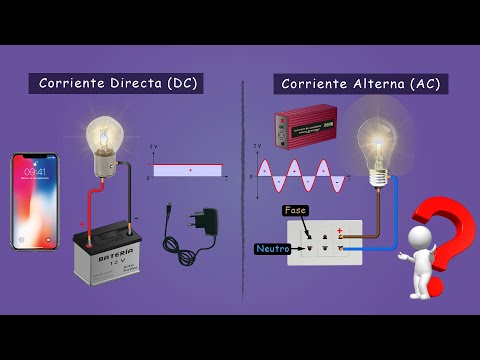
Corriente Directa o Continua y Corriente Alterna AC | Similitudes y diferencias
Understanding Direct Current (DC) and Alternating Current (AC)
In this section, we will explore the similarities and differences between direct current (DC) or continuous current and alternating current (AC).
Similarities and Differences between DC and AC
- DC is a continuous flow of electric charge in one direction, while AC alternates its direction periodically.
- When a light bulb is connected to a battery, the current flows continuously from the negative terminal to the positive terminal. This creates a straight line on a voltage-current graph.
- In an AC circuit, such as when connecting a light bulb to a power outlet, the current alternates its direction due to the changing polarity of the voltage. This results in a sinusoidal waveform on a voltage-current graph.
- The frequency of AC depends on the country's power supply system, typically 60 Hz or 50 Hz. This means there are 60 or 50 cycles per second respectively.
- DC can be obtained from batteries or solar panels, while AC is primarily generated in hydroelectric power plants for long-distance transmission.
Characteristics of DC and AC
- DC devices have terminals with positive and negative polarities. The flow of electric current occurs only in one direction, from negative to positive.
- DC is commonly used in electronics and control circuits due to its constant flow over time. It allows information transfer through pulses but cannot be efficiently transmitted over long distances due to power losses.
- AC, attributed to Nikola Tesla, is generated at high voltages in power plants and then stepped down for domestic use. It travels through high-voltage transmission lines before being distributed to electrical panels for lighting and outlets.
- AC can be converted to DC using a power supply, such as when charging a phone battery. Conversely, DC can be converted to AC using an inverter for applications like running a motor pump.
- The voltage level of AC can be adjusted according to the desired application, typically 110 volts or 220 volts.
Conclusion
Understanding the differences between direct current (DC) and alternating current (AC) is crucial in comprehending how electricity flows and is utilized in various devices and systems. While DC provides a continuous flow of charge in one direction, AC alternates its direction periodically. Each type has its own characteristics and applications, making them essential components of modern electrical systems.