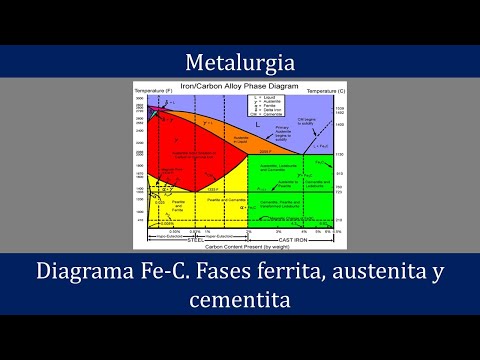
Sistema Fe-C. Diagrama de equilibrio metaestable Fe-C. Fases austenita, ferrita y cementita
Introduction to the Iron-Carbon Phase Diagram
In this class, we will focus on studying the iron-carbon phase diagram, specifically carbon steels and cast irons. Before diving into the equilibrium diagram of the iron-carbon system, it is important to understand that pure iron can exist in two different crystal structures.
Crystal Structures of Pure Iron
- Pure iron can crystallize in two different structures depending on the temperature:
- Face-centered cubic (FCC) structure or Austenite (γ)
- Body-centered cubic (BCC) structure or Ferrite (α)
Solubility of Carbon in Iron
- Carbon is the most common alloying element for iron.
- The atomic size of carbon is much smaller than that of iron.
- Carbon forms a solid solution with iron.
- Carbon is more soluble in FCC phase compared to BCC phase due to larger interstitial space available.
Importance of Carbon Solubility
- The difference in carbon solubility between FCC and BCC phases is crucial in understanding the iron-carbon phase diagram.
- The shown phase diagram represents metastable conditions as obtaining equilibrium conditions requires extremely slow cooling rates which are not practical.
Metastable Phase: Cementite (Iron Carbide)
- Cementite or Iron Carbide is a metastable phase formed by decomposition of austenite at temperatures below 723°C.
- Cementite has a chemical formula Fe3C and crystallizes in a orthorhombic structure.
- At approximately 6.67% carbon, cementite exists as a separate phase within the alloy.
Formation of Pearlite
- Pearlite is not a single phase but rather a composite microstructure consisting of two distinct phases:
- Ferrite (α): Soft matrix phase
- Cementite (Fe3C): Hard phase
- Pearlite forms when austenite transforms at a constant temperature of 723°C and approximately 0.8% carbon.
Important Reactions in the Iron-Carbon Phase Diagram
- There are three important reactions in the iron-carbon phase diagram:
- Eutectoid reaction: Transformation of austenite into ferrite and cementite.
- Peritectic reaction: Formation of gamma phase from liquid and delta phase.
- Eutectic reaction: Transformation of gamma phase into cementite and pearlite.
Conclusion
- Understanding the iron-carbon phase diagram is essential for studying the behavior and properties of carbon steels and cast irons.
- The solubility of carbon in different phases plays a significant role in determining the microstructure and mechanical properties of these alloys.
New Section
This section discusses the microstructure of pearlite and ferrite in steel, as well as their formation at different carbon percentages.
Microstructure of Pearlite and Ferrite
- Pearlite is a two-phase structure consisting of ferrite and cementite.
- In the metallography, pearlite is considered as a separate phase due to its distinct characteristics.
- Steel with lower carbon percentages has grains of gamma phase coexisting with ferrite.
- As temperature decreases, pearlite starts to grow on the grain boundaries of austenite.
- When austenite becomes unstable, perlite crystallizes and grows, resulting in more ferrite in the structure.
- The microstructure varies depending on the carbon percentage. Lower carbon content leads to predominantly ferritic structure, while higher carbon content results in a more balanced distribution between pearlite and cementite.
New Section
This section explains how to calculate the percentage of carbon in a steel alloy based on its microstructure.
Calculating Carbon Percentage from Microstructure
- A practical example is given for calculating the unknown carbon percentage in an iron-carbon alloy using metallography.
- Given an image showing 95% pearlite and 5% cementite after slow cooling from the austenitic zone, we can determine that it is a hypoeutectoid steel (carbon percentage less than 0.8%).
- By applying the lever rule between 100% pearlite at room temperature and 100% cementite at 6.67% carbon, we can estimate the actual carbon percentage.
- The determined percentage falls somewhere to the right of 0.8%, indicating that it is not purely ferritic but contains both pearlite and cementite phases.
Timestamps are provided for each section to easily locate the corresponding part of the video.