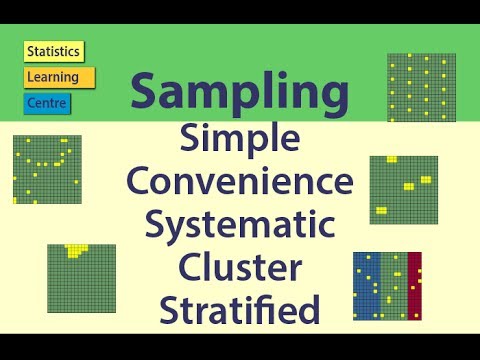
Sampling: Simple Random, Convenience, systematic, cluster, stratified - Statistics Help
Sampling Methods in Research
Understanding Sampling and Its Importance
- A sample is a selection of objects or observations taken from a larger population to gather insights about that population, such as measuring the size of apples in an orchard.
- The method for sampling depends on the nature of the population and available resources, including time and money.
Characteristics of an Ideal Sample
- An unbiased sample is one where each object in the population has an equal chance of being selected, ensuring representativeness.
- Sampling error is inevitable since only a part of the population is measured; this concept will be explored further in related videos.
Overview of Sampling Methods
Simple Random Sampling
- This method involves listing all members of a population and using random numbers to select samples, producing an unbiased representation.
- While theoretically ideal, simple random sampling can be challenging and costly when applied to human populations or dispersed groups.
Convenience Sampling
- Convenience sampling involves selecting individuals who are easily accessible, such as people nearby or those passing by in public spaces.
- Although convenient and cost-effective for quick polls, convenience samples often carry biases due to self-selection among participants.
Systematic Sampling
- In systematic sampling, a random starting point is chosen, followed by selecting every nth object (e.g., every 20th item).
- This method simplifies administration compared to simple random sampling but may introduce bias if there are patterns within the population.
Cluster Sampling
- Cluster sampling divides the population into clusters (e.g., departments or neighborhoods), randomly selecting entire clusters for inclusion in the sample.
- While practical, cluster sampling can lead to bias if selected clusters differ significantly regarding key characteristics being measured.
Stratified Sampling
- Stratified sampling involves dividing the population into specific strata based on characteristics like age or ethnicity before taking random samples from each group.