Коммутаторы Ethernet | Курс "Компьютерные сети"
Introduction to Ethernet Switches
Overview of Ethernet Technologies
- The lecture introduces the topic of Ethernet switches, highlighting two main types: classic Ethernet and switched Ethernet.
- Classic Ethernet emerged in 1973, utilizing a shared medium initially through coaxial cables, which later transitioned to hubs.
- A significant drawback of classic Ethernet is its poor scalability due to collisions when multiple computers transmit data simultaneously.
Transition to Switched Ethernet
- Switched Ethernet was developed in 1995 as a solution to the limitations of classic Ethernet by eliminating the shared medium.
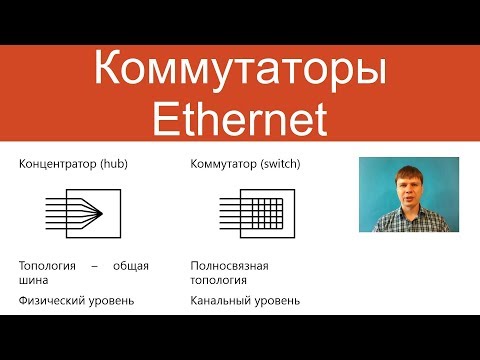
- Hubs and switches may appear similar but function differently; hubs use a bus topology while switches employ a full-mesh topology for direct connections between ports.
Understanding Switch Functionality
Key Concepts in Switching
- To grasp how switches operate, it's essential to understand three concepts: switching table, MAC addresses, and transparent bridging.
- The switching table consists of two columns: one for switch ports and another for connected MAC addresses. This structure aids in efficient data transmission.
Learning MAC Addresses
- Switches learn MAC addresses through reverse learning algorithms by analyzing incoming frames on their ports.
- Initially empty, the switching table fills as the switch receives frames and records sender MAC addresses associated with specific ports.
Data Transmission Mechanisms
Transparent Bridging Algorithm
- Bridges were used historically to connect networks; they reduced collisions by segmenting larger networks into smaller ones.
- The transparent bridge mode allows switches to operate without requiring configuration or having their own MAC address.
Frame Handling Process
- When receiving frames, if the destination MAC address is known (exists in the switching table), it forwards only to that port.
- If unknown, it broadcasts the frame across all ports except the originating one—similar behavior as hubs—until more information is learned about network devices.
Collision Management in Networks
Collision Avoidance Strategies
Understanding Switched Ethernet Technology
Overview of Half-Duplex and Full-Duplex Connections
- The discussion begins with half-duplex connections, where data transmission can only occur in one direction at a time. This mode is rarely used today and typically arises from equipment malfunctions.
- If a hub is connected to any of the switch's ports, it creates a shared medium that can lead to collisions, similar to traditional Ethernet networks.
Transition to Switched Ethernet
- Switched Ethernet represents a significant advancement over classic Ethernet technology, requiring new devices known as switches that facilitate point-to-point connections without shared media or collisions.
- Most modern Ethernet equipment supports both traditional and switched modes; however, 10G Ethernet and newer technologies exclusively support switched configurations.
Functionality of Switches
- Switches operate at the data link layer (Layer 2), analyzing frame headers to direct frames specifically to their intended recipients rather than broadcasting them to all devices on the network.