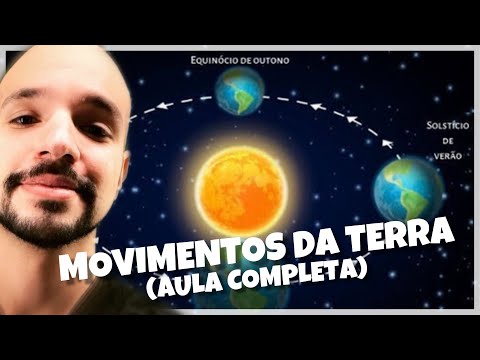
Movimentos da Terra (Translação e Rotação) e suas consequências - AULA COMPLETA | Ricardo Marcílio
New Section
The speaker introduces the topic of Earth's movements, including seasons, time zones, and days. They also mention the availability of geography-related content for students preparing for exams.
Understanding Earth's Movements
- The main focus is on the movements of the Earth, particularly its rotation and revolution around the sun.
- Earth undergoes two primary movements: translation (around the sun) and rotation (around its own axis).
- Translation refers to Earth's movement around the sun, taking approximately 365 days to complete a full orbit.
- Rotation involves Earth spinning on its axis, leading to day and night cycles.
Exploring Seasons and Time
The discussion delves into leap years, specifically how every four years an extra day is added in February. This impacts events like the Olympics and World Cup.
Leap Years and Calendar Adjustments
- Every four years, a leap year occurs with an additional day added to February to account for the extra 6 hours in a year.
- Leap years coincide with major events like the Olympics or World Cup due to their calendar adjustments.
Understanding Orbital Variations
Details about Earth's elliptical orbit around the sun are explained, highlighting aphelion (farthest point from the sun) and perihelion (closest point).
Aphelion vs. Perihelion
- Earth's orbit is not a perfect circle but an ellipse, impacting its distance from the sun at aphelion (farthest) and perihelion (closest).
- These orbital variations have minimal impact on temperatures despite significant distance differences due to Earth being approximately 150 million kilometers away from the sun.
Influence of Inclination on Seasons
The tilt of Earth's axis plays a crucial role in determining seasons by affecting sunlight distribution across hemispheres.
Axis Tilt Impact on Seasons
- The 23.5-degree tilt of Earth's axis influences seasonal changes by altering sunlight intensity in different hemispheres.
Seasons and Their Causes
The discussion delves into the causes of seasons, emphasizing that they are not solely determined by the Earth's distance from the sun but rather by a combination of factors such as the Earth's axial tilt and its revolution around the sun.
Understanding Seasons
- Seasons are primarily caused by two factors: the Earth's axial tilt of 23.5 degrees and its revolution around the sun.
- Both factors, axial tilt and revolution, are essential for the occurrence of distinct seasons.
- Specific dates like December 21st, June 21st, and September 23rd play crucial roles in understanding seasonal changes.
- The angle at which sunlight hits different latitudes is influenced by key lines on Earth such as the equator and tropics.
- Solstices occur when sunlight is perpendicular to either Tropic of Capricorn or Tropic of Cancer, marking extreme points in solar intensity.
Significance of Solstices
Solstices mark days with maximum solar intensity on either hemisphere, influencing whether it is summer or winter in a particular region based on where sunlight is most concentrated.
Exploring Solstices
- Solstices signify days when sunlight hits one of the tropics perpendicularly, determining summer or winter for each hemisphere.
- The latitude at which sunlight strikes most directly defines solstice occurrences.
- During June 21st solstice, Northern Hemisphere experiences summer while Southern Hemisphere encounters winter due to varying solar illumination.
- Understanding solstice dates aids in distinguishing between summer and winter hemispheric conditions.
- It is crucial to differentiate between solstice events (maximum solar intensity days) and actual seasonal periods lasting three months.
Equinoxes and Equal Day-Night Period
Equinoxes represent moments when day and night have equal lengths globally due to sunlight hitting Earth's equator directly.
Deciphering Equinoxes
- Equinoxes symbolize days with equal day-night durations worldwide as sunlight aligns with Earth's equator.
- Equinoxes occur when sunlight falls perpendicularly on the equator, leading to balanced daylight distribution globally.
Spring Equinox and Seasons Explanation
In this section, the speaker explains the concept of seasons, focusing on the spring equinox and its significance in relation to the four seasons.
Understanding Seasons
- The speaker discusses how after the summer solstice in one hemisphere, the next season will be autumn. Similarly, after winter solstice in one hemisphere, the following season will be spring.
- Explains that on September 23rd, there is an equinox where the sun's rays are perpendicular to the equator. Understanding these dates is crucial for exams.
- Differentiates between solstices and equinoxes by highlighting that while solstices have fixed dates (e.g., December 21st for summer solstice), seasons like summer start on a different date (e.g., December 21st).
Seasonal Transitions
- Emphasizes the importance of distinguishing between solstices and equinoxes for exams as they mark transitions between seasons.
- Illustrates how seasons transition: e.g., from summer starting on December 21st to autumn beginning on March 20th.
Personal Example and Recap
- Provides a personal example of birthday falling in May and explains how it relates to seasonal transitions.
- Summarizes key points about solstices and equinoxes, emphasizing their role in marking seasonal changes.
Impact of Solstices on Daylight Duration
This section delves into how solstices affect daylight duration based on one's location relative to latitudes.
Daylight Duration Variation
- Defines a solstice as a date with maximum sunlight incidence marking the start of a season. These dates vary but generally occur around December 21st.
- Discusses how daylight duration varies at different latitudes due to solar angles during solstices.
Latitude Influence
- Explores how latitude impacts daylight duration; higher latitudes experience more significant variations in daylight hours during different seasons.
- Contrasts daylight durations during summer (longer days) and winter (shorter days), illustrating this phenomenon with examples like London's extreme differences.
Personal Experience
- Shares personal experiences regarding daylight variations at different latitudes, such as observing early sunsets in high latitude locations like London.
- Highlights that higher latitudes witness more pronounced differences in daylight length between seasons due to their proximity to poles.
Understanding Day and Night Duration Based on Latitude
In this section, the speaker discusses how the duration of day and night varies based on latitude, using examples like Iceland and explaining the impact of solstices and equinoxes.
The Impact of Latitude on Day and Night Duration
- At higher latitudes near the poles, there can be six months of continuous daylight followed by six months of darkness due to the extreme differences in luminosity with changing seasons.
- Near the equator, changes in day length are minimal during equinoxes when day and night are approximately equal in duration.
- Equinoxes occur around March 20th/21st and September 22nd/23rd, marking the transition between seasons with equal day and night lengths across all latitudes.
- During autumnal equinox, not all locations experience equal day and night lengths; it is a global phenomenon occurring twice a year.
Transition from Autumn to Winter Solstice
- As autumn progresses towards winter solstice, nights become longer while days shorten gradually until reaching the longest night of the year.
- Spring, conversely, sees nights shortening as days lengthen leading up to summer solstice when daylight reaches its peak duration.
Understanding Seasonal Changes in Daylight
- Summer solstice marks the longest period of daylight in a year while winter solstice has the shortest daylight hours based on Earth's axial tilt.
- The variation in daylight hours at different latitudes during solstices highlights how regions near poles may experience extended periods of darkness or light.
The Apparent Movement of Sun Across Different Latitudes
This part delves into how the apparent movement of the sun impacts sunrise directions across various latitudes throughout different times of the year.
Observing Sun's Apparent Movement
- The sun rises towards east due to its changing position over time; this apparent movement should not be confused with actual solar motion but rather an optical illusion caused by Earth's rotation.
Visualizing Solar Movements Using Diagram
- By visualizing Earth's rotation as a globe with key lines like equator, tropics, and polar circles marked out, one can understand how sunlight angles change throughout the year.
Sun's Position Relative to Tropics
- On December 21st (winter solstice), sunlight is perpendicular to Tropic of Capricorn affecting regions close to it like São Paulo where midday sun appears directly overhead.
New Section
In this section, the speaker discusses the position of the sun in relation to specific locations on Earth and how it changes throughout the year.
Sun's Position and Movement
- The sun will be shining perpendicularly at the Tropic of Cancer, near Mexico City, making it visible overhead for individuals close to this region.
- Only people living between the tropics can see the sun directly overhead at zenith, such as those at 30 or 50 degrees north latitude.
- The sun's movement from tropic to tropic occurs annually, affecting its position relative to different latitudes.
- Understanding the sun's path is crucial for optimizing natural light in buildings; a house facing north in the Southern Hemisphere receives more sunlight throughout the year.
- For optimal sunlight exposure in a house located in the Southern Hemisphere, having windows facing north is recommended regardless of the season.
New Section
This section delves into how understanding solar movements can influence architectural and civil engineering decisions.
Solar Orientation for Buildings
- Architects and civil engineers must consider solar positioning when designing structures to maximize natural light exposure.
- Houses facing south are preferred in cities like Lisbon (Portugal), located in the Northern Hemisphere, as they receive consistent sunlight throughout different seasons.
- In regions near the equator, such as Ecuador, sunlight distribution remains relatively constant throughout the year due to its location on Earth's axis.
New Section
This part explores how solar movements impact building orientation and sunlight exposure based on hemispheric differences.
Building Orientation and Sunlight Exposure
- Houses facing north are ideal in the Southern Hemisphere for consistent front-facing sunlight exposure throughout various times of the year.
- Contrary to common belief, sunrise does not always occur due east; it varies based on location and time of year due to Earth's axial tilt.
New Section
The discussion continues with insights into how solar movements affect sunrise directions across different latitudes.
Sunrise Directions and Solar Movements
- Sunrise positions vary depending on location and date; during summer solstice in São Paulo (23/12), sunrise occurs closer to Capricorn Tropic than during winter solstice (21/6).
Understanding Time Zones and Longitudes
In this section, the speaker delves into the concept of time zones and longitudes, explaining how they are interconnected and influence time differences across the globe.
Calculating Time Zones
- The Earth is not flat but a geoide with 360°. It takes 24 hours for the Earth to complete a full rotation.
- Each longitude space of 15° from east to west is termed as a time zone, resulting in 24 time zones around the Earth.
- Visualizing the Earth as a giant orange divided into 24 segments of 15° each helps understand time zones' distribution.
Time Zone Rules
- Every 15° longitude difference corresponds to a one-hour time difference on our clocks.
- Moving east adds hours while moving west subtracts hours due to longitudinal shifts.
Calculating Time Differences Between Locations
This segment focuses on practical applications of calculating time differences between specific locations based on longitudes and time zones.
Practical Example: Calling London from São Paulo
- Illustration using São Paulo (45° west of Greenwich) calling London (0°): A three-hour time difference must be considered.
- For every 15° shift in longitudes towards the east or west, adjust your clock by an hour accordingly.
Global Communication Considerations
- Understanding longitude differences aids in determining appropriate times for international communication.
New Section
In this section, the speaker discusses the impact of different time zones on governance and individual choices, using China as an example.
Time Zones and Governance
- China's Unique Time Zone Situation:
- China should technically have five different time zones based on its longitudinal span, but it operates with a single official time zone.
- This decision affects individuals' daily routines and biological clocks, showcasing how political choices can influence societal practices.
- Political Choice vs. Practicality:
- Countries have the freedom to choose their time zone alignment based on governance needs.
- The practical use of time zones differs from theoretical considerations, emphasizing the importance of understanding real-world applications.
Understanding Time Zones Practically
- Practical vs. Theoretical Knowledge:
- While practical knowledge is crucial for daily life, theoretical knowledge is often tested in academic settings like exams.
- Demonstrating an example with Brazil's four time zones highlights the discrepancy between theoretical learning and practical application.
New Section
This section delves into Brazil's specific time zone configurations and their implications for different regions within the country.
Brazil's Time Zone Complexity
- Four Time Zones in Brazil:
- Brazil spans four distinct time zones, including a GMT-2 zone for its oceanic islands.
- Understanding these variations is essential for navigating regional differences in timing across the country.
- Regional Time Zone Distribution:
- Different Brazilian states align with specific time zones based on geographical location.
- States like Brasília follow GMT-3, while others in the North and Center-West adhere to GMT-4 or GMT-5, reflecting diverse regional practices.
New Section
This section explores how varying time zones within Brazil impact daily life and administrative processes across different regions.
Impact of Time Zones in Brazil
- Regional Differences in Timing:
- The distribution of time zones influences activities such as elections, where results may be delayed due to staggered voting times across regions.
- Real-Time Examples:
- Using São Paulo as a reference point, the speaker illustrates how different states like Fernando de Noronha or Acre operate under distinct time zones relative to Brasília.
New Section
This section discusses historical shifts in Brazil's time zone policies and their effects on local populations' daily routines.
Historical Context of Time Zones in Brazil
- Election Result Timings:
- Election result announcements are influenced by varied voting times across Brazilian states due to differing time zone alignments.
- Acre's Time Zone Controversy:
- Acre faced challenges when its timezone was altered between 2008 and 2013, impacting residents' solar schedules negatively.
New Section
In this final segment, the speaker concludes by emphasizing viewer engagement through sharing content and supporting channel growth.
Conclusion and Viewer Engagement
- Importance of Sharing Knowledge:
- Encouraging viewers to share educational content fosters community learning and channel development.
- Return to Four Time Zones: