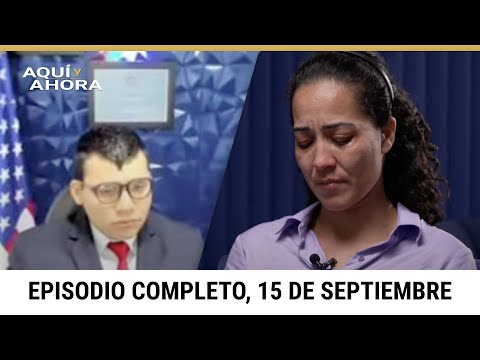
Episodio completo de Aquí y Ahora, domingo 15 de septiembre de 2024
The Harrowing Journey of Robleys Robles
Background and Initial Situation
- Robles describes her traumatic experience, likening it to the loss of her three brothers. She sought refuge in a migrant shelter after traveling through several Central and South American countries.
- Her journey began when a fellow church member introduced her to an immigration lawyer named Gustavo Cortés, who promised affordable legal services for asylum, residency, and citizenship.
Trusting the Wrong Lawyer
- Robles initially trusted Cortés due to his seemingly serious demeanor and Spanish-speaking ability.
- During a recorded hearing from the New York shelter, she realized that Cortés had not even secured asylum for her but charged for various services nonetheless.
Financial Exploitation
- Robles had given Cortés all her earnings from cleaning houses in New York, believing it was necessary to continue her immigration process.
- She was threatened with deportation if she did not complete the process, which she recognized as extortion.
Realization of Fraud
- Despite initial trust based on personal interactions via video calls, doubts arose when inconsistencies in the legal proceedings became apparent.
- The fraudulent nature of the operation began to unravel when victims noticed that officials in videos were playing multiple roles.
Confirmation of Deception
- Robles consulted with other church members about discrepancies in their cases and confirmed suspicions regarding their supposed lawyers' identities.
- A federal official played both judge and immigration officer in different cases, leading to further realization that they were being scammed.
Community Response and Legal Action
- Pastor Sandro Martínez noted suspicious signs such as emails from supposed lawyers using non-government email addresses (Gmail instead of .gov).
- After gathering evidence of fraud affecting multiple victims, Robles decided to report the case at NYPD's precinct 44 alongside her friend Nivida Green.
Expert Analysis on Documentation
- Attorney José Javier Orochena reviewed documents related to the case and concluded they were nonsensical; he believed they were cobbled together from online sources without any legitimate basis.
Investigation into Immigration Fraud
Allegations of Asylum Fraud
- Joe Biden's statement is dismissed as completely false, emphasizing that certain questions are only relevant for citizenship applicants, not asylum seekers.
- Univision reporters initiate a series of calls to phone numbers linked to bank transfers made by victims of the alleged fraud.
- The supposed lawyer, Gustavo Cortez, initially responds but refuses to allow recording and hangs up after scheduling a meeting without providing an address.
Contact with Gustavo Cortez
- Reyes identifies himself as a reporter from Univision and mentions complaints from immigrants regarding services offered by Cortez that appear fraudulent.
- After several hours, Cortez contacts Reyes back and agrees to record the conversation while claiming he is calling from a Venezuelan prison.
Criminal Charges and Concerns
- Cortez reveals he faces serious charges including homicide, extortion, and money laundering with a potential sentence of 50 to 55 years.
- When asked about giving an on-camera interview, Cortez expresses fear for his life due to his criminal background.
Technology Used in Deception
- Cortez discusses using green screen technology to create fake scenarios aimed at deceiving undocumented individuals seeking help.
- He expresses concern over revealing names of accomplices involved in the scheme while showing remorse for his actions.
Ongoing Issues in Healthcare Access
- Despite expressing regret and willingness to repay victims, Cortez continues advertising services on social media that he cannot fulfill.
Healthcare Challenges in the U.S.
Shortage of Healthcare Professionals
- A report indicates that 30% of Americans have experienced difficulty securing medical appointments due to a shortage of healthcare professionals.
Personal Experiences with Medical Appointments
- Maria Guadalupe Ceja shares her past struggles with canceling medical appointments due to language barriers affecting communication with doctors.
Overcoming Language Barriers
- With improved communication now established through her new obstetrician who speaks Spanish fluently, Ceja no longer misses appointments and follows medical advice closely.
Pilot Program for Rural Communities
- Dr. Armando Moreno is one of 30 Mexican doctors participating in a pilot program aimed at serving migrant communities in Northern California.
Commitment to Community Health
- Dr. Moreno expresses enthusiasm about providing healthcare services in the U.S., highlighting his desire to contribute positively after working previously in Mexico.
Experiences of Mexican Doctors in the U.S.
Decision to Emigrate
- The young doctor, after facing extortion attempts and kidnappings in Mexico, decided to close his father's clinic and emigrate to the United States with his wife, also a doctor.
- In the U.S., they practice medicine with more peace of mind, free from threats like phone calls demanding money.
The Mexican Doctors Program
- The program provided Moreno a three-year visa to work at the same salary as American colleagues. This initiative took nearly two decades for California's legislature to approve.
- Dr. Maximiliano Cuevas leads this program aimed at bringing quality doctors to communities historically lacking access to healthcare.
Addressing Healthcare Access Issues
- A report revealed that over 83 million people in the U.S. lack access to primary care physicians, highlighting a significant healthcare crisis not limited to California alone.
- Despite being the largest minority group in the country, Hispanics are disproportionately affected by physician shortages; only 6% of doctors are Latino according to a recent UCLA report.
Challenges Faced by Foreign Doctors
- To join this program, foreign doctors must graduate from accredited universities and receive approval from California's medical board. Dr. Cuevas notes that many incoming doctors from Mexico City are highly qualified academics.
- Once in practice, these doctors face rigorous demands; for instance, Dr. Juana Lucio González manages high patient volumes while providing comprehensive care through telemedicine as well as in-person consultations.
Impact on Patients' Lives
- The pilot program has significantly improved life for farmworkers and their families in Salinas Valley but faces criticism regarding its sustainability and quality of care compared to other regions in the U.S..
- Past criticisms included claims that it did not meet national medical standards; some Latino members even referred to it derogatorily as a "bracero" program reminiscent of historical labor agreements allowing Mexican workers into the U.S..
Overcoming Criticism and Building Trust
- Dr. Cuevas remains unfazed by criticism, noting an increase in patient satisfaction and appointment requests as patients feel their health issues are being effectively managed through this program.
- Dr. Armando Moreno emphasizes that shared cultural backgrounds foster better communication with patients who often have specific beliefs about health practices influenced by their culture (e.g., using red threads or amulets).
Patient Relationships and Community Integration
- Many patients prefer Spanish-speaking doctors due to trust built through effective communication; one patient expressed confidence because her doctor explains things thoroughly despite her ability to speak English fluently.
- Both Dr. Lucio González and her family have established roots within Salinas Valley’s rural community, feeling part of something larger through their work at this clinic.
Promoting New Talents in Opera
Javier Camarena's Rise to Fame
- Javier Camarena is performing at the Palacio de Bellas Artes, showcasing his latest presentation despite the absence of an audience.
- In less than two decades, Camarena has performed on major operatic stages in Europe and the United States, achieving feats unmatched by legendary interpreters like Luciano Pavarotti or Plácido Domingo.
- He is notably the only performer in history to have sung encores for three different works at the Metropolitan Opera in New York, receiving a standing ovation for his last encore in 2019.
- Reflecting on his early career, Camarena recalls his first performances at Bellas Artes and describes them as terrifying experiences.
- His passion for music began early; he was influenced by diverse musical styles from family members and had a fascination with various genres.
Educational Journey and Early Career
- Initially pursuing a degree in electrical mechanical engineering at Universidad Veracruzana, he left without informing his parents when he was accepted into music school.
- After revealing his acceptance to music school through university publications, he began studying singing under Cecilia Perfecto at Universidad de Guanajuato and graduated with honors.
- His breakthrough came after debuting in 2004; shortly thereafter, he received a scholarship to study in Zurich, Switzerland.
- Life in Zurich was challenging; Camarena described living on minimal food while striving for success.
- After six months, he secured a position with the Zurich Opera House which marked the beginning of consistent success.
Vocal Techniques and Personal Preferences
- Camarena discusses tenor vocal techniques that allow him to reach high notes known as "do de pecho," emphasizing their difficulty and impact on audiences.
- He expresses a love for singing boleros but does not favor any particular song. This versatility has contributed significantly to his acclaim.
Mentorship and Support for Young Artists
- During his recent tour in Mexico, Camarena invited young pianist María Hahnemann to perform alongside him.
- Hahnemann shares her experience of meeting Camarena after winning a competition and how it transformed her career opportunities. She expresses deep gratitude for his support during her performances.
Recognition and Achievements
- This year, Javier Camarena was recognized as Best Male Singer by the International Opera Awards, solidifying his status among the world's greatest tenors.