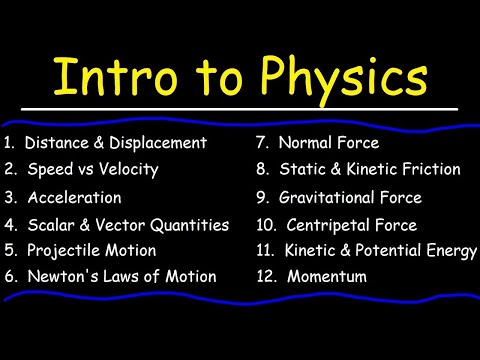
Physics - Basic Introduction
Introduction to Basic Physics Concepts
In this video, the speaker introduces basic physics concepts such as displacement, velocity, acceleration, projectile motion, Newton's three laws, forces, momentum and more.
Distance vs Displacement
- Distance is the total amount of ground covered by an object while displacement is the difference between the final position and initial position of an object.
- Displacement is a vector quantity that has both magnitude and direction while distance is a scalar quantity that only has magnitude.
- Displacement can be positive or negative depending on the direction of travel while distance is always positive.
Magnitude and Direction
- Magnitude refers to how far an object travels while direction refers to where it travels.
- The sign of displacement depends on whether an object moves in a positive or negative direction.
- Distance is always positive but displacement can be either positive or negative.
Examples
- If you simply state 200 miles without indicating any direction, you are describing distance.
- If you indicate both magnitude (300 miles) and direction (north), you are describing displacement.
Conclusion
The video provides an introduction to basic physics concepts such as distance and displacement. It explains the differences between these two quantities and how they relate to each other. Additionally, it highlights the importance of considering both magnitude and direction when dealing with physical quantities like displacement.
Speed and Velocity
In this section, the speaker discusses speed and velocity. They explain what speed is, how it's calculated, and provide an example. The speaker also explains the difference between speed and velocity, how to calculate velocity, and provides examples.
Understanding Speed
- Speed tells you how fast something is moving.
- If a car is traveling 30 meters per second, that means it will travel a distance of 30 meters every second.
- The formula for calculating speed is d = vt (distance = velocity x time).
- If you're driving a car at 60 miles per hour, you'll travel 60 miles in one hour.
Understanding Velocity
- Velocity is similar to speed but includes direction.
- Speed is always positive while velocity can be positive or negative depending on direction.
- A train moving at 45 meters per second describes its speed while a train moving at 30 meters per second going west describes its velocity.
- Velocity can be calculated using the same formula as speed (d = vt), but with direction included.
Example Calculation
- An object moving at 50 meters per second will take 20 seconds to travel a distance of 1000 meters. This calculation uses the formula d = vt.
Introduction to Speed, Velocity, and Acceleration
In this section, the speaker introduces the mathematical formulas used in physics to calculate speed and velocity. The difference between average speed and average velocity is explained.
Average Speed
- Average speed is calculated by dividing the total distance traveled by an object by the total time taken.
- The formula for average speed is v = d/t, where v represents the average speed, d represents the total distance traveled, and t represents the total time taken.
Average Velocity
- Average velocity is calculated by dividing displacement by the total time taken.
- The formula for average velocity is v = d/t, where v represents the average velocity, d represents displacement, and t represents the total time taken.
- Displacement can be positive or negative depending on whether an object moves towards a positive or negative direction respectively.
Example Calculation
- An example calculation of both average speed and average velocity is given.
- An object travels 12 meters east and then 20 meters west in a total time period of four seconds.
- The total distance traveled is 32 meters (12+20), so the average speed is 8 m/s (32/4).
- The net displacement of this trip from position A to C was -8 meters (-12+(-20)), so the average velocity was -2 m/s (-8/4).
Acceleration
- Acceleration is defined as the rate at which velocity changes.
- The speaker uses an example of a truck and a sports car to explain that the vehicle with greater acceleration can reach a certain speed faster than the other.
Acceleration and Velocity Understanding Acceleration and Velocity
In this section, we learn about acceleration and velocity. We define acceleration as the change in velocity divided by the change in time or sometimes just t. We also learn how to calculate acceleration using the formula a = (v_f - v_i)/t.
Calculating Acceleration
- Acceleration is defined as the change in velocity divided by the change in time.
- The formula for calculating acceleration is a = (v_f - v_i)/t.
- If an object has a positive acceleration, its velocity is increasing. If it has negative acceleration, its velocity is decreasing.
Understanding Velocity
- Velocity can be described as speed with direction.
- The formula for calculating final velocity is v_f = v_i + at.
- If an object's acceleration and velocity have opposite signs, it will slow down. If they have the same sign, it will speed up.
Making a Table
- We can make a table to track an object's velocity over time.
- Speed is always positive and equal to the absolute value of velocity.
Overall, this section teaches us about how to calculate acceleration and understand its relationship with velocity. We also learn how to make tables to track an object's motion over time.
Understanding Acceleration and Velocity
In this section, the speaker explains how acceleration and velocity affect an object's speed. They also discuss gravitational acceleration and its effect on velocity.
Object Slowing Down
- The object is slowing down in the first four seconds.
- The speed is decreasing from 24 to zero.
- The object is moving but over time it's moving slower and slower.
- At four seconds, the object is not moving but changing direction.
Acceleration and Velocity
- If acceleration and velocity share the same sign, the object speeds up.
- If they have opposite signs, the object slows down.
- During the first four seconds, velocity is positive, and acceleration is negative; therefore, it's slowing down.
- After four seconds, velocity is negative, and acceleration is negative; therefore, it's speeding up.
Gravitational Acceleration
- Gravitational acceleration of planet earth = -9.8 meters per second squared (m/s^2).
- It varies for different planets or large objects.
- Gravitational acceleration affects vertical velocity (v_y) but not horizontal velocity (v_x).
Understanding Gravitational Acceleration
In this section, the speaker explains gravitational acceleration in more detail using an example of a person standing on top of a cliff next to an ocean.
Vertical Velocity of Falling Object
- When a ball falls from rest due to gravity:
- Its initial vertical velocity at t=0s is zero.
- Its vertical velocity decreases by 9.8 m/s^2 every second due to negative gravitational acceleration (g_y).
- Its speed remains positive throughout its fall.
Gravitational Acceleration on Earth vs Moon
- Gravitational acceleration of the moon is -1.6 m/s^2, which is less than that of Earth.
- Gravitational acceleration affects vertical velocity (v_y) but not horizontal velocity (v_x).
- On the moon, you would weigh less and feel lighter due to its lower gravitational acceleration.
Projectile Motion
In this section, the speaker discusses projectile motion and how it relates to gravity. They explain how a ball thrown upward will eventually reach its maximum height before falling back down due to the influence of gravity. The speaker also introduces the concept of two-dimensional projectile motion.
Vertical Velocity of a Thrown Ball
- When a ball is thrown upward with an initial speed of 29.4 meters per second, its vertical velocity will decrease by 1.6 meters per second every second due to the influence of gravity.
- A table can be created to show the values of time and vertical velocity at different points in time.
- It takes three seconds for the ball to reach its maximum height, where its vertical velocity is zero.
- Once the ball passes its maximum height, it begins to fall back down with a negative vertical velocity.
Two-Dimensional Projectile Motion
- Projectile motion refers to an object moving under the influence of gravity after being released or thrown.
- Two-dimensional projectile motion involves both horizontal and vertical components of velocity.
- The path that a projectile travels is known as its trajectory.
- A table can be created to show the values of time, horizontal velocity, and vertical velocity at different points in time during two-dimensional projectile motion.
Projectile Motion
In this section, we learn about projectile motion and how to calculate the velocity at different points in time.
Velocity in Projectile Motion
- The velocity of a projectile can be calculated at different points in time.
- The vertical velocity decreases by 9.8 m/s every second due to gravitational acceleration.
- The horizontal acceleration is zero, so the horizontal velocity remains constant unless there is an external force acting on it.
- When dealing with projectile motion, it's important to understand that the velocity in the x direction (v_x) is constant and does not change unless there is an external force acting on it.
Example of Projectile Motion
- A ball kicked off the ground at an angle will go up and then come down.
- The initial values of v_x and v_y can be calculated using v cosine theta and v sine theta respectively.
- One second later, v_x will still be constant while v_y will decrease by 9.8 m/s due to gravitational acceleration.
- At the maximum height, v_y is zero but v_x remains constant.
- The speed is the same when the height is symmetrical.
Newton's Three Laws
In this section, we learn about Newton's three laws of motion.
First Law of Motion
- Newton's first law of motion states that an object at rest will remain at rest, and an object in motion will remain in motion with a constant velocity unless acted upon by a net external force.
Second Law of Motion
- Newton's second law of motion states that the acceleration of an object is directly proportional to the net force acting on it and inversely proportional to its mass.
- The formula for calculating force is F = ma, where F is the net force, m is the mass, and a is the acceleration.
Third Law of Motion
- Newton's third law of motion states that for every action, there is an equal and opposite reaction.
- This means that when one object exerts a force on another object, the second object exerts an equal but opposite force back on the first object.
Newton's Laws of Motion
In this section, we learn about Newton's laws of motion and how they apply to objects in motion.
Forces and Motion
- An object at rest will remain at rest unless acted upon by a force.
- A force is a push or pull action that can be applied to an object.
- Friction always opposes motion and tends to slow things down.
- Objects moving in outer space tend to move forever due to the absence of friction.
Newton's Second Law
- The net force acting on an object is equal to the mass times the acceleration.
- If a 10 kg mass rests on a horizontal surface with no friction and an 80 N force is applied, it will accelerate at 8 m/s^2.
Applying Force
- When a force is applied to an object, it exerts an acceleration on that object, increasing its velocity.