Teoría al diseño de columnas absorción y agotamiento Parte 1
Design of Columns for Performance and Exhaustion
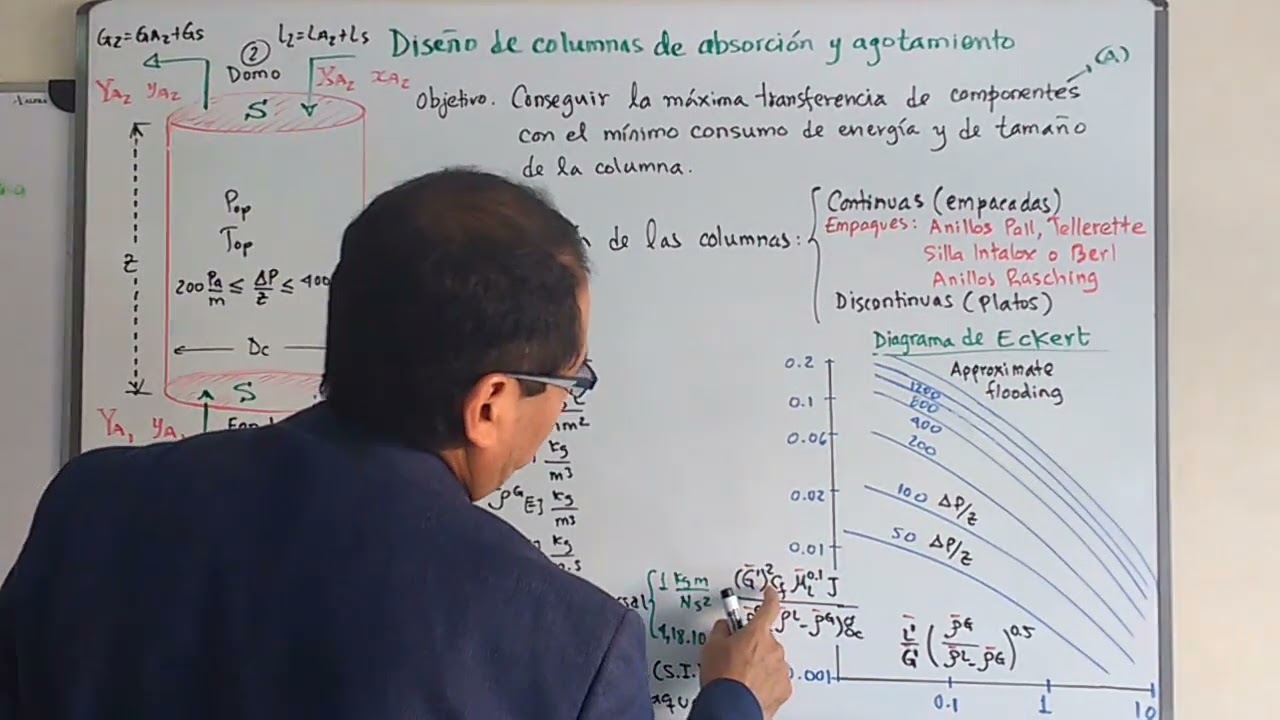
The discussion focuses on designing columns for optimal component transfer with minimal energy consumption, covering continuous and discontinuous column classifications, parameters consideration, operation pressure, flooding prevention, and key design factors.
Column Classification and Design Considerations
- Columns are classified as continuous (packed columns) or discontinuous (plate columns), impacting the packing type used.
- Parameters like total and individual flow rates are crucial in column design for gases and liquids to ensure efficient performance.
- Pressure, temperature, pressure drop across packings, column diameter, and height are vital considerations in achieving optimal design.
Balancing Material Flow and Concentrations
- Balancing material flow is essential in counter-current columns to prevent flooding; concentrations of entering and exiting components must be monitored closely.
- Inadequate pressure drop consideration can lead to flooding where gas displaces liquid; proper liquid loading is critical for optimal performance.
Graphical Representation Techniques
- Utilizing log-log plots aids in visualizing pressure drop against packing height; understanding maximum gas velocity is crucial for efficient operation.
- Naker's diagram illustrates molar flux relationships between gas and liquid phases based on density differences; factor corrections play a significant role.
Flood Prevention Strategies
- Monitoring flood potential through the dryness of packings helps determine optimal liquid loading ranges to avoid operational issues.
New Section
In this section, the speaker discusses the importance of considering various factors such as viscosity and testing locations in a system. The curves presented represent pressure drop concerning packing height.
Factors to Consider in System Design
- Importance of considering viscosity and testing locations on the x-axis and at 10.
- Pressure drop represented by curves based on packing height.
- Units for G prime, liquid viscosity, gas density, and other parameters discussed.
- Explanation of constants like universal constant value.
- Introduction to correction factor (cf) and packing factor (cf).
New Section
This part delves into the basic design of diffusional packed towers for isothermal absorption of a single component under steady-state conditions.
Designing Packed Towers for Absorption
- Calculation of packing height crucial for concentration change in gas and liquid phases.
- Utilizing a mathematical model derived from a physical model for tower design.
- Assumptions about uniform distribution in the column affecting transfer processes.
New Section
Here, the focus shifts to correlations used in tower design that must account for mass transfer coefficients crucial in absorption processes.
Correlations and Tower Design
- Emphasizing the significance of mass transfer coefficients in absorption processes.
- All absorption transfers occur at the column base involving gas velocity and cross-sectional area.
New Section
Discussion centers on formulating a mathematical model based on differential equations for isothermal absorption without chemical reactions.
Formulating Mathematical Model
- Conditions set for modeling isothermal absorption without chemical reactions.
Detailed Mathematical Analysis
In this section, a detailed mathematical analysis is conducted involving derivatives and gradients within the context of the discussion.
Derivative Calculation and Analysis
- The derivative of a quotient is calculated as the derivative of the numerator times the denominator minus the numerator times the derivative of the denominator. This process is crucial for understanding variations in functions.
Multiplication and Binomial Expansion
- Multiplying terms involving binomials results in expanding to (1 - y)^2, highlighting fundamental algebraic operations within mathematical expressions.
Expression Simplification and Variable Isolation
- Expressions are simplified by dividing by specific terms to isolate variables, leading to a clearer representation of mathematical relationships.
Integration Process Initiation
- The integration process begins by multiplying and simplifying terms before proceeding with integrating over specified ranges, demonstrating step-by-step mathematical procedures.
Integration and Concentration Analysis
This segment delves into integrating concentration values within defined limits to analyze chemical processes accurately.
Integral Calculation for Concentration Analysis
- Integrating concentration values from initial to final states provides insights into chemical absorption processes, offering a comprehensive view of concentration changes over time.
Determination of Theoretical Column Height
- The theoretical column height is derived through mathematical modeling, emphasizing the importance of theoretical frameworks in practical applications such as chemical engineering.