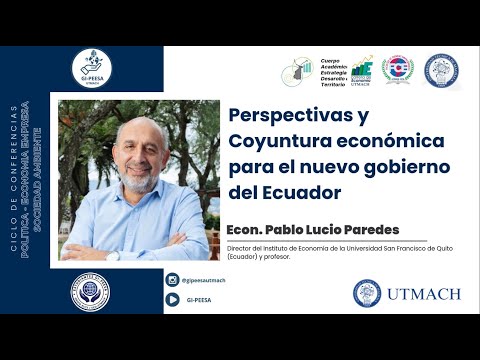
Pablo Lucio Paredes #ecuador #fiscaldescentralization #fiscal #economics #globaleconomicgovernance
Economic Perspective and Challenges for the New Government in Ecuador
Introduction to Pablo Lucio Paredes
- Pablo Lucio Paredes is an economist with a PhD in applied economics from the Institute of Political Studies in Paris, France.
- He serves as the director of the Institute of Economics at the University of San Francisco de Quito and has extensive experience as a consultant for national and international companies.
- His background includes significant roles such as secretary of planning and member of the 2007 Constituent Assembly, along with founding various educational initiatives.
Key Themes in Economic Development
- Paredes emphasizes that his discussion will focus on economic challenges facing Ecuador's new government within a 30-minute timeframe.
- He expresses a desire to discuss future-oriented topics but acknowledges that current issues require immediate attention due to stagnation over decades.
Importance of Productivity
- The essence of economic development lies in productivity, defined as generating more value by utilizing resources effectively.
- Paredes categorizes productivity into three types: economic (producing quality goods/services), social (improving education/health), and institutional (enhancing political quality).
The Role of Dollarization
- Dollarization is highlighted as a crucial asset for Ecuador’s economy, providing stability essential for growth.
- Paredes notes that many young people may take dollarization for granted, yet it forms a solid foundation upon which further economic development can be built.
- He compares Ecuador's situation without dollarization to Argentina's ongoing economic struggles, underscoring its importance.
Economic Stability and Growth in Ecuador
The Importance of Dollarization
- The speaker emphasizes that maintaining dollarization is crucial for Ecuador's economic stability, comparing the country to Argentina and Venezuela. Without dollarization, Ecuador would face greater uncertainty and instability.
- Dollarization is described as a deep asset for Ecuador that should be preserved without debate, regardless of how long it lasts—be it 10, 50, or even 200 years.
Economic Growth Objectives
- The primary economic objective for society should be straightforward: to grow the economy and increase economic activity. This growth leads to more supply and demand, investment opportunities, job creation, and improved incomes.
- Economic growth is not only vital for financial improvement but also enhances social conditions and political stability by allowing citizens to make more informed choices during elections.
Target Growth Rates
- A reasonable annual growth target for Ecuador is set between 4% and 5%, considering historical growth rates have hovered around this range over the past decade.
- Given recent trends of low or negative growth since 2015, aiming for a modest yet achievable goal of 4% to 5% annually is deemed essential for improving overall life quality in Ecuador.
Sustainable Growth Challenges
- Achieving sustainable growth requires collective effort from all sectors; it's not an easy task. Sustainable growth means maintaining improvements over time rather than experiencing temporary spikes through debt or depletion of savings.
- Short-term gains can lead to unsustainable practices like excessive borrowing or spending savings ("raspar la olla"), which ultimately result in worse conditions after a few years if not managed properly.
Steps Towards Economic Improvement
- To foster sustainable economic growth in Ecuador, multiple strategies must be implemented—akin to assembling a puzzle with various pieces that need attention simultaneously.
Insecurity and Energy Challenges in Ecuador
The Impact of Narcoeconomy on Youth
- The speaker highlights the concerning trend of youth being drawn into narcoeconomy, suggesting that they should be offered better opportunities instead. This issue is a critical piece of the insecurity puzzle in Ecuador.
Addressing Insecurity
- The speaker admits uncertainty about how to effectively tackle insecurity, emphasizing that it is primarily a security issue rather than an economic one. They acknowledge the need for specialized expertise to address this complex problem.
Electricity as a Fundamental Issue
- A significant concern raised is the reliability of electricity supply, which is essential for modern society's functioning. The speaker reflects on historical reliance on energy sources and warns about potential future outages similar to those experienced previously in 2023.
Political Representation and Electoral Reform
- There is a pressing need to improve political representation in Ecuador, with citizens feeling poorly represented by their elected officials. Suggestions include electoral system changes and eliminating mandatory voting to enhance accountability among representatives.
- Despite widespread dissatisfaction with the National Assembly, many incumbents are likely to be re-elected, raising questions about voter behavior and political reform effectiveness.
Justice System Concerns
- The justice system's integrity is questioned; there’s a call for trust in its ability to deliver fair outcomes without requiring bribes or payments for justice services. This corruption undermines public confidence and reflects broader societal issues within Ecuador's governance structure.
Social Security Issues
Reformas Necesarias para el Ecuador
Mercado Laboral y Empleo Pleno
- El mercado laboral en Ecuador es ineficiente tanto para empresarios como para trabajadores, con solo un tercio de la población ocupada teniendo un empleo pleno (40 horas semanales y salario básico).
- Se propone aumentar el porcentaje de empleos plenos al 40% y luego al 50%, lo cual requiere crecimiento económico y reformas laborales.
- La reforma laboral es crucial para mejorar las relaciones entre trabajadores y empleadores, permitiendo mejores condiciones laborales.
Recursos Naturales: Petróleo y Minería
- Es fundamental impulsar la explotación responsable del petróleo y la minería legal en Ecuador, evitando la minería ilegal.
- Se enfatiza que estas actividades deben ser responsables con el medio ambiente, aprovechando los recursos naturales que posee el país.
Apertura del Sistema Financiero
- Se sugiere abrir el sistema financiero ecuatoriano al mundo, aumentando la presencia de instituciones financieras internacionales.
- Esto podría ofrecer más crédito en mejores condiciones a los ecuatorianos, aprovechando la dolarización del país.
Reforma del Estado
- Se plantea una reforma integral del gobierno ecuatoriano debido a su gasto anual de $48,000 millones, buscando eficiencia en el uso de estos recursos.
- La actual gestión gubernamental se critica por malgastar dinero sin lograr resultados efectivos en educación o salud.
Eficiencia Gubernamental
- Es necesario gastar menos pero mejor; malgastar recursos empobrece a la sociedad igual que lo haría en una familia o empresa.
- La propuesta incluye dejar de gastar en cosas innecesarias y enfocarse en áreas críticas que beneficien a la población.
Conclusiones sobre Reformas
- Se presentan nueve reformas clave como piezas de un rompecabezas para mejorar la productividad económica y social del país.
Ecuador's Challenges in Consensus Building
Lack of Agreement and Dialogue
- The speaker highlights a significant issue in Ecuador: the inability to reach consensus. People often refuse to engage with others based on political affiliations or personal feelings.
- This lack of dialogue stems from a belief that one's own perspective is the only valid one, making it difficult for society to progress collectively.
Importance of Freedom for Economic Growth
- In response to a question about sustainable economic growth, the speaker emphasizes that a less restrictive state fostering free enterprise is essential for development.
- The speaker argues that true societal progress comes from individuals and families rather than government intervention, which should create an enabling environment.
Key Economic Challenges Facing Ecuador
Defining Freedom and Its Implications
- The concept of freedom is clarified as not merely doing whatever one wants but acting respectfully towards others, which is crucial for social harmony.
- An analogy using traffic illustrates how individual freedoms must coexist with respect for others' rights to ensure functionality within society.
Major Issues for the Upcoming Government
- The speaker identifies nine critical challenges facing the new government, including insecurity, electricity issues, justice reform, and social security system sustainability.
- A pressing concern is the impending crisis in the pension system due to increasing numbers of retirees without adequate support structures.
Strategies for Economic Reform
Opening Up Trade Opportunities
- Emphasizing international trade agreements as vital for Ecuador’s economic potential, the speaker notes recent treaties with Europe and ongoing negotiations with Canada and South Korea.
Labor Market Reforms
- Addressing labor market modernization, there’s an acknowledgment of current employment quality issues; 30% are deemed adequate while 70% are not.
Improving Employment Conditions in Ecuador
The Importance of Gradual Improvement
- Emphasizes the need for gradual improvement in employment conditions, suggesting that both adequate and inadequate jobs should see progress over time.
- Advocates for a realistic approach where every Ecuadorian can improve their job situation incrementally, leading to better overall conditions in the future.
Aligning Employer and Employee Needs
- Highlights the necessity of aligning employer needs with employee capabilities rather than forcing one to adapt to the other.
- Discusses specific examples, such as restaurants needing staff during certain hours, indicating a mismatch between available work hours and employee availability.
Addressing Abuse in Employment Relationships
- Points out potential abuses from employers who may underpay workers or change agreed salaries without notice, stressing that this is unacceptable.
- Stresses that worker abuse towards employers is equally wrong; both sides must find a reasonable balance to avoid exploitation.
Fiscal Deficit Solutions for Ecuador
Strategies for Addressing Fiscal Deficit
- Identifies two main strategies: increasing government revenue through taxes or reducing unnecessary government expenditures.
- Critiques current practices focused on raising taxes instead of addressing wasteful spending within government operations.
Evaluating Government Expenditures
- Suggests evaluating all government programs and institutions from scratch (zero-based budgeting), questioning their utility and eliminating those deemed unnecessary.
- Argues that cutting wasteful spending does not harm the economy but rather strengthens it by removing financial burdens that hinder growth.
Implementing Zero-Based Budgeting
Financing and Investment Opportunities in Ecuador
Strengthening Public Finances
- The speaker emphasizes the importance of strengthening public finances to enhance their effectiveness, advocating for a focus on expenditure rather than revenue generation.
Private Investment as a Key Driver
- Responding to a question about investment opportunities, the speaker asserts that Ecuador needs primarily private investments, particularly in export products and services.
- It is highlighted that while foreign investment accounts for 20% globally, 80% should come from domestic sources. The challenge lies in creating favorable conditions for local investors.
Government's Role in Creating an Enabling Environment
- The government must foster an environment conducive to investment by addressing various challenges and encouraging risk-taking among potential investors.
- The speaker argues that sectors like oil should see private investments rather than relying on state-owned enterprises like Petroamazonas.
Infrastructure Development Challenges
- A call is made for private sector involvement in infrastructure projects such as new refineries and highways, citing historical delays in road construction between major cities like Quito and Guayaquil.
- The speaker reflects on past proposals for highway improvements that remain unaddressed decades later, highlighting inefficiencies in infrastructure development.
Current State of Road Infrastructure
- Observations are made regarding the poor condition of roads connecting key cities like Machala and Guayaquil, stressing the need for urgent upgrades to facilitate economic growth.
- There is frustration expressed over ongoing delays with road projects despite previous commitments from various administrations to complete them.
Critique of Prioritization of Projects
- The discussion critiques the prioritization of toll booths over actual road completion, questioning the logic behind charging fees before providing adequate infrastructure.
- Emphasis is placed on basic infrastructural needs being unmet while more advanced topics like artificial intelligence are discussed without foundational support being established first.
Conclusion: Addressing Basic Needs Before Advancing
Future Challenges in Ecuador
Addressing Basic Problems Before Progress
- The speaker emphasizes the importance of resolving basic issues before moving on to more advanced topics. They express concern about returning in 15 years to find no progress made.
- A vision for the future includes having completed infrastructure projects, improved fiscal stability, and advancements in pension systems, allowing discussions on broader future topics.
- The speaker expresses gratitude for the opportunity to share insights and highlights the value of learning from each other during this conference.
Closing Remarks and Future Outlook
- In concluding remarks, the speaker thanks attendees for their engagement and expresses hope for future conversations, ideally in a different location (Machala).
- The speaker acknowledges Ecuador's potential despite its challenges, urging young people to actively pursue opportunities rather than waiting passively.