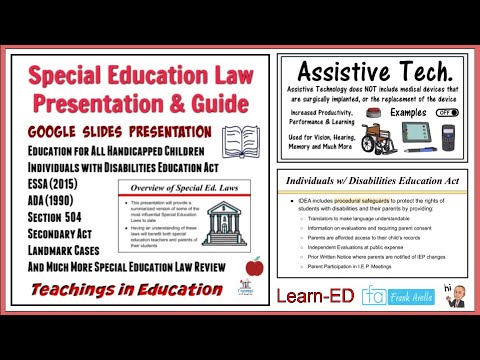
Special Education Law Course
Introduction to Special Education Law
This section provides an introduction to special education law and emphasizes the importance of understanding the law for teachers, parents, and students.
Importance of Knowing Special Education Law
- Everyone involved in special education should have knowledge of the law.
- Schools often provide parents with information about special education rights.
- Understanding the law helps ensure that schools are following proper procedures.
Overview of the Course
This section gives an overview of what will be covered in the course on special education law.
Course Content
- The course will cover a brief history of special education laws.
- Specific landmark cases will be discussed.
- The Individuals with Disabilities Education Act (IDEA) will be explored.
- The course aims to provide a comprehensive understanding of special education laws.
Availability of Resources
This section highlights the availability of resources related to special education law.
Video Resource
- A condensed video on special education law is available for further learning.
- The video provides an overview of important laws and a short history.
Importance for Teachers and Parents
This section emphasizes the importance for both teachers and parents to understand special education laws.
Benefits of Knowing the Law
- Knowledge of the law benefits both teachers and parents in advocating for students with disabilities.
- Schools often provide parents with information about their rights in IEP meetings.
Elementary and Secondary Education Act (ESEA)
This section discusses the Elementary and Secondary Education Act (ESEA), which was signed into law in 1965.
Key Provisions of ESEA
- Signed into law by Lyndon B. Johnson in 1965 as Public Law 89-10 (PL 89-10).
- Aimed to provide educational support to low-income families.
- Included provisions for free and reduced lunch programs.
- Focused on equal access to education for all students.
Vocational Rehabilitation Act and Section 504
This section introduces the Vocational Rehabilitation Act and Section 504, which aim to protect individuals from discrimination based on disabilities.
Key Points
- The Vocational Rehabilitation Act and Section 504 guarantee rights for individuals with disabilities.
- Affirmative action programs were established under these acts.
- These laws set a precedent for future special education laws.
Funding and Achievement Gaps
This section discusses funding issues and achievement gaps between wealthy and impoverished schools.
Funding Provisions
- The ESEA provided funding for professional development, instructional materials, parent engagement opportunities, and support systems for students.
- Large achievement gaps existed between wealthy and impoverished schools at that time.
These are the main sections covered in the transcript.
New Section
The history of special education and the importance of laws protecting the rights of students with disabilities.
History of Special Education
- In the 1800s, special needs children were denied access to schools and had their own separate institutions.
- Prior to the 1950s, there was discrimination against individuals with disabilities in education.
- The 1970s marked a turning point with the introduction of laws protecting the rights of students with disabilities.
Importance of Laws
- Activism played a role in advocating for laws that protect individuals with disabilities.
- Prohibition should lead to positive changes in the form of laws.
- Laws ensure equal access to education and reasonable accommodations for individuals with disabilities.
- Reasonable accommodations are important but do not mean exempting individuals from work responsibilities.
- Employers must make reasonable accommodations but are not obligated to hire unqualified individuals or those who pose a danger to others in the workplace.
New Section
Section 504 of the Rehabilitation Act and its significance in ensuring equal access to education for students with disabilities.
Section 504 and ADA
- Section 504 is a historic civil rights law enacted in the United States that guarantees equal access to education for students with disabilities.
- It serves as the basis for the Americans with Disabilities Act (ADA).
- Students are defined as having a disability if they have a mental or physical impairment that limits major life activities, including breathing, concentrating, walking, speaking, learning, self-care, and manual tasks.
- A record of impairment is necessary to qualify under Section 504.
Eligibility and Accommodations
- To be covered under Section 504, students must be qualified and between the ages of 3 and 22.
- Examples of impairments include long-term debilitating illnesses, epilepsy, chronic illness, severe allergies, and diabetes.
- A committee consisting of educators and others familiar with the student evaluates eligibility for 504 services.
- Accommodations for 504 students may include extended time, enlarged print, oral assessments, books on tape, graphic organizers, and behavior intervention plans.
New Section
The evaluation process and parental involvement in Section 504 plans.
Evaluation Process
- Anyone can refer a student for evaluation under Section 504 to determine eligibility for services.
- A committee reviews the child's academic progress, teacher evaluations, observations, and other relevant factors.
- Parental notification is crucial throughout the evaluation process.
Parental Involvement
- Parents must be notified about the evaluation process and have input in decision-making regarding their child's Section 504 plan.
- This trend of parental involvement continues in special education law training when discussing Individualized Education Programs (IEPs).
New Section
Least restrictive environment and additional resources related to Section 504.
Least Restrictive Environment
- Accommodations provided under Section 504 aim to ensure access to education in the least restrictive environment possible.
- An infographic is available that provides more information on Section 504.
The transcript does not provide further content beyond this point.
Definition of Appropriate Education
This section provides a definition of the term "appropriate education" and discusses the familiarity of educators with students with 504 plans.
- Appropriate education is a term used in education to describe the type of education that is suitable for each student's needs.
- Many educators are familiar with students who have 504 plans, which outline accommodations for these students.
Educational Amendments Act and Due Process
This section discusses the Educational Amendments Act and its provision for due process in special education cases.
- The Educational Amendments Act grants students and families the right to due process.
- Due process ensures fair treatment through a normal judicial system, especially in special education law cases.
Office of Gifted and Talented and Federal Funds
This section highlights the initial housing of the Office of Gifted and Talented within the U.S. Office of Education and mentions federal funds provided to state programs for exceptional learners.
- The Office of Gifted and Talented was initially held within the U.S. Office of Education.
- Federal funds are allocated to state programs that cater to exceptional learners.
Education for All Handicapped Children Act (EAHCA)
This section focuses on the significance of the Education for All Handicapped Children Act (EAHCA), enacted in 1975, as a turning point in special education.
- The EAHCA, also known as Public Law 94-142, was enacted by Congress in 1975.
- It is considered a crucial law in special education, guaranteeing free and appropriate public education (FAPE) to all students with disabilities.
Accomplishments and Reauthorization of EAHCA
This section discusses the accomplishments of the Education for All Handicapped Children Act (EAHCA) and its subsequent reauthorizations.
- The EAHCA was eventually reauthorized as the Individuals with Disabilities Education Act (IDEA), which has undergone improvements in 1997 and amendments in 2004.
- The law ensures continuous improvement and reauthorization to enhance special education services.
FAPE and Least Restrictive Environment (LRE)
This section highlights the concept of Free Appropriate Public Education (FAPE) and the Least Restrictive Environment (LRE).
- FAPE guarantees that students with disabilities receive a free and appropriate education funded by the public.
- LRE refers to an educational environment where students with disabilities are placed alongside their non-disabled peers, based on their academic, social, and emotional capabilities.
Decision-Making in Special Education Services
This section discusses how educators make fair decisions regarding the type and kind of educational services received by special education students.
- Educators are responsible for making fair decisions regarding the educational services provided to special education students.
- The goal is to ensure that decisions align with each student's needs, abilities, and requirements.
Placement Options Based on Academic Goals
This section explores placement options for special education students based on their academic goals.
- Students can be placed in separate schools with other disabled peers if their academic goals cannot be met in a regular education classroom.
- The ultimate goal is to move students up the LRE ladder, allowing them to spend more time with non-disabled peers.
Mainstreaming and Inclusion
This section introduces the concept of mainstreaming, which occurs when students with disabilities are placed in general education classrooms.
- Mainstreaming aims to provide students with disabilities access to the general education curriculum and classes.
- Students may be placed in general education classes based on their strengths, while receiving additional support for weaker subjects.
Maximizing Time with Non-Disabled Peers
This section emphasizes the importance of maximizing time spent by children with disabilities alongside their non-disabled peers.
- The goal is for children with disabilities to spend as much time as possible with their non-disabled peers.
- Placement in separate schools or specialized settings should only occur if necessary, with the aim of gradually increasing inclusion opportunities.
The summary has been provided in English language and markdown format as requested.
New Section
This section discusses the importance of due process in ensuring that parties meet their legal obligations. It also highlights the funding agreement for special education and the entitlement of physically or mentally disabled children to free school meals.
Due Process and Legal Obligations
- Due process allows courts to get involved when schools fail to meet their legal obligations.
- The concept of due process ensures that schools cannot make unilateral decisions without accountability.
- Due process is a crucial aspect of education law, providing protection and fairness.
Funding for Special Education
- Congress agrees to fund up to 40% of the excess cost of special education.
- Physically or mentally disabled children are entitled to at least one free school meal per day.
- This funding agreement is an essential part of ensuring equal access to education for all students.
Evaluation and Individualized Education Program (IEP)
- Public school districts must evaluate handicapped children at their own expense.
- Parents do not have to pay for evaluations if they suspect their child has a learning disability.
- Evaluations are used to create an individualized education program (IEP) tailored to each child's abilities.
Importance of Parental Input in IEP Development
- Parents' input is crucial when developing IEPs as they have valuable information about their child.
- The IEP must place the child in a position where they can succeed academically and socially.
- The Education for All Handicapped Children Act protects the rights of students and parents under the 14th Amendment's equal protection clause.
New Section
This section emphasizes the importance of equal protection under law, highlights the Child Find requirement, and discusses intervention and referral services.
Equal Protection and Child Find
- The 14th Amendment's equal protection clause ensures that the rights of students and parents are protected.
- No state can deny any individual within its jurisdiction equal protection under the law.
- Schools are required to actively search for students with disabilities through a process called Child Find.
Intervention and Referral Services
- Many parents and children may be in denial about having a disability, which is why Child Find is crucial.
- Intervention and referral services aim to identify students who may need special education support.
- School systems have implemented various programs, such as response to intervention plans, to ensure early identification of students with disabilities.
New Section
This section focuses on the Education of Handicapped Act Amendments enacted in 1986, extending free and appropriate education to young children ages three to five. It also introduces early intervention programs.
Education of Handicapped Act Amendments (1986)
- The Public Law 99-457 enacted in 1986 aimed to provide better services for young children and their families.
- Free and appropriate education was extended from age five through eighteen to include children ages three to five.
- Early intervention programs for children with disabilities were requested from birth age onwards.
Handicapped Infants and Toddlers Program
- The law created the Handicapped Infants and Toddlers Program specifically for children with developmental delays or disabilities.
- States received assistance in implementing these programs for very young children.
- Research shows that early intervention has long-term benefits for children with disabilities.
New Section
This section introduces the Americans with Disabilities Act (ADA) enacted in 1990, which prohibits discrimination in the workforce based on various factors.
Americans with Disabilities Act (ADA)
- The ADA builds upon the civil rights laws of the 1960s and focuses on prohibiting discrimination in the workforce.
- The law specifically addresses discrimination based on sex, religion, sexual orientation, and race.
- Its aim is to ensure equal opportunities for individuals with disabilities in employment.
New Section
This section discusses the importance of the Americans with Disabilities Act (ADA) and its impact on people with disabilities, including students in school systems.
ADA and Its Protections
- ADA makes it illegal to discriminate against people with disabilities anywhere, including school systems.
- School systems are included under the umbrella of ADA, providing protections for students with disabilities.
- Other laws such as Section 504 and IDEA offer additional protections for children with disabilities.
New Section
This section explains the relationship between ADA and special education law in schools.
ADA's Impact on School Systems
- ADA offers protections to students with disabilities in school systems.
- While ADA provides some level of protection, other laws like Section 504 and IDEA offer even more comprehensive safeguards.
New Section
This section provides an overview of reasonable accommodations under ADA.
Reasonable Accommodations Under ADA
- Reasonable accommodations are provided under ADA to ensure equal opportunities for individuals with disabilities.
- Examples of reasonable accommodations include building ramps for wheelchair accessibility or allowing short breaks for medical needs.
- Unreasonable accommodations, such as excessive time off or extravagant requests, are not required by law.
New Section
This section discusses the requirements and provisions of reasonable accommodations under ADA.
Requirements and Provisions of Reasonable Accommodations
- Employers must provide reasonable accommodations as mandated by ADA.
- Public accessibility requirements ensure that buildings, products, and services are designed to be readily available to individuals with disabilities.
- Various reasonable accommodations can be made to facilitate accessibility for individuals with disabilities.
New Section
This section introduces the Individuals with Disabilities Education Act (IDEA) of 1990 and its purpose.
Introduction to IDEA
- IDEA, enacted in 1990, renamed the Education for All Handicapped Children Act of 1975.
- The law was amended in 1997 and 2004 to make necessary improvements.
- IDEA aims to improve transitional programming, evaluation of students, and procedural safeguards.
New Section
This section explains the purpose and objectives of IDEA.
Purpose and Objectives of IDEA
- The purpose of IDEA is to respect each child's unique needs in special education.
- It pushes schools to provide more individualized education for children with disabilities.
- IDEA aims to protect the rights of special education children and parents, assist states and school districts, prepare educators through research-based knowledge, secure materials and tools, and assess program effectiveness.
New Section
This section discusses the evaluation process under IDEA.
Evaluation Process under IDEA
- Evaluations are conducted to determine a student's eligibility for special education through a defined process.
- The evaluation process should minimize misidentifications and identify students in need of support.
New Section
The importance of considering language and tools used in special education evaluations.
Language and Evaluation Tools
- The choice of language and wording used in evaluation tools is crucial in special education assessments.
- Different evaluation tools should be used to avoid misidentifications and discrimination.
- The law emphasizes the use of a variety of evaluation tools to ensure individualized education for special needs children.
New Section
Understanding the concept of Free Appropriate Public Education (FAPE) and its significance.
Free Appropriate Public Education (FAPE)
- FAPE was first guaranteed under the Rehabilitation Act and further established in the Education for All Handicapped Children Act (EAHCA) of 1975.
- FAPE ensures that a child's unique needs are met while preparing them for life outside of education.
- An appropriate education must meet state standards, including preschool, elementary, and secondary schools.
New Section
Individualized Education Programs (IEPs) as legal documents outlining a child's educational plan.
Individualized Education Programs (IEPs)
- Public schools are required to create an IEP for any student eligible for special education services.
- An IEP is a legal document that must be followed without debate.
- It serves as the centerpiece for delivering a child's special education, providing a blueprint for teaching methods and goals.
New Section
Components that an IEP should include.
Components of an IEP
- Present level of academic performance, annual goals, functional and academic related services needed.
- Supplemental aids such as speech therapy or physical therapy may be necessary.
- Accommodations for statewide testing, including extended time.
- Reason for placement and inclusion with non-disabled peers.
- Mention of the time spent in a general education setting.
- Classroom modifications and progress towards annual goals.
New Section
Least Restrictive Environment (LRE) and dispute resolution guidelines.
Least Restrictive Environment (LRE)
- Students with disabilities should be educated to the maximum extent possible with their non-disabled peers.
- Special needs students should only be removed from a general education setting if their needs cannot be met there.
- Dispute resolution guidelines include due process hearings, mediation, and the right to file a civil lawsuit if mediation is unsatisfactory.
New Section
Stay put provision and alternative dispute resolution methods.
Stay Put Provision and Alternative Dispute Resolution
- The stay put provision ensures that a student remains in their current school until a resolution is reached during disputes.
- Mediation can serve as an alternative to due process, involving a third-party mediator to resolve conflicts between parents and schools.
- If mediation fails, parents have the option to file a civil lawsuit.
The summary has been provided based on the given transcript.
New Section
This section discusses the importance of confidentiality in student records and the rights of parents to review and correct inaccurate information.
Ferpa and Confidentiality
- The law known as FERPA (Federal Education Rights and Protection Act) ensures that parents have the right to review their children's records.
- These records must be kept confidential from individuals outside of the school.
- Personal information, such as addresses, phone numbers, and personal stories, should be kept private.
New Section
This section explains the procedural safeguards provided by IDEA (Individuals with Disabilities Education Act) to protect the rights of students with disabilities and their parents.
Procedural Safeguards
- IDEA provides translators to make language understandable for parents who do not speak English.
- Schools must provide information on evaluations and require parent consent.
- Parents have access to their child's records.
- Independent evaluations can be conducted at the public's expense.
- Prior written notice is given to parents regarding changes in the IEP (Individualized Education Program).
- Parent participation in the IEP meeting is encouraged but not mandatory.
New Section
This section highlights the importance of collaboration between parents and teachers, as well as related services provided for students with disabilities.
Collaboration and Related Services
- IDEA encourages collaboration between parents and teachers, recognizing that parents are a valuable source of information about their child.
- Parents have a right to contribute to the IEP meeting.
- Students with disabilities are entitled to certain related services such as corrective therapy, speech therapy, occupational therapy, physical therapy, recreational services, counseling, psychological services, and transportation services.
New Section
This section focuses on transitional services for students with disabilities and the importance of transition planning.
Transitional Services and Planning
- IDEA states that students with disabilities must begin transitional services at the age of 16.
- Transitional services help students transition from high school to post-secondary life, including jobs, independent living, or college.
- Transition planning helps students identify their strengths and plan for their future.
- The goal is to accentuate a student's strengths, avoid career pitfalls, and ensure they engage in activities they enjoy.
New Section
This section discusses the reauthorization of IDEA in 1997, focusing on parent involvement and disciplinary consequences.
Reauthorization of IDEA in 1997
- The reauthorization aimed to improve special education by emphasizing parent involvement and disciplinary consequences.
- One major change was allowing the IEP evaluator to access previously collected data, saving time and reducing unnecessary tests for students.
- Evaluations can now consider previous testing, reporting, and background information.
- This amendment benefits both schools and students by reducing costs and burden.
New Section
This section highlights the involvement of students with disabilities in general education classrooms and focuses on modifications and accommodations.
Inclusion in General Education
- IDEA emphasizes the involvement of students with disabilities in general education classrooms.
- Modifications and accommodations are provided to support their learning needs.
Understanding Accommodations and Modifications
In this section, the speaker discusses the difference between accommodations and modifications in education.
Difference between Accommodations and Modifications
- Accommodations are provided to help students better access the content, while modifications involve actual changes to the content or learning goals.
- Examples of accommodations include preferential seating, extended time for tests, and open notebooks.
- Examples of modifications include alternate reading materials, word banks, and opportunities to retake quizzes.
- It is important to understand the difference between accommodations and modifications in education.
The IEP Team and Eligibility Determination
This section focuses on the composition of the Individualized Education Program (IEP) team and eligibility determination for special education services.
Composition of the IEP Team
- The IEP team must include qualified members such as a parent or guardian, special education teacher, regular education teacher, test interpreter, and school representative.
- Under IDEA 1997, parents legally became part of the team in determining their child's eligibility for special education services.
Eligibility Determination
- To be eligible for special education services, evidence must show that a student not only has a disability but that it also detrimentally affects their educational performance.
- Parent inclusion was emphasized through an amendment to IDEA 1997, ensuring their involvement in decision-making regarding their child's eligibility.
Changes to IEP in 1997
This section highlights the changes made to the Individualized Education Program (IEP) in 1997.
- Changes included testing accommodations for standardized tests, statewide testing, and proper training for classroom paraprofessionals.
- The Present Level of Educational Performance (PLEP) statement was required to explain how a student's disability affects their progress in reaching general education goals.
- The PLEP also needed to address the extent to which special needs students would participate with their non-disabled peers in both classroom and extracurricular activities.
- Students must be informed of their rights at least one year before reaching the legal age of majority, when parental rights are transferred to the child.
The transcript provided does not include timestamps beyond this point.
Beginning as Early as 14 Years Old
This section discusses the age at which transitional services can begin for students with disabilities, as well as the role of mediation in resolving disagreements between parents and schools.
Transitional Services and Mediation
- Beginning at 14 years old, students with disabilities can start receiving transitional services.
- Transitional services help students transition from high school to outside life.
- Mediation is used when parents and schools cannot come to mutual agreements.
- The state provides a mediator to resolve disagreements between parents and school districts.
Manifestation Determination
This section explains the concept of manifestation determination, which involves reviewing a student's behavior to determine if it is a result of their disability or unrelated.
Understanding Behavior and Disability
- Manifestation determination is a review of a student's behavior to investigate whether it is a result of their disability.
- If the student's misbehavior is due to their disability, they cannot be blamed for it.
- If the student is misbehaving for reasons unrelated to their disability, disciplinary actions can be taken.
Conducting Manifestation Determination
- Manifestation determination must be conducted before suspending or expelling a special needs student.
- The review should take place within 10 days of the behavioral incident.
- It investigates whether improper behaviors resulted from inappropriate placement or detrimental educational programs.
- It also considers if the child's disability impairs their understanding of consequences or if the misconduct was caused by their disability.
Outcomes of Manifestation Determination
- If misconduct is found to be a result of the disability or inappropriate placement, expulsion is not allowed. However, changing placement may be acceptable.
- If there is no relationship between the disability and inappropriate behavior, disciplinary action can be applied.
Standardized Testing and Graduation
This section discusses the impact of standardized testing on students with disabilities and their graduation.
Testing for Students with Disabilities
- Students with disabilities are required to take standardized tests.
- These tests cannot be used to hold them back from graduation.
Pros and Cons of Standardized Testing
This section explores the pros and cons of standardized testing, particularly in relation to special education.
Pros and Cons of Standardized Testing
- There are both positive and negative aspects associated with standardized testing.
- The speaker believes that the benefits outweigh the drawbacks.
- A video discussing the pros and cons of standardized testing in special education is provided as additional information.
No Child Left Behind (NCLB)
This section introduces the No Child Left Behind (NCLB) law, which follows the Elementary and Secondary Education Act.
Introduction to NCLB
- The discussion transitions from IDEA 1997 to the No Child Left Behind (NCLB) law.
- Further details about NCLB will be provided in subsequent sections.
New Section
This section discusses the collaboration between Democrats and Republicans to help underachieving minority students. It explores the pros and cons of the No Child Left Behind Act, focusing on the pressure it puts on schools with bad teachers and weak administrators, as well as its emphasis on test scores.
Collaboration to Help Underachieving Minority Students
- The collaboration between Democrats and Republicans aims to assist underachieving minority students.
- Pros of the No Child Left Behind Act:
- Puts pressure on bad schools.
- Holds schools accountable for academic success.
- Cons of the No Child Left Behind Act:
- Too much emphasis on test scores.
New Section
In this section, teachers' perspectives on the No Child Left Behind Act are discussed. The law is criticized for focusing too much on test scores, but it also imposes penalties on schools that fail to fulfill their responsibilities.
Teachers' Perspectives
- Teachers believe that the law places excessive emphasis on test scores.
- The law holds schools accountable by imposing penalties for not fulfilling their duties.
- Schools argue that they are in a tough spot due to these requirements.
New Section
This section provides an overview of Public Law 107-110, also known as the No Child Left Behind Act. It was signed into law by President Bush in 2002 with the main purpose of holding schools accountable for delivering academic success to their students. School choice is a key aspect of this act.
Public Law 107-110: No Child Left Behind Act
- Public Law 107-110, signed into law in 2002 by President Bush, aims to hold schools accountable for academic success.
- School choice is emphasized, ensuring all students have opportunities to attend successful schools.
New Section
This section highlights the emphasis on standardized testing in the No Child Left Behind Act. It aims to identify lagging schools and students at risk, providing support and intervention to help them succeed. The law also requires testing of students in mathematics and reading across multiple grades.
Emphasis on Standardized Testing
- The No Child Left Behind Act emphasizes standardized testing.
- It aims to identify failing schools and students at risk.
- States are required to test students in mathematics and reading from grades three to eight.
- High school students must be tested at least once in math and reading.
New Section
This section discusses the requirements for public schools to make improvements and achieve success under the No Child Left Behind Act. While some argue that it places unnecessary pressure on school personnel, the act aims to ensure all students demonstrate proficiency in math, reading, and science.
Requirements for Public Schools
- Public schools are required to make improvements and achieve success.
- Some argue that this places unnecessary pressure on school personnel.
- The goal is for all students to demonstrate proficiency in math, reading, and science.
New Section
This section explores how the No Child Left Behind Act provides choices for students and their families. It promotes chartering schools' growth, offers protections for homeschooling, and allows children attending failing or unsafe schools to choose other public schools.
School Choice Options
- The No Child Left Behind Act provides choices for students and families.
- Students attending failing or unsafe schools can choose other public schools.
- Chartering schools' growth is encouraged.
- Protections are provided for homeschooling.
New Section
This section emphasizes the importance of providing relevant information to parents for making decisions about school choice. States and school districts must provide data through report cards, allowing parents to make informed decisions.
Providing Relevant Information to Parents
- States and school districts must provide relevant information to parents.
- Report cards are used to present performance data.
- Data is disaggregated based on grades, race, and gender.
- This helps identify any issues or discrimination.
New Section
This section highlights the increased flexibility in spending money provided by the No Child Left Behind Act. It aims to address the unique needs of each state and school district while reducing unnecessary paperwork. Local educators are given more decision-making power.
Flexibility in Spending Money
- The No Child Left Behind Act provides more flexibility in how states and schools can spend their money.
- Each state and school has different needs, so flexibility is beneficial.
- Local educators have more decision-making abilities.
- The act addresses complaints about excessive paperwork.
New Section
This section discusses the goals set by each state for their students under the No Child Left Behind Act. These goals include increasing standardized test scores, attendance rates, and graduation rates. Failing schools must meet minimum benchmarks for student achievement or risk being taken over by the state.
State Goals for Student Achievement
- Each state sets goals for students, such as increasing standardized test scores, attendance rates, and graduation rates.
- Failing schools must meet minimum benchmarks for student achievement.
- Schools are required to make annual progress towards their goals in math and reading.
New Section
This section emphasizes that the No Child Left Behind Act aims to improve education for all students regardless of their economic status or ethnicity. Schools must meet annual progress marks to close achievement gaps. Students can raise their targets each year, and states can adjust the annual progress targets.
Closing Achievement Gaps
- The No Child Left Behind Act aims to improve education for all students.
- Schools must meet annual progress marks to close achievement gaps.
- Students and states can raise their targets each year.
New Section
This section highlights the requirement for school districts to make annual reports on their achievements and shortcomings. These reports provide relevant information to parents when making decisions about where to send their children to school.
Annual Reports by School Districts
- School districts are required to make annual reports on their achievements and shortcomings.
- Reports must present performance data and disaggregate it based on subgroups.
- Parents can use these reports to make informed decisions about school choice.
New Section
This section focuses on the requirements for special education teachers under the No Child Left Behind Act. They must meet highly qualified status, which includes being state certified or licensed.
Requirements for Special Education Teachers
- Special education teachers must meet highly qualified status.
- They need to be state certified or licensed.
The transcript is already in English, so there is no need for translation.
New Section
In this section, the speaker discusses their qualifications as a special education and high school biology teacher. They mention having a K-12 certificate in biology and special education, making them highly qualified to teach these subjects.
Qualifications as a Biology and Mathematics Teacher
- The speaker is both a special education and high school biology teacher.
- They have a K-12 certificate in biology, which qualifies them to teach general education biology.
- They also have a K-12 mathematics certificate, allowing them to teach general education math.
- These qualifications make them highly qualified in both subjects.
New Section
This section focuses on the changes brought about by the law to make special education classes comparable to general education classes. It also discusses hiring standards for paraprofessionals and the importance of research-based instruction.
Making Special Education Comparable to General Education
- The law aims to ensure that both general education and special education teachers are knowledgeable in their subject areas.
- Previously, some teachers were grandfathered into teaching without meeting specific qualifications.
- The law requires special education teachers to meet the same standards as general education teachers.
Hiring Standards for Paraprofessionals
- Paraprofessionals working with tier one funding must meet certain standards.
- These standards include completing a two-year study at an institution, possessing an associate's degree or higher, or demonstrating proficiency through formal writing.
Importance of Research-Based Instruction
- Research-based instruction involves objective procedures and valid knowledge related to educational programs.
- Federal funding targets programs that have shown achievement through research-based methods.
New Section
This section emphasizes the importance of reading skills and research-based instructional strategies. It also highlights resources and funding available for early childhood intervention programs.
Importance of Reading Skills
- Reading skills are crucial for academic success.
- Teachers should focus on strengthening previously learned skills and helping students acquire new reading skills.
- Children with a solid foundation in reading are more likely to succeed in other subjects.
Research-Based Instructional Strategies
- Reading teachers from kindergarten to third grade are required to use research-based instructional strategies.
- These strategies have proven effectiveness in improving reading skills.
Resources and Funding for Early Childhood Intervention
- No Child Left Behind allocates resources and funding specifically for early childhood intervention programs.
- States opting into the Reading First program may receive funding for use in Head Start programs.
New Section
This section highlights the importance of safe schools and the consequences faced by schools that do not meet annual yearly progress (AYP) requirements. It also mentions the option for students to transfer schools if their current school is deemed unsafe.
Importance of Safe Schools
- Safe schools are essential for children's academic success.
- Funding is increased for drug and violence prevention programs, emphasizing the need for safe learning environments.
Consequences for Not Meeting AYP Requirements
- Schools that fail to meet AYP requirements face consequences based on the number of years they fail.
- After two years of failing, students must be allowed to transfer to better-performing schools, with transportation costs covered by the failing school.
- After three years, failing schools must offer supplemental educational services such as free tutoring or summer enrichment programs.
- After four years, failing schools must either replace staff or change their curriculum.
New Section
This section discusses the IDEA Improvement Act of 2004, which aimed to provide further support for special needs students. The speaker expresses their belief that these changes are beneficial despite frequent updates to education laws.
IDEA Improvement Act of 2004
- The Individuals with Disabilities Education Act (IDEA) was changed to include an extra "I" for improvement.
- The purpose of the act was to provide additional support for special needs students in preparing them for life outside of school.
Belief in Positive Changes
- Despite frequent updates and changes to education laws, the speaker believes that these changes are ultimately beneficial for students.
Qualifications for Special Education Teachers
This section discusses the qualifications required for special education teachers, including a bachelor's degree and state certification in special education.
Qualifications for Special Education Teachers
- Special education teachers must hold a bachelor's degree and have full state special education certification.
- The No Child Left Behind Act emphasized the need for highly qualified teachers, including special education teachers.
- Special education teachers in core academic subjects must prove subject mastery through tests like the Praxis.
- Consultation-only special education teachers do not need to prove subject mastery.
- The law pushes for high expectations for special needs children and increased exposure to general education classrooms.
Assistive Technology and Inclusion
This section explains the requirements for assistive technology devices and the focus on inclusion in special education.
Assistive Technology and Inclusion
- Special education inclusion teachers who provide consultation do not need to prove subject mastery.
- However, if they teach specific subjects like biology, they must demonstrate subject mastery through tests and credits.
- The law emphasizes high expectations for special needs children and increasing their time in general education classrooms.
- Assistive technology devices are defined as equipment used to increase, maintain, or improve functional capabilities.
- Some students with disabilities may require assistive technology devices to access printed materials.
Surgically Implanted Devices and Independent Living
This section discusses the definition of assistive technology devices, specifically excluding surgically implanted devices. It also clarifies that schools are not responsible for implementing or removing such devices.
Surgically Implanted Devices and Independent Living
- The definition of an assistive technology device was amended to exclude surgically implanted devices like cochlear implants.
- Students with assistive technology devices cannot be prevented from receiving special education services.
- Schools are not responsible for the implementation or removal of surgically implanted devices.
- The focus in 2004 is on preparing special education students for independent living, employment, and further education.
National Instructional Materials Accessibility Standards (NIMAS)
This section explains the importance of NIMAS in ensuring that students with disabilities have access to educational materials in formats other than print.
National Instructional Materials Accessibility Standards (NIMAS)
- IDEA 2004 required each state to follow the National Instructional Materials Accessibility Standards (NIMAS).
- NIMAS ensures that students who need educational materials in formats other than print have access to them.
- There is a link provided for more information about NIMAS.
Categories of Students with Disabilities
This section discusses the different categories of students with disabilities and how they are eligible for special education services.
Categories of Students with Disabilities
- In 1990, autism and traumatic brain injury were added as new categories of students with disabilities.
- Currently, there are 14 different categories, but one category may only apply until age nine.
- Students falling into these categories are eligible for special education services.
- A video is linked for more detailed information about the different categories.
Changes to Evaluation Requirements
This section highlights changes made to evaluation requirements under IDEA 2004, including parent consent and timeframes for evaluations.
Changes to Evaluation Requirements
- Parent consent is now required for special education evaluation services before they can begin.
- The timeframe between the request for an initial evaluation and determination of a disability was changed from 60 days to 60 calendar days.
- A single assessment tool should not be solely used to determine qualification for special education services.
- The criteria for determining specific learning disability allows for both discrepancy between achievement and...
Addition of Tourette Syndrome
This section discusses the addition of Tourette syndrome as a category under Other Health Impairment (OHI).
Addition of Tourette Syndrome
- Tourette syndrome, characterized by tics and verbal outbursts, was directly added to the category of Other Health Impairment (OHI).
- IDEA 2004 provides several changes to evaluation requirements.
Timeframe and Qualification Determination
This section further explains the changes made to evaluation requirements, including timeframes and qualification determination.
Timeframe and Qualification Determination
- The timeframe for initial evaluations changed from 60 school days to 60 calendar days.
- Multiple assessment tools should be used to determine the category of specific learning disability.
- IDEA 2004 provides several changes to evaluation requirements.
The remaining part of the transcript is not included in the provided information.
Classroom Observations and Academic Achievement
This section discusses the evaluation requirements for students with disabilities, including classroom observations, state testing, and overall academic achievement.
Evaluation Requirements
- Evaluations must be conducted in the child's native language.
- Assessment tools should be non-discriminatory and free from cultural bias.
- Assessments should be performed by individuals who are knowledgeable and trained in conducting assessments.
- Parents have the right to use private evaluations, but the school is not obligated to accept their recommendations.
Changes to IEP Requirements
This section highlights changes made to Individualized Education Program (IEP) requirements under the Improvement Act.
Changes to Evaluation Requirements
- The definition of an IEP now includes functional performance in addition to academic performance.
- Short-term objectives and benchmarks are no longer required on IEPs, except for special needs students taking alternative assessments.
- Goals should be based on academic progress towards standards.
Transfer of Special Needs Students
This section explains the changes made regarding transfer of special needs students between schools.
Transfer of Special Needs Students
- When a special needs student transfers schools, the new school must offer services comparable to those provided by the previous school district.
- The notice of procedural safeguards only needs to be distributed once a year, reducing administrative burden.
Alternate Ways of Conducting IEP Meetings
This section discusses alternate methods for conducting Individualized Education Program (IEP) meetings.
Alternate Methods for IEP Meetings
- IEP meetings can occur through video conferencing or other means, allowing flexibility during situations like social distancing.
- After an IEP meeting has taken place, amendments to the IEP can be made without the need for another meeting.
Transition Planning Amendments
This section covers amendments made to transition planning requirements under the Improvement Act.
Transition Planning Amendments
- Transition planning must now begin in the first IEP that will be in effect when the child turns 16, rather than at age 14.
- Transition planning should include appropriate post-secondary goals and assessments based on students' strengths and interests.
Disciplining Students with Disabilities
This section outlines additional procedures for disciplining students with disabilities.
Disciplinary Procedures
- Unique circumstances of a student's behavior can be considered on a case-by-case basis during disciplinary actions.
- Schools must notify parents on the same day in writing if there is a change of placement due to disciplinary measures.
- A pattern of removals exceeding 10 days constitutes a change of placement.
Inclusion Movement and Classroom Collaboration
This section discusses the inclusion movement and its impact on classroom collaboration between general and special education teachers.
Inclusion Movement and Classroom Collaboration
- The inclusion movement advocates for including students with disabilities in general education classrooms.
- Collaboration between general and special education teachers benefits special needs children, leading to improved performance.
Every Student Succeeds Act (ESSA)
This section provides an overview of the Every Student Succeeds Act (ESSA), which replaced No Child Left Behind in 2015.
Every Student Succeeds Act (ESSA)
- ESSA replaces No Child Left Behind as an educational policy framework.
- ESSA aims to ensure that every student succeeds and includes various provisions for improving education.
The transcript does not provide further details on the content after this timestamp.
No Child Left Behind and State Accountability
This section discusses the elimination of Adequate Yearly Progress (AYP) requirements under the No Child Left Behind Act. States are now required to submit goals and plans for achieving them to the U.S. Department of Education. Schools must offer college and career counseling, advanced placement classes, and bullying prevention programs.
Changes Under No Child Left Behind Act
- AYP requirements were eliminated, relieving schools from meeting specific standards.
- States are now responsible for submitting goals and plans to the U.S. Department of Education.
- The Department of Education provides feedback on state plans and holds states accountable through standardized tests.
Preparation for Post-Secondary Life
- Schools must provide college and career counseling to ensure students are well-prepared after high school.
- Advanced placement classes should be offered to students.
- Bullying prevention programs are implemented, with a focus on protecting special needs children.
Advocacy for Special Education
- Parents played a crucial role in advocating for special education legislation.
- Early in the 1800s, children with special needs were denied access to public schools.
- Inclusion movements have led to significant progress in providing education opportunities for individuals with disabilities.
Landmark Cases in Special Education
This section highlights important landmark cases that have influenced special education laws and rights.
Brown v. Board of Education (1954)
- Decision against racial segregation based on the concept of "separate but equal."
- Important landmark case in the civil rights movement that also impacted special education rights.
Board of Ed v. Rowley (1982)
- Amy Rowley, a deaf student, requested a sign language interpreter but was denied by her high school district.
- Supreme Court ruled that schools are not obligated to ensure students reach their maximum potential, but rather provide a basic level of education.
Smith v. Robinson (1984)
- Focused on reimbursement fees for parents' lawyers in special education cases.
- Congress passed a law allowing reimbursement for lawyer fees if the parent wins the case.
Mills v. Board of Education (1972)
- Court ruled that students with disabilities must be provided with a public education, regardless of their ability to pay.
The transcript does not specify the language used, so I have assumed it is English based on the content and context.
Independent versus Tatro
This section discusses the case of Amber, a student with spina bifida who required catheterization during school hours. The question was whether this service fell under medical services not covered by IDEA or related services covered by the IEP.
The Court Ruling
- The court ruled that the school board had to provide and pay for catheterization because it was necessary for Amber's learning.
- In comparison to another case involving a sign language interpreter, where the school didn't have to pay because the student was already learning.
Emotionally Disturbed Student Suspension
This section talks about a case where an emotionally disturbed student in San Francisco was suspended indefinitely for inappropriate behavior. The ruling stated that schools cannot suspend students if their behaviors are related to their disabilities.
Park versus Pennsylvania
This section discusses the case of Park suing public schools in Pennsylvania over a law that allowed denying children public education if they didn't meet academic standards.
- The court ruled that schools cannot deny a child public education based on academic ability.
Conclusion
This transcript provides insights into important legal cases related to special education rights. It highlights the need for schools to provide necessary services and accommodations for students with disabilities and emphasizes that behaviors caused by disabilities should not result in suspensions or denials of education.
Turn any video into a summary like this
YouTube links, meetings, lectures. With transcripts, search, and chat.