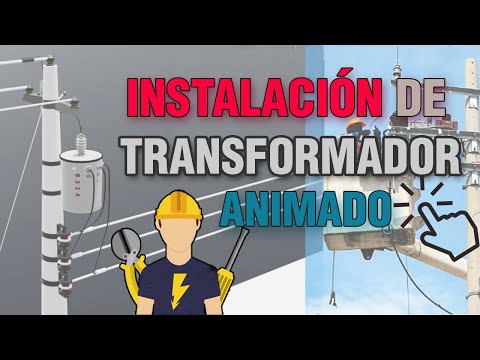
Instalación Montaje de Transformador Monofásico en 3D Animado | Partes y Componentes || Conecvid
Transforming Electrical Energy: Installation of a Single-Phase Transformer
Overview of Electrical Energy Transformation
- The video discusses the transformation of electrical energy, focusing on the installation and connection of a single-phase transformer.
- It explains how electricity generated from water in power plants is transformed and transmitted through high-voltage lines to substations, where voltage levels are adjusted.
Components of a Single-Phase Transformer
- Before installation, the video outlines the various components that make up a single-phase transformer.
- High-voltage lines arrive at the transformer supported by insulators; these lines are crucial for maintaining electrical integrity during transmission.
Structural Elements
- The main structure consists of concrete poles (also known as lighting poles), which support both high and low voltage lines. These poles have grounding holes for safety.
- Circuit breakers equipped with fuse holders allow for safe connection/disconnection of high-voltage lines ranging from 10 to 30 kilovolts.
Safety Mechanisms
- Surge arresters protect transformers and distribution networks from overvoltages caused by atmospheric discharges or network issues. They feature pressure relief devices to manage severe surges.
Transformer Specifications
- A single-phase transformer converts high voltages (3200 or 7600 volts) into lower voltages suitable for use (120/240 volts or 480/277 volts).
Installation Process
Initial Setup Steps
- Steel tensioners are used to absorb angular stress resulting from the weight of transformers and overhead lines, ensuring stability during installation.
Mounting Procedure
- The first step in mounting involves placing circuit breakers before attaching fuse holders connected to high-voltage lines.
- After securing the transformer with clamps onto concrete poles, surge arresters should be positioned close to high-voltage terminals.
Final Connection Steps
Ensuring Safe Operations
- Insulators are installed for low-voltage connections at the front side of the transformer before connecting them securely.
Completing Connections Safely
- The final steps involve disconnecting power before connecting circuit breakers to ensure safety during installation.
Connecting a Transformer: Step-by-Step Guide
Overview of Transformer Connections
- The transformer serves as protection, with the neutral line connected to the first line as previously explained. This step is crucial for ensuring proper functionality.
- Reference to earlier lessons on internal coils of the transformer is made, indicating that x2 corresponds to the neutral line. A cable is used to connect x2 of the transformer to this first low voltage line.
- The connection process continues with x3 being linked to e1. A cable connects this terminal from the transformer to the second low voltage line designated as the phase line.
- Finally, x1 connects to l2, completing the connections where x3 and x1 represent 120 volts while x2 serves as the neutral or return line. The lines can also be arranged in an intertwined manner for practical purposes.
Starting Up the Transformer
- The startup process involves using a manual mechanism known as "partícula y ver sal," which allows for connecting and disconnecting high voltage lines effectively.