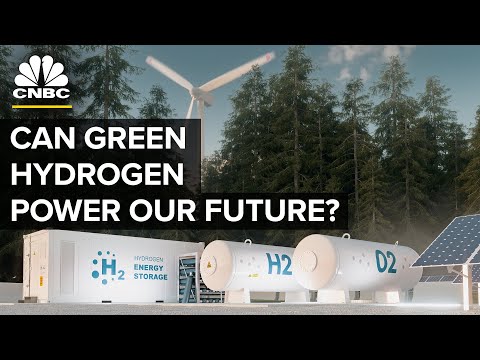
What Is Green Hydrogen And Will It Power The Future?
Humanity's Battle Against Climate Change
The discussion highlights the urgent need to curb global carbon emissions to prevent a 1.5-degree Celsius rise in temperatures above pre-industrial levels.
The Rise of Green Hydrogen
- Green hydrogen, produced from renewable power, offers a clean-burning solution for decarbonizing challenging sectors like iron and steel industries and transportation.
- Hydrogen plays a crucial role in achieving up to a 50-60% reduction in total emissions, especially for industries not directly linked to renewable energy.
Challenges of Hydrogen Production
- Hydrogen's reactivity necessitates extraction from compounds like water through an energy-intensive process.
- Current hydrogen production methods contribute significantly to global CO2 emissions, emphasizing the appeal of green hydrogen despite its high production costs.
Diverse Methods of Hydrogen Production
- Hydrogen production methods are categorized by colors; brown and gray hydrogen dominate current production but emit large amounts of CO2.
- Electrolysis offers a cleaner method using renewable electricity to split water into hydrogen and oxygen, promoting green hydrogen as a sustainable alternative.
Global Shift Towards Green Hydrogen
- Industries traditionally reliant on conventional hydrogen are transitioning towards green hydrogen due to advancements in production and storage technologies.
- Nations like Europe, China, South Korea, Japan, and the U.S. are investing heavily in green initiatives and transitioning key sectors like transportation towards hydrogen-based solutions.
Advancements in Fuel Cell Technology
- Transportation stands out as a sector ripe for transformation with the potential for hydrogen to replace traditional fuels due to its zero-carbon footprint.
Hydrogen Fuel Cell Vehicles: Advantages and Challenges
This section discusses the advantages and challenges associated with hydrogen fuel cell vehicles, including their potential applications in various sectors and the obstacles hindering their widespread adoption.
Faster Refueling Times and Energy Storage Efficiency
- Hydrogen fuel cell vehicles offer faster refueling times of five minutes compared to 45 minutes for battery vehicles.
- These vehicles provide about five times better energy storage per unit volume and weight, allowing for more space within the automobile for passengers and storage.
Applications in Hard-to-Electrify Sectors
- Experts believe that hydrogen fuel cell vehicles are well-suited for long-haul trucking, freight shipping, and long-haul air travel where heavy batteries would be inefficient.
- The larger the vehicle or device, the greater the advantage of using hydrogen fuel cells over lithium batteries.
Slow Adoption and Cost Considerations
- Global adoption of hydrogen fuel cell vehicles has been slow, with only three car companies offering such vehicles at around $60,000 each.
- France's Total invested in a hydrogen fuel cell truck startup, while Nikola Motors plans consumer production of its hydrogen fuel cell truck by 2023.
Infrastructure Challenges
- Lack of fueling station infrastructure is a significant barrier to adopting hydrogen fuel cell vehicles globally.
- Currently, there are only around 407 operational hydrogen stations worldwide, with most located in Europe followed by Asia and North America.
Efficiency Concerns and Cost Reduction Efforts
- Hydrogen faces efficiency challenges due to manufacturing processes; however, it is energy-dense which aids in storing large amounts of energy in a small volume.
- Efforts are underway to reduce costs associated with producing fuel cells and storage systems to make hydrogen technology more affordable.
Renewable Energy Storage Potential
- Hydrogen can be used to store renewable energy efficiently for extended periods when excess power is generated but not immediately needed on the grid.
Hydrogen Storage and Usage in Energy Systems
In this section, the discussion revolves around storing hydrogen in salt domes for extended periods to be utilized when needed by the grid. The focus is on repurposing a coal-fired power plant with gas turbines that can operate using a blend of natural gas and hydrogen.
Storing Hydrogen in Salt Domes
- Hydrogen storage in salt domes enables long-term storage for grid electricity needs.
- Intermountain Power Project plans to repower using gas turbines fueled by a mix of hydrogen and natural gas.
Advantages of Hydrogen Storage
- Initial turbine usage: 30% hydrogen and 70% natural gas, aiming for 100% green hydrogen by 2045.
- Hydrogen storage in salt domes offers cost-effective long-term energy storage compared to batteries.
Potential Disruption by Clean Hydrogen
This part discusses the versatility of clean hydrogen as a disruptor across various sectors like energy production, storage, transportation, and industry. It also touches upon the potential growth of clean hydrogen's share in meeting future energy demands.
Versatility of Clean Hydrogen
- Clean hydrogen's versatility can revolutionize energy sectors and increase its share from 4% to an estimated 22% by 2050.
- Generating sufficient green hydrogen requires substantial renewable electricity generation and significant investments.
Cost Reduction Trends
- Declining costs: Electrolyzer prices down by 50%, renewable energy costs reduced by 50–60%, with further expected decreases before the end of the decade.
- Scaling up fuel cells will drive down costs, making green hydrogen more competitive against fossil fuels.
Role of Government Policies in Green Hydrogen Adoption
The final segment emphasizes the crucial role of government policies and investments in advancing green hydrogen technologies. It highlights the necessity for widespread adoption of green hydrogen to achieve decarbonization goals.
Government Intervention
- Governments play a vital role through policies and investments to drive green hydrogen adoption at scale.