Stress Class 1
Introduction to Material Resistance
Overview of Material Resistance Concepts
- The class focuses on material resistance, covering concepts such as stress types and equations for calculations.
- Material mechanics, also known as solid mechanics, aims to equip future engineers with the knowledge to analyze and design load-bearing machines and structures.
- Analysis and design involve determining stresses and deformations in structures, which is crucial for ensuring they can withstand loads without failure.
Importance of Analyzing Structures
- Understanding material limitations is essential; engineers must know how much load a structure can bear before deformation or failure occurs.
- Various structures like vehicles, ships, aircraft require careful analysis regarding their ability to support loads effectively.
Understanding Stress in Structural Members
Key Concepts of Stress
- When analyzing a structure's ability to support loads, it’s vital to assess whether components like cables or hooks will fail under tension.
- Stress relates directly to the cross-sectional area of materials being analyzed; internal forces play a significant role in determining if a component will break.
Internal Forces and Their Significance
- Internal forces arise when external forces are applied; these forces resist displacement within the material.
- Understanding internal forces helps clarify how materials respond under load conditions—essential for accurate stress analysis.
Defining Stress: Key Characteristics
Distribution of Forces
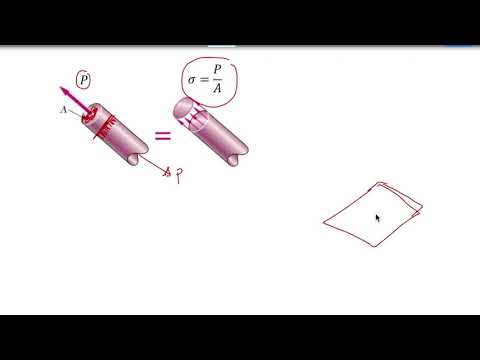
- The internal force within a material represents the resultant of all small distributed forces across its cross-section.
- Average stress is calculated by dividing total force by the area over which it acts; this concept is fundamental in understanding material behavior under load.
Types of Stress
- Normal stress (σ), defined as force per unit area acting perpendicular to the surface, is critical for evaluating structural integrity.
Measuring Stress: Units and Conversions
International System Units
- In SI units, stress is measured in Pascals (Pa), where 1 Pascal equals 1 Newton/m². This measurement reflects how small stresses can be due to large areas involved.
English System Units
- In the English system, stress may be expressed in pounds per square inch (psi); understanding both systems aids engineers working internationally.
Types of Stresses: Focus on Normal Stress
Characteristics of Normal Stress
- Normal stress occurs when an axial load acts through the centerline of an element; this ensures that all particles experience uniform loading conditions.
Implications for Design
- Recognizing that not all particles carry equal loads during deformation emphasizes the need for thorough analysis when designing structural elements.