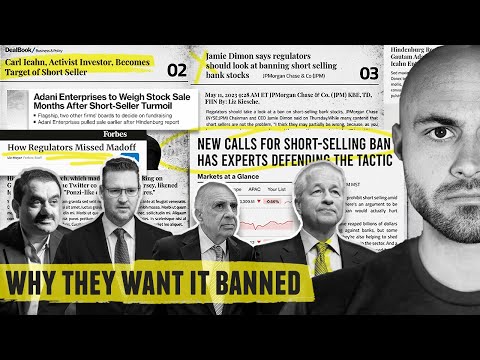
Why Everyone Suddenly Wants to Outlaw Short Selling
Introduction to Short Selling
In this section, the speaker introduces the concept of short selling and its increasing controversy in modern financial markets.
What is Short Selling?
- Short selling is the ability to profit off of somebody else's losses.
- It involves borrowing something you don't own yet and exchanging it for something else.
- Shorting makes sense when you're exchanging it for dollars, but most people aren't aware of a second example of shorting which is mortgages.
Examples of Short Selling
- The speaker provides an example using an iPhone where someone borrows their friend's old iPhone, sells it on eBay, buys another one at a lower price after Apple releases a new model, and returns the original phone to their friend while keeping the profit.
- The speaker explains how buying a home with a mortgage involves borrowing US Dollars and then exchanging them for something else.
Debate on Short Selling
- Jamie Dimon has called for regulators to ban short selling of banks, sparking debate about whether short selling is net beneficial or damaging to markets.
- The debate has been ongoing for a long time especially in times of market turmoil.
Sponsorship Message: I Trust Capital
In this section, the speaker talks about I Trust Capital as today's sponsor and how it allows people to purchase investments that will preserve their purchasing power without being exposed to the dollar.
About I Trust Capital
- People are concerned about inflation eroding their purchasing power and want investments that can preserve value.
- Most people have most of their wealth in their 401ks, which do not allow people to buy gold, silver, or Bitcoin.
- I Trust Capital allows people to open up actual retirement accounts and buy gold, silver, Bitcoin, and other cryptocurrencies.
Sign Up Bonus
- People who sign up with the speaker's link in the description below will get a $100 worth of bitcoin as a sign-up bonus for opening an account.
Buying and Short Selling Stocks
In this section, the speaker explains the mechanics of buying a home with a mortgage and short selling stocks. They also discuss how short selling works with stocks and the importance of having a margin account.
Buying a Home with a Mortgage
- When buying a home with a mortgage, you borrow money from the bank to purchase the house.
- You then pay back the loan over time, plus interest.
- If you sell the house later for more than what you owe on your mortgage, you make a profit.
Short Selling Stocks
- Short selling is when you sell something that you don't own by borrowing it first.
- To short sell stocks, you need to have a margin account which allows you to borrow shares in order to sell them.
- Your broker will locate those shares for you and let you borrow them from them automatically when you short the shares.
- In situations where there is high demand for shorting shares, there may be an interest rate associated with borrowing them.
Ramifications of Short Selling
In this section, the speaker discusses how short selling can cause damage to markets and companies. They also talk about speculative attacks and spreading false information.
Profit Motive
- There's a built-in profit motive in seeing stock prices fall when short selling because if someone borrows stock and sells it, they only make money if they can buy it back at a lower price.
Speculative Attacks
- There's an opportunity for speculative attacks when people spread false information or jump on bandwagons to try and crush a company just to profit off of it.
Damage to Companies
- Short selling can damage the reputation of companies, causing long-term damage as they have to battle it out and constantly be talking to the press and releasing reports trying to contradict what the short sellers are saying.
The Pros and Cons of Short Selling
In this section, the speaker discusses the potential dangers of short selling and how it can lead to a bank run. However, they also argue that short selling is necessary for market stability and fraud detection.
Dangers of Short Selling
- If a bank run starts due to short selling, the bank may collapse if everyone requests their money back at once.
- A bunch of people can load up on shorting Bank shares, spreading rumors about insolvency, causing a bank run and leading to the collapse of the bank.
- Short selling can damage markets and companies' long-term performance.
Reasons to Allow Short Selling
- Speculative buying bubbles are more damaging than short selling.
- Allowing short selling provides an equal and opposite market force to counteract buying that causes bubbles in the first place.
- Short sellers are good at sniffing out fraud since they have an incentive to find overvalued assets.
- Regulators who have no incentive whatsoever to find fraud may not be as effective as those with a profit motive.
Examples
- Bernie Madoff's Ponzi scheme went undetected for decades despite numerous warnings because regulators had no incentive to find it.
- Hindenburg Research targeted Carl Icahn's company Icon Enterprises, which had not a care in the world until someone came out with allegations against them.
The Role of Short Sellers in the Market
In this section, the speaker discusses the role of short sellers in the market and how they help to identify overvalued or fraudulent companies.
Short Sellers as Market Watchdogs
- Short sellers are investors who bet against a company's stock price by borrowing shares and selling them with the hope of buying them back at a lower price.
- They have an incentive to find overvalued or fraudulent companies because if they are right, they will profit handsomely.
- Short sellers provide a service to the markets by identifying these companies and informing others so that they can sell their shares and stop further damage.
Skin in the Game
- Short sellers also have skin in the game on the loss side because if they are wrong, the stock price goes up, and they lose money.
- There are not as many speculative or fraudulent attacks by short sellers as portrayed by media because being wrong means losses instead of profits.
Regulators vs. Short Sellers
- Regulators do not have a profit motive or loss motive to find fraud and ensure accuracy.
- Without short sellers, companies may artificially inflate their stock prices without worry about anyone forcing it down.
Benefits of Short Selling
- When short sellers release reports that cause stock prices to drop, it creates an opportunity for long investors to buy stocks at a discount.
- Even being liquidity providers is vital for healthy market functioning.
Overall, short sellers play an important role in identifying overvalued or fraudulent companies while providing liquidity to markets. They also create opportunities for long investors when proven wrong.
The Future of Markets
In this section, the speaker discusses the potential future of markets and how they may become fully regulated, leading to forced ownership or non-ownership.
Markets Will Cease to Exist
- Bubbles may be banned and markets will become fully regulated.
- This will lead to a lack of freedom in the market.
- Forced ownership or non-ownership may become the norm.
- This would result in markets ceasing to exist.
Short Selling
In this section, the speaker discusses short selling and how it can be beneficial for those who want agility with their investments.
Long-Term Investing
- If you're right about a short seller attack, you'll make money in the long term.
- It's important to see reports and get out if necessary.
Short-Term Trading
- Those who want agility with their investments can engage in short-term trading.
- Margin accounts are available for those who want to profit off of bubbles and overvalued companies coming down.
Conclusion
In this section, the speaker concludes by thanking viewers for watching and encouraging them to engage with markets in a way that works best for them.
Final Thoughts
- Viewers are thanked for watching.
- Encouragement is given to engage with markets in a way that works best for each individual.