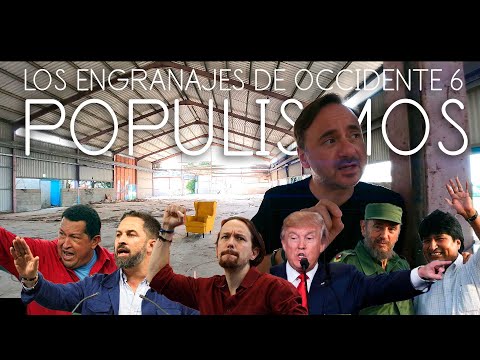
🔴 POPULISMOS -- Los engranajes de Occidente 6
Understanding Populism in a Hyper-Globalized Era
The Nature of Contemporary Politics
- In today's hyper-globalized era, a specific political approach emerges that relies on deception and division, creating artificial splits among people.
- This political style simplifies society into two opposing groups: "us" versus "them," fostering a culture of confrontation and distrust.
- It thrives on crises to undermine democratic institutions like the separation of powers, press freedom, and free thought, leading to dangerous policies.
Characteristics of Populism
- The series "Los engranajes de occidente" explores the psychosocial mechanisms degrading Western civilization, focusing on populism as a complex yet widespread phenomenon.
- Various populist movements share similar electoral strategies and communication styles across different historical contexts—from 19th-century socialism in Russia to contemporary right-wing populism in Europe.
Defining Populism
- Populism is characterized by an antagonistic view between two distinct groups: the virtuous 'people' versus the corrupt elite or outsiders.
- The 'other' is often dehumanized and portrayed as a caricature representing evil, which justifies public scorn and hostility towards them.
Identity and Values in Populist Discourse
- Populist rhetoric emphasizes shared values and identities, claiming to represent the true essence of national history and traditions.
- This narrative aims to reconstruct a lost identity due to social crises while positioning populists as the sole moral authority capable of restoring these values.
Sovereignty and Authoritarian Tendencies
- There is an inherent glorification of popular sovereignty within populist discourse; however, this often masks authoritarian intentions that exclude dissenting voices from their definition of 'the people.'
- Despite advocating for direct democracy through referendums or public consultations, many populists aim to establish authoritarian states that contradict democratic principles.
Historical Revisionism in Populist Narratives
- A common tactic among populists involves reinterpreting history to create collective memories that evoke emotional responses from citizens.
- This can include exaggerating past glories or fabricating narratives of humiliation aimed at rallying support against perceived enemies.
Populism and Its Characteristics
The Use of Manipulative Tactics
- The speaker discusses the tactic of using half-truths and incendiary rhetoric to create a victim narrative aimed at undermining opponents, emphasizing that such strategies are reminiscent of Francoist ideologies.
Populism's Leadership Dynamics
- A key characteristic of populism is the presence of a charismatic leader who claims to protect the people from external threats, often portrayed as an outsider with aggressive communication styles.
- This leader typically embodies identifiable physical traits (e.g., distinctive hairstyles or attire), which become central to their public image and marketing strategy.
Media Influence on Populist Movements
- Leaders often leverage media platforms, including television, to amplify their messages and maintain visibility, suggesting that control over media narratives is crucial for populist success.
Ideological Flexibility of Populism
- Populism lacks a coherent ideology; instead, it adapts by aligning with various ideologies (nationalism, communism) to gain traction during crises.
Crisis Exploitation by Populists
- The speaker notes that populist movements thrive in times of economic and social instability, using dramatic narratives to galvanize support while perpetuating division among groups.
Historical Context and Evolution of Populism
Historical Precedents
- The discussion highlights past instances of populism in Russia during the 1870s and in the United States around 1890, noting its resurgence in post-war Latin America.
Modern Manifestations
- Contemporary examples include movements like Trumpism in the U.S., Greece's Syriza party, Italy's "Movimento 5 Stelle," Vox in Spain, and right-wing parties across Europe.
The Impact of Hyperconnectivity on Politics
Rise of Hyperconnected Political Discourse
- In today's hyperconnected world, ideas spread rapidly—both beneficially and detrimentally—leading to increased political polarization as individuals feel overwhelmed by chaotic information flows.
Perception of Control Loss
- Many individuals experience a sense of loss regarding personal agency amidst perceived societal disorder. This feeling can drive them towards populist leaders who promise simple solutions.
Globalization and Economic Uncertainty
The Impact of Globalization
- Globalization and economic uncertainty contribute to a sense of dislocation among individuals consuming diverse global products, leading to questions about identity and belonging.
- The roots of globalization trace back to the 1970s, accelerating through the 1980s and peaking in the 1990s, with significant growth until the financial crisis of 2008.
Economic Growth vs. Wealth Concentration
- Initially, globalization appeared beneficial as global wealth increased; however, it led to wealth concentration among a few, stagnating middle-class incomes in Western countries.
- Job losses occurred for many workers due to production shifts abroad and rising immigration concerns, compounded by technological advancements that displaced low-skilled labor.
Social Implications of Immigration
- Increased immigration from war-torn regions heightened social tensions in Europe, which struggled more than the U.S. to adapt due to its historical context as an immigrant nation.
- Citizens experienced feelings of helplessness amid rapid changes and perceived political indifference towards their diminishing national identities.
The Role of Social Media
- The advent of the internet and social media transformed idea dissemination, allowing for rapid spread without traditional editorial oversight.
- Populists exploit this environment by appealing directly to emotions rather than facts, often using sensationalism or superficiality for visibility.
Rise of Populism
- Misinformation spreads faster than verified news on social media platforms, fostering a toxic culture rooted in fear and hatred.
- Populist rhetoric often identifies vague enemies—be they political elites or abstract entities—creating a narrative that resonates with public grievances.
The Emergence of Modern Populism in Spain
Catalysts for Change
- Modern populism emerged in Spain around 2008 amidst austerity measures and rising unemployment rates that fueled public discontent.
- The "Indignados" movement arose on March 15th, 2011, advocating for systemic change through peaceful protests organized via social media.
Intellectual Underpinnings
- Key figures within this movement had extensive academic backgrounds but also experience advising Latin American populist governments like those led by Evo Morales and Hugo Chávez.
Political Discourse Transformation
- A narrative was constructed portraying a catastrophic situation necessitating confrontation between ordinary citizens ("the people") and established elites ("the caste").
Critique of Established Institutions
- This new populist discourse criticized existing institutions such as monarchy and judiciary while promoting anti-establishment sentiments against austerity policies dictated by Brussels.
Moral Superiority Claims
Francoist Fascism and Populism in Spain
Historical Context and Political Identity
- The speaker accuses the Francoist fascists of desiring a coup d'état but lacking the courage to execute it, emphasizing the need for a well-defined political identity.
- The discussion highlights how historical revisionism focuses on the Spanish Civil War and the transition period, illustrating ongoing societal divisions that populists exploit.
Podemos and Direct Democracy
- Podemos is introduced as advocating for direct democracy, promoting referendums in regions like Catalonia and Western Sahara to empower citizen participation.
- Pablo Iglesias, as a charismatic leader, embodies this populist movement by presenting himself as relatable while fostering an emotional connection with supporters.
Challenges Within Podemos
- Tensions arise within Podemos leading to the marginalization of key figures such as Juan Carlos Monedero and Íñigo Errejón due to internal conflicts.
- The party's strategy includes denouncing austerity measures, corruption, and cultural regression while aiming to establish new social rights across various sectors.
Threats to Democracy
- The speaker warns about hidden forces undermining democracy in Spain, including state corruption and media manipulation by powerful elites.
- A gradual erosion of democratic principles is described, where elected leaders undermine political pluralism through authoritarian practices rather than overt military coups.
Populist Strategies Against Opposition
- The process of delegitimizing opponents involves labeling them as fascists or corrupt when they do not align with Podemos' views.
- Media independence is attacked; journalists are branded as biased if their reporting contradicts party narratives.
Nationalism and Populism Resurgence
- A resurgence of nationalism employs populist tactics to gain social power; secessionist movements adapt their rhetoric for greater impact.
- Catalan nationalism emerges prominently post-2010, utilizing visual symbols to rally public support for independence.
Polarization in Society
- This era witnesses increased polarization marked by public protests against constitutional symbols and institutions perceived as oppressive.
- Charismatic leadership intensifies divisive rhetoric, framing struggles in heroic terms while mobilizing mass sentiment against perceived enemies.
Conclusion: Moral Superiority Narrative
- Independentists position themselves morally superior against state institutions they accuse of oppression.
The Dynamics of Nationalism and Populism in Spain
The Historical Context of Spanish Nationalism
- Discussion on how certain regions in Spain perceive themselves as distinct from the rest of the country, often viewing their relationship with Spain through a colonial lens.
- Emphasis on the unique vocabulary used by these regions, which reflects a cultural separation and reinforces their identity against broader Spanish culture.
Sovereignty and Its Implications
- Examination of the concept of popular sovereignty as a tool for independence movements, prioritizing it over existing laws and constitutional frameworks.
- Analysis of how charismatic leaders are portrayed within nationalist movements, specifically referencing Arnaldo Otegi's image as a martyr or peace figure.
Rise of Vox: A Response to Political Discontent
- Overview of Vox's emergence amid widespread dissatisfaction with political parties, capitalizing on concerns about immigration and separatist challenges.
- Description of Vox's polarizing rhetoric that frames issues in terms of "us vs. them," targeting immigrants, feminists, and separatists.
Populist Rhetoric and Strategies
- Insight into Vox’s critique of established institutions like Brussels, advocating for national sovereignty while dismissing perceived ideological biases.
- Exploration of Vox’s moralistic discourse that vilifies opponents by labeling them as part of a corrupt coalition undermining national integrity.
International Connections and Campaign Strategies
- Discussion on how Vox employs nativist sentiments to justify policies such as closing mosques and imposing stricter immigration controls.
- Comparison between Vox's narrative and other populist movements globally, highlighting shared themes around grievances related to economic control and social dynamics.
Electoral Successes and Strategic Alliances
- Analysis of how international populist networks influence local strategies, including collaboration with similar parties across Europe.
The Influence of Populism: Vox and Trump
Parallels Between Vox and Trump
- Vox has adopted strategies from Trump, including the concept of a border wall, claiming it would be funded by neighboring countries.
- Both political movements emphasize a return to a glorified past, with Vox linking this to historical events like the Reconquista.
Media Relations and Populist Tactics
- Similar to Trump’s approach, Vox exhibits hostility towards opposing media outlets, exemplified by their slogan "no moleste."
- The party's ideology presents simplistic solutions disguised as answers to complex issues, contributing to societal division.
The Role of Hate in Political Discourse
Agenda Driven by Fear and Intolerance
- A significant portion of Vox's rhetoric is rooted in hate, emphasizing divisions between 'the people' and 'the elite.'
- Their agenda includes racism and intolerance towards specific groups, which exacerbates societal polarization.
Erosion of Democratic Institutions
- The populist tactics employed by Vox risk undermining the rule of law and eroding democratic structures.
- Their ultimate goal appears to be absolute power through the marginalization of opposition voices.
Historical Context: Latin American Populism
Rise of Populism in Latin America
- Latin America has experienced long-standing populist movements that have spread like a viral disease across the continent.
- Institutional weakness often fuels populism, particularly during economic crises affecting countries like Ecuador and Peru.
Notable Leaders and Movements
- Figures such as Hugo Chávez, Evo Morales, and Rafael Correa share similarities with neo-populists but differ in their adoption of nationalist economic policies.
- These leaders view themselves not as conventional politicians but as representatives advocating for critical visions aimed at achieving independence from traditional political systems.
Consequences of Populist Governance
Impact on Democracy
- While promising empowerment for the populace, these regimes often lead to loss of freedoms and diminished opposition.
- Instead of delivering on promises for greater democracy, they frequently result in instability, corruption, and poverty due to their focus on maintaining power at all costs.
Case Studies: Brazil vs. Argentina
- Lula da Silva's Workers' Party is noted for its organization; unlike typical populists, it does not rely on constant re-election tactics or constitutional assemblies.
- Juan Domingo Perón’s rise marked classic populism in Argentina through direct engagement with his base using mass media effectively.
Legacy and Current Trends in Populism
Positive Aspects vs. Negative Outcomes
- Despite some positive impacts on popular organization over 50 years, contemporary populisms threaten democratic institutions significantly.
Global Recession of Freedom
- There is an ongoing global recession regarding freedom since around 2006–2007 after a period of democratic expansion; more nations are experiencing declines in liberty than gains.
Democratic Erosion and the Rise of Populism
Interconnected Factors Affecting Democracy
- A noticeable democratic malaise is spreading within established democracies, exacerbated during the pandemic, affecting various life sectors from mobility to economy.
- This discontent has led to a general lack of trust in governments' ability to address citizens' issues and in political institutions, contributing to electoral shifts like Trump's victory and changes in Hungary.
- We are witnessing a gradual but unstoppable deconsolidation of fragile democracies such as those in South Africa, Mongolia, Brazil, Thailand, Turkey, Russia, and Venezuela.
- The failure of democratization processes like the Arab Spring and military interventions (e.g., Iraq) has resulted in widespread disenchantment with democracy.
- Observers increasingly feel that liberal democracy faces its most serious challenge since the radical uprisings of the mid-1970s.
The Appeal of Populism
- Populism appears to offer simple solutions for complex crises; it is anti-elitist and challenges institutions while claiming to empower the people through strong governments with broad social consensus.
- While populism can stimulate reforms—such as breaking monopolies or redistributing power—it often undermines liberal democracy rather than strengthening it.
- Many doubt whether current systems can reform themselves effectively; however, populism tends toward hegemony by rejecting democratic pluralism and viewing itself as the sole valid solution.
Dangers of Populist Movements
- Populism restricts freedom of expression by aiming for homogeneous societies where dissent is silenced; it systematically marginalizes certain groups based on identity or beliefs.
- Although we are not experiencing a repeat of 1920s/30s fascist movements, troubling trends persist that warrant concern regarding populist ideologies.
Critical Citizen Engagement
- Citizens must distance themselves from parties offering simplistic solutions or demonizing opponents; critical thinking should prevail over emotional responses driven by moral indignation.
- It’s essential to understand what is genuinely at stake rather than succumbing to fear-mongering narratives about societal collapse; awareness is crucial amidst shifting global dynamics.
Turn any video into a summary like this
YouTube links, meetings, lectures — with transcripts, search, and chat.