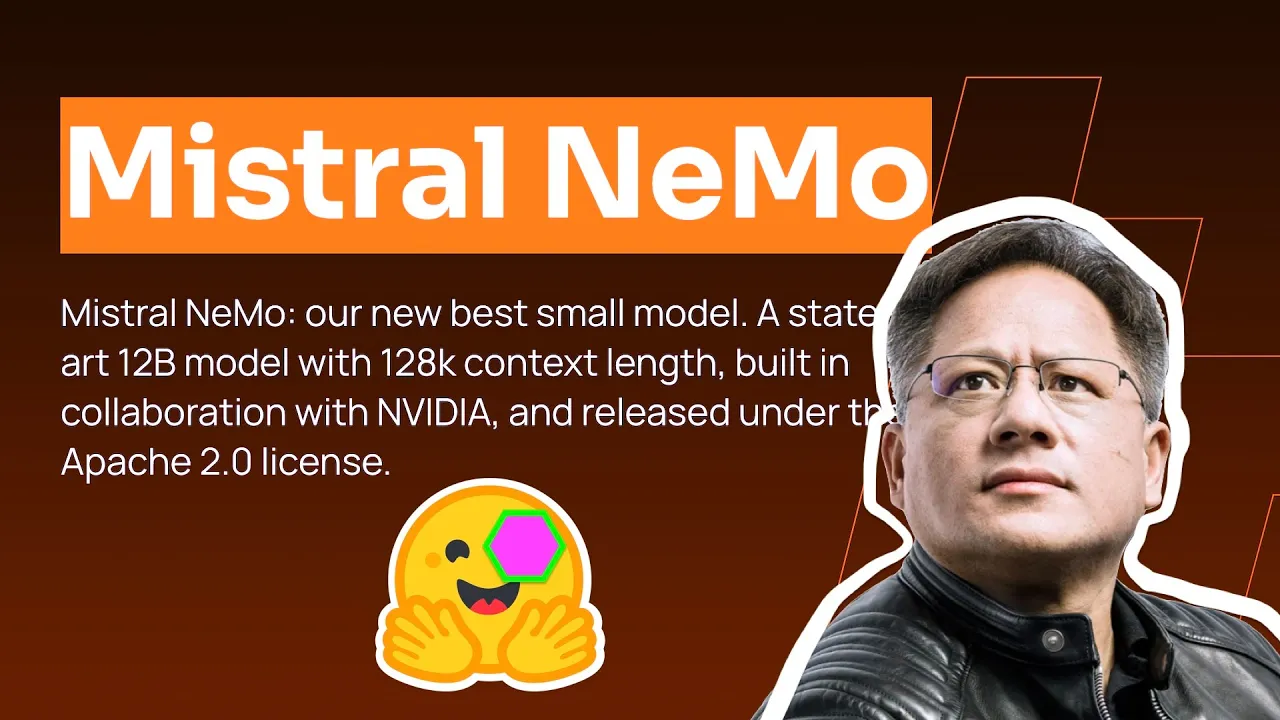
Mistral NeMo 12B: The Instruct Model for Coders & AI Agents - Supercharge Your Workflow
Mistral AI's New Model: Nemo
This week has been significant for Mistral AI, with the release of two models and an exciting new base model called Nemo in collaboration with Nvidia. This document summarizes the key features and implications of these developments.
Overview of Mistral AI's Releases
- Mistral AI released two models earlier this week focused on code completion and math, showcasing impressive capabilities for their size.
- The announcement of the Nemo model marks a shift from previous Transformer-based architectures to a new enterprise-grade ready model.
- Nemo is tuned with instruct contexts, aligning with recent standards set by Deep SE coder, enhancing its usability.
- The model consists of 12 billion parameters and boasts a large context window of 128,000 tokens while operating at FP8 precision without requiring expensive GPUs.
- Nvidia’s blog provides deeper insights into the model's attributes compared to Mistral’s own website.
Collaboration Between Mistral AI and Nvidia
- Nvidia recognizes the high-quality AI work emerging from Europe, leading to their partnership with Mistral for developing the Nemo model.
- There is potential for further advancements as Nemo serves as a foundational base model for future iterations.
- The collaboration combines Mistral's training data expertise with Nvidia's optimized hardware/software ecosystem to enhance performance across various applications like chatbots and multilingual tasks.
Performance Metrics and Comparisons
- Benchmarks indicate that Nemo performs exceptionally well at FP8 precision without significant performance loss when compared to larger models like Gemma 29B and Llama 38B.
- Notably, Nemo offers a much larger context window than similar-sized models (8,000 tokens), making it more versatile in handling complex tasks.
- While not outperforming every aspect of larger models (e.g., Llama 3 70B), it remains accessible for broader usage due to its efficiency on standard GPUs.
Technical Innovations in Tokenization
- A new tokenizer called Tekken is utilized in Nemo, which improves efficiency by compressing natural language text across over 100 languages effectively.
- This tokenizer addresses challenges faced by smaller models regarding compute requirements during tokenization processes.
Instruction Fine-Tuning Enhancements
- Instruction fine-tuning was emphasized during development; this allows better adherence to user instructions and enhances multi-turn conversation capabilities.
- Compared to previous versions like Mistral 7B, Nemo shows superior performance in benchmarks such as MTY Bench and Wild Bench due to advanced alignment techniques used during training.
Nvidia's TensorRT LLM: Accelerating AI Inference
Section Overview
This section discusses Nvidia's TensorRT LLM platform, its capabilities in accelerating inference for AI models, and the broader ecosystem Nvidia aims to create for model builders.
Key Features of TensorRT LLM
- Accelerated Inference: The Nvidia platform allows for accelerated inference with any models built on it, enhancing both fine-tuning and deployment processes.
- Multi-Turn Conversations: It excels in handling multi-turn conversations, a challenging area for many AI tools, including those from OpenAI.
- Enterprise Grade Model: Marketed as an enterprise-grade AI model due to its precision and reliable performance; it supports a sizable content window.
- FP8 Precision Benefits: Utilizes FP8 precision to reduce memory size and speed up deployment without sacrificing accuracy.
- Consumer Accessibility: Designed to work with more accessible consumer GPUs, making advanced AI technology available to a wider audience.
Training Infrastructure and Capabilities
Section Overview
This section highlights the training infrastructure behind the TensorRT LLM and its intended use cases across various platforms.
Training Details
- Single GPU Compatibility: Optimized to fit within the memory constraints of single Nvidia GPUs like RTX 490 or RTX 4500.
- Training Resources: Trained using approximately 3,180 gig tensor core GPUs on DGX Cloud with Megatron LM orchestration.
- Future Developments: Anticipation of updates regarding ideal AI workstation configurations from Nvidia in future videos.
- Cloud Versatility: Promoted as capable of running anywhere—on cloud data centers or local RTX workstations.
Running Models Locally
Section Overview
This section explores recommendations for running models locally using Nvidia hardware and addresses user inquiries about configurations.
Local Model Execution
- Best GPU Recommendations: Suggested GPUs for local execution include the 3080, 3090, A100, and 4090; distinctions are made between consumer and enterprise options.
- Power Supply Considerations: Acknowledges that a 1,000-watt power supply is sufficient but suggests that a higher capacity would be preferable for optimal performance.
- Cost-effective Configurations: Discusses potential setups involving multiple lower-cost GPUs (under $300 each), emphasizing community-driven insights from platforms like Reddit.
Understanding Model and Pipeline Parallelism in LLMs
Section Overview
This section discusses the challenges of using large language models (LLMs) for specific tasks, particularly focusing on model and pipeline parallelism. It also explores how LLMs handle various queries, including a practical example involving mangoes.
Challenges with GPU Utilization
- The speaker expresses disappointment that the LLM did not recognize the need for more than four GPUs, highlighting its understanding of model and pipeline parallelism as a nuanced area.
- A test is conducted by asking the LLM about obtaining three glasses of mangoes from a tree, illustrating potential confusion in interpreting user intent.
- The LLM suggests making mango puree instead of simply picking mangoes, showcasing its tendency to interpret questions creatively rather than literally.
Evaluating Instruction Handling
- The speaker tests the LLM's ability to convert a list of steps into coherent prose, noting that many instruct models struggle with this transition.
- A request is made to translate instructions into South Korean, demonstrating the model's multimodal capabilities and adaptability between different character sets.
Interface Preferences and Future Developments
- The speaker shares positive feedback about Nvidia’s interface compared to Hugging Face’s infrastructure, citing reliability as a key factor.
- An inquiry is posed regarding future developments on top of new models like Mistol Bass; there are mentions of upcoming videos focused on code completion tools utilizing open-source models.
Conclusion and Engagement