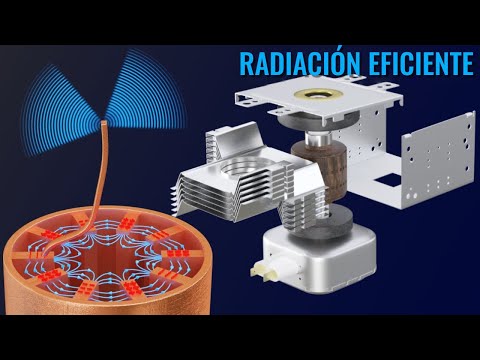
Magnetrón, ¿cómo funciona?
Understanding the Magnetron: A Key Invention of WWII
Introduction to the Magnetron
- The Second World War was a traumatic event but also led to significant inventions, including the cavity magnetron, which revolutionized radar technology.
- Cavity magnetrons are responsible for producing high-power microwaves and are used in microwave ovens.
Physics Behind the Cavity Magnetron
- The operation of cavity magnetrons is based on LC oscillation principles, where a charged capacitor is placed next to an inductor, creating electron movement.
- When an antenna connected to an inductor is near an LC circuit's inductor, it emits electromagnetic waves, forming the theoretical basis for the cavity magnetron.
Transition from Theory to Practical Application
- The theoretical energy loss due to radiation can be mitigated by practical design changes; introducing a permanent magnet allows electrons to follow a curved path, increasing interaction time.
- This configuration leads to more efficient radiation as electrons spend more time interacting within the device. The resulting structure is known as a Hull magnetron.
Enhancing Efficiency with Oscillations
- Hull magnetrons improve efficiency further through designed cavities that create significant physical differences affecting electron behavior.
- Electrons emitted from the cathode induce charge distributions on cavity surfaces, acting similarly to capacitor plates and leading to oscillations when connected with inductors.
Electron Dynamics and Charge Patterns
- As electrons interact with cavities, they create positive and negative charge patterns that influence subsequent electron movements within these structures. This dynamic forms a "wheel of spokes" pattern due to oscillating charges.
- The curvature of cavity surfaces acts like inductors, allowing simultaneous LC oscillation extraction via metal loops and antennas while maintaining continuous electron flow between cathode and anode.
Coupling Phenomena in Magnetrons
- Only one antenna connects with a single cavity; however, magnetic field lines generated in one cavity affect others through mutual coupling—allowing energy extraction across multiple cavities simultaneously.
Historical Context and Impact