Introdução à Metaprogramação em Python
Understanding Metaprogramming in Python
Introduction to Metaprogramming
- The speaker introduces the topic of metaprogramming, emphasizing the importance of understanding fundamental concepts in programming, particularly in Python.
- It is highlighted that everything in Python is an object, and objects are represented as dictionaries (hash tables), which are crucial for manipulating data structures.
Objects and Dictionaries
- An example of a simple car model is presented, illustrating how attributes like model and year can be stored as key-value pairs within a dictionary.
- The speaker explains how to access and manipulate these attributes using methods that start with double underscores (dunder methods).
Class Representation
- Discussion on how classes in Python are also objects; thus, they can be printed out as dictionaries to reveal their structure and attributes.
- The relationship between instances of classes and their types is explored, showing that each class instance is an object of its respective class type.
Class Attributes vs Instance Attributes
- A distinction is made between instance attributes (specific to each object) and class attributes (shared across all instances), using the example of a car's manufacturer attribute.
- The concept that classes themselves are instances of the type
Typeis introduced, suggesting that creating classes dynamically through constructors is possible.
Dynamic Class Creation
- The speaker proposes creating a class using the
Typeconstructor directly, demonstrating this with an example where a coordinate system origin attribute remains constant across instances.
Understanding Class and Metaclass in Python
Defining a Class
- The class code is introduced, emphasizing the simplicity of defining methods like
__init__outside the class body.
- An example is given where coordinates are set to (x, y), demonstrating how to pass values and print them using a dictionary.
- It highlights that an object is merely an instance of a class, reinforcing the concept of classes in programming.
Introduction to Metaclasses
- A discussion on metaclasses begins, explaining their role in altering how classes are created and represented in memory.
- The speaker plans to demonstrate how to use a metaclass with a practical example involving a Ferrari class.
Creating a Metaclass
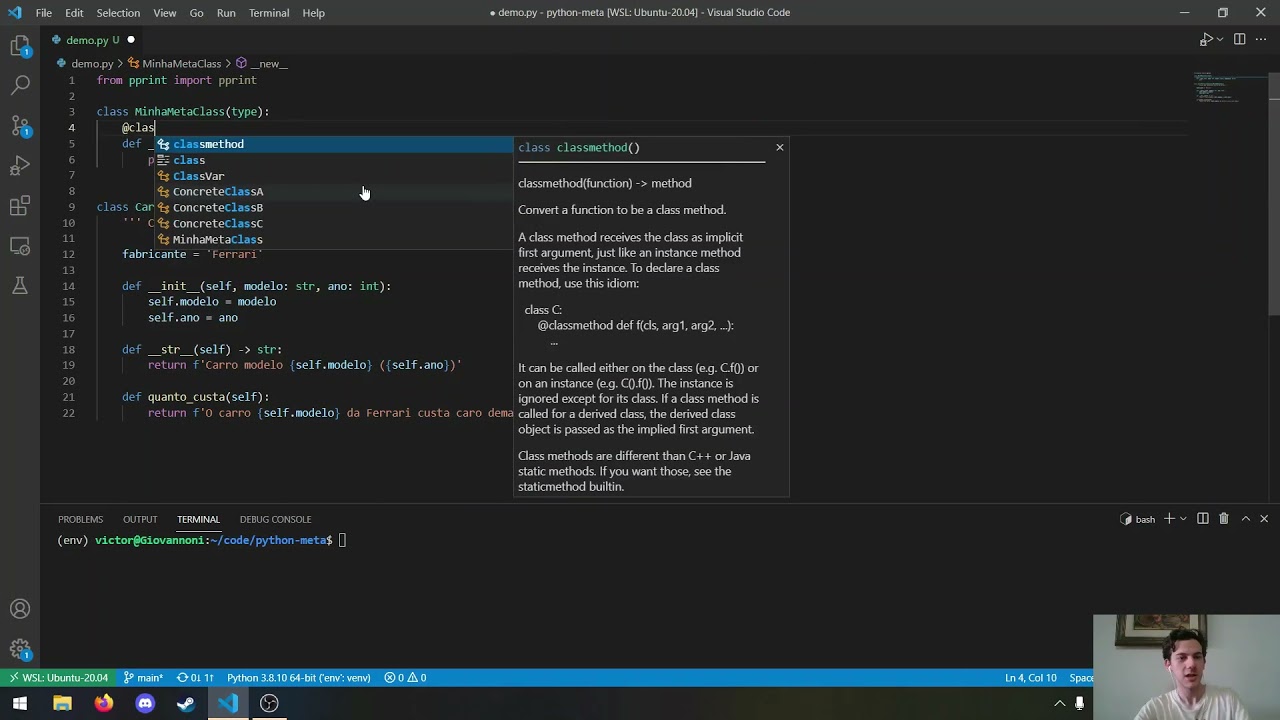
- The process of creating a metaclass is outlined; it involves defining it as a type of class.
- Clarification that this isn't inheritance but rather an attribute assignment for the metaclass.
Interfering with Class Creation
- The function
__new__is defined within the context of the metaclass, which allows interception during class creation.
- Explanation about parameters passed into
__new__, including the name and bases for the new class being created.
Modifying Attributes with Metaclasses
- Discussion on modifying attributes before passing them to the constructor, showcasing flexibility in namespace manipulation.
Understanding Metaclasses in Python
Introduction to Metaclasses
- The discussion begins with the limitations of using uppercase letters in certain methods, emphasizing that only specific cases should be capitalized.
- The speaker mentions the importance of maintaining consistency in naming conventions and introduces a practical example involving namespaces.
Practical Examples with Classes
- An example is provided where a class
Ferrariis created, demonstrating how to instantiate it with attributes like model and year.
- The speaker illustrates accessing attributes through a dictionary representation of the class instance, highlighting how modifications affect the class's behavior.
Exploring Class Functionality
- A distinction is made between accessing attributes directly versus through method calls, showcasing how metaclasses can influence attribute retrieval.
- The potential power of metaclasses is discussed, particularly for framework authors who need to implement specific behaviors within user-defined classes.
Limitations and Alternatives
- While acknowledging the utility of metaclasses, the speaker suggests that there are often simpler methods available for achieving similar outcomes without resorting to them.
- The conversation shifts towards understanding metaclasses better so developers can navigate frameworks that utilize them without confusion.
Real-world Applications of Metaclasses
- A transition into real-world applications occurs as an abstract class example is introduced, utilizing Python’s built-in ABC module for creating abstract classes.
- The concept of abstract classes is explained: they cannot be instantiated directly if they contain unimplemented abstract methods.
Implementing Abstract Classes
- Concrete implementations are shown through subclasses like
USBReaderandDatabaseReader, which fulfill the requirements set by their abstract parent class.
- An error handling scenario demonstrates what happens when attempting to instantiate an object from an abstract class without implementing all required methods.
Method Implementation Insights
- Further exploration reveals how non-abstract methods can still be called from an abstract superclass even when other methods remain unimplemented.
Understanding Metaclasses and Abstract Classes in Python
Overview of Metaclasses and Call Operators
- The discussion begins with the concept of subclasses utilizing metaclasses, emphasizing the importance of the call operator when associating class names.
- It is highlighted that if an abstract class has abstract methods, it cannot be instantiated; otherwise, it can be used normally.
Identifying Abstract Methods
- The process for identifying abstract methods involves checking all methods in an abstract class to see if they are marked as abstract. If any are found, instantiation is prohibited.
Implementation Examples
- An example is provided regarding the implementation of a metaclass and its relation to a parent class. The speaker notes differences in their approach due to using metaclasses.
Characteristics of Data Classes
- A "data class" is described as primarily focused on attributes rather than complex logic, serving as a structure for data storage.
Automatic Attribute Handling
- In this context, it's noted that defining types and names for attributes does not require an explicit
__init__method; automatic generation occurs instead.
Simplifying Class Definitions
- The speaker discusses how using metaclasses simplifies creating classes with many attributes by automatically generating necessary methods like comparison and string representation.
Importance of Meta Class Methods
- The significance of the
__new__method is emphasized; it runs before__init__, allowing attribute annotations to be processed during class creation.
Function Creation from Attributes
- A mechanism for dynamically creating an
__init__function based on defined attributes is explained. This includes handling global variables correctly within namespaces.
Correct Namespace Management
- Proper management of global variables versus local namespace variables during function execution is discussed, stressing best practices in variable scoping.
Method Construction Process
- The construction process for methods involves gathering arguments and building function signatures dynamically based on defined attributes within the class.
Recursion and Complex Structures
Advanced Function Overloading in Python
Introduction to Function Overloading
- The discussion begins with an introduction to function overloading, emphasizing its application in advanced programming scenarios.
- A recommendation is made for a video by Emmy Golden that explores the implementation of function overloading using metaclasses, highlighting its complexity and advanced concepts.
Resources for Further Learning
- The speaker mentions additional references will be provided in the description for those interested in delving deeper into advanced programming concepts related to function overloading and metaclasses.
- A repository containing automated processes and implementations of two classes is mentioned, with a link promised in the description for viewers who wish to explore it further.
Conclusion