TEORÍA DEL APRENDIZAJE DE ROBERT GAGNE
Introduction to Robert Gagné's Learning Theory
Overview of Robert Gagné
- Robert Gagné was an influential American psychologist and educator, born in 1916 and passed away in 2002. He is recognized as a pioneer in instructional science during World War II.
- He served as the director of the Perception and Motor Skills Laboratory for the U.S. Air Force and consulted for both the Department of Defense and the Office of Education.
Application of Gagné's Theory
- Gagné’s learning theory is relevant today for organizing and planning educational actions aimed at motivating students and enhancing their interest in learning.
- Before preparing educational activities, it is crucial to understand the type or category of learning objectives related to the subject matter.
Stages of Learning According to Gagné
Internal vs External Events
- The theory emphasizes internal events (learning processes) versus external events (pedagogical activities), integrating insights from psychological theories into teaching practices.
Eight Stages of Instructional Design
- Motivation:
- Initiating learning by capturing student attention, fostering expectation or reward.
- Comprehension:
- Students must identify relevant parts of stimuli related to their learning, focusing on attention and selective perception.
- Acquisition:
- This stage marks the actual beginning of learning where information enters memory for storage and encoding.
- Retention:
- Once encoded, information can be retained either permanently or temporarily; this involves long-term memory storage processes.
- Remembrance:
- Involves recalling stored information through retrieval processes, often aided by external cues like oral language.
- Generalization:
- After retrieving information, learners apply what they have learned to new situations—this reflects knowledge transfer.
- Action:
- Demonstrates learned knowledge through actions that reflect understanding; this stage measures acquired knowledge through responses.
- Reinforcement:
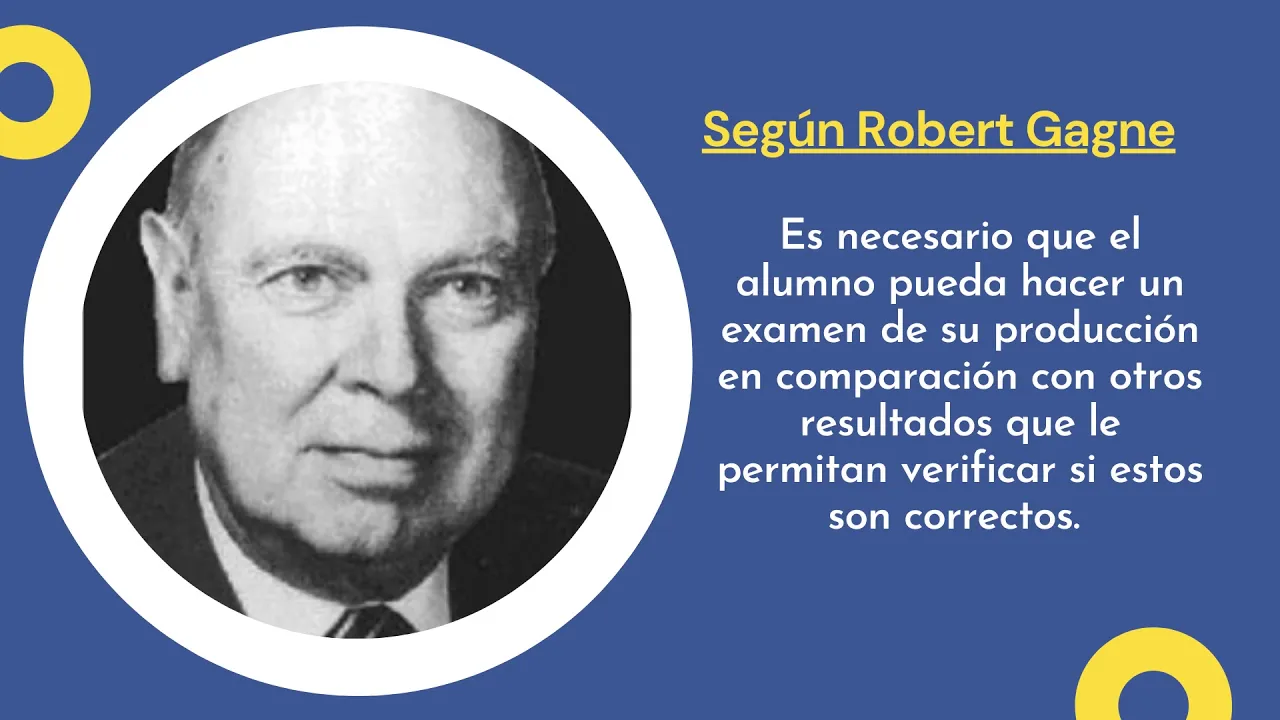
- Feedback occurs during evaluation at the end of the learning process, allowing students to compare their performance against standards set by others.
Integration with Psychological Theories
Cognitive vs Behavioral Psychology
- The stages encompass cognitive psychology aspects (comprehension, acquisition, retention, remembrance), while motivational elements align with behavioral psychology principles (motivation, generalization).
Flexibility in Implementation
- Educators can adapt these eight stages into fewer categories based on their teaching criteria; they may also organize them sequentially or circularly according to specific needs.
Practical Example: Teaching Coherence and Cohesion
Planning Educational Activities
- A practical example illustrates how to implement Gagné’s theory within communication studies focused on coherence and cohesion.
Required Materials & Strategies
- Essential materials include photocopies of texts, whiteboards, markers, notebooks, dictionaries.
Initial Steps in Instructional Strategy
- Motivation Phase:
- Utilize expectation-setting strategies by clearly stating lesson objectives at the start (e.g., identifying coherent ideas).
Teaching Strategies and Learning Processes
Understanding the Stages of Learning
- The process of comprehension involves attention and selective perception, where pedagogical strategies are guided by student tasks. Teachers play a crucial role in helping students identify and recognize key ideas from texts.
- In the acquisition stage, information overload should be avoided to prevent hindering the identification of new structures. Teachers must synthesize ideas effectively to enhance student learning.
- The retention phase focuses on storage processes, emphasizing the need for revisiting challenging phrases. Teachers should encourage participation from all students to reinforce understanding.
- Remembrance involves recovery processes similar to retention, while generalization emphasizes transferring knowledge across contexts. Both stages require repetition for effective learning.
- Action entails responding through coherent writing tasks, such as drafting anecdotes. Reinforcement is achieved by providing similar texts that highlight coherence and cohesion in ideas.
Evaluation Types in Education
- Various evaluation types exist; formative evaluation is highlighted as essential for timely decision-making that can redirect student learning processes and teaching strategies.
- Evaluation criteria are established specifically for the last two learning stages, focusing on eliciting desired behaviors aligned with educational objectives.
Conclusion on Teaching Processes