Vortex Shedding in Water
What Happens When an Object Moves Through a Fluid?
Introduction to Vortex Shedding
- Wolfgang introduces the concept of vortex shedding, which occurs when an object moves through a fluid, highlighting its significance in understanding fluid dynamics.
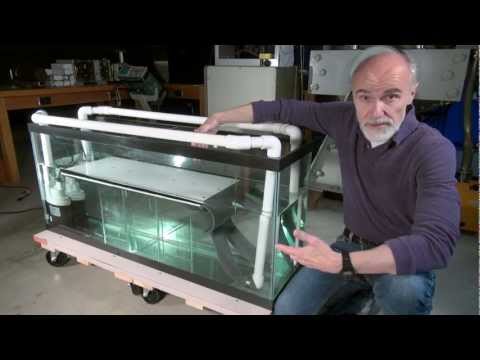
- The experiment involves a pendulum as the object and water as the fluid, utilizing a specially designed aquarium converted into a flow tank.
Experimental Setup
- The aquarium features a barrier that separates two ends, with pumps circulating water to create controlled flow conditions.
- A meter stick is placed in the water to measure flow speed; initial tests with a ping pong ball reveal it floats downstream at approximately 10 cm per second.
Observations with the Pendulum
- The pendulum is initially placed upstream where water flows fastest; it exhibits minimal motion due to chaotic vortices and eddies around it.
- When moved downstream to slower water flow, the pendulum begins oscillating back and forth, demonstrating how shed vortices influence its movement.
Interaction of Vortices and Pendulum Motion
- As vortices are shed alternately from either side of the pendulum, it reacts by moving in the opposite direction each time, showcasing alternating forces acting on it.
Turn any video into a summary like this
YouTube links, meetings, lectures — with transcripts, search, and chat.