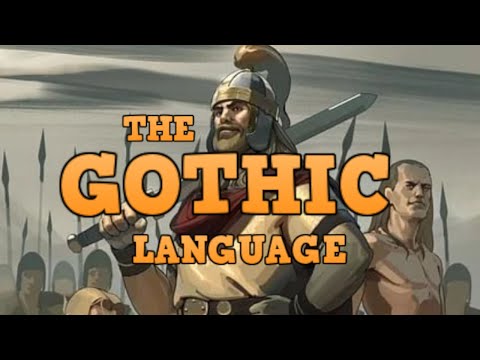
THE GOTHIC LANGUAGE - History and Grammar of an Extinct Germanic Language
New Section
This video provides an overview of the Gothic language, its origins, and its influence on other languages.
The Gothic Language
- The Gothic language is associated with the Goths, an Eastern Germanic tribe that originated in late Antiquity.
- The Goths played a significant role in the fall of the Roman Empire and invaded various regions, including Italy, Southern France, Spain, and Portugal.
- Other Eastern Germanic tribes such as the Vandals and Burgundians were also related to Gothic but have become extinct over time.
- The Goths had their own language, which was closely related to ancient Viking language (Old Norse).
- Over time, the Gothic people assimilated into the majority population of the regions they settled in.
History of Gothic Language
- The Goths migrated from their homeland along the Baltic Coast to Eastern Europe and eventually settled in areas near Greece.
- A bishop named Ulfilas translated the Bible from Greek into Gothic and invented the Gothic alphabet.
- The Goths expanded their territory by migrating into Italy, Southern France, Spain, and Portugal during the late period of the Roman Empire.
- Two major branches of Goths emerged: Ostrogoths (dominant in Italy) and Visigoths (dominant in Western Europe).
- The Visigothic Kingdom encompassed parts of Spain, Portugal, Provence (France), and even absorbed the Allen Kingdom before being overruled by Goths.
Influence on Romance Languages
- Many Gothic words were incorporated into Romance languages like Portuguese. Portuguese has a significant number of loanwords from Gothic.
- Examples include "agazzalio" meaning warm clothes and "entregua" meaning peace agreement.
Preservation of Gothic Language
- Besides Ulfilas' translation of the Bible known as Wulfila Bible, Gothic language is known from a few runic inscriptions.
- The Gothic language gradually withered away during Medieval Times, except for some remnants in Crimea.
Grammar and Vocabulary of Gothic
This section focuses on the grammar and vocabulary of the Gothic language.
Grammar of Gothic
- Detailed explanation of Gothic grammar will be covered in this video.
Vocabulary of Gothic
- Comprehensive understanding of Gothic vocabulary will be covered in this video.
Comparison with Old Norse
This section compares the Gothic language with Old Norse.
Comparison between Gothic and Old Norse
- The Goths had a language similar to ancient Viking language (Old Norse).
- A comparison between the grammar and vocabulary of these two languages will be discussed later in the video.
The History of Gothic Language in Crimea
This section discusses the history of the Gothic language in Crimea, specifically focusing on its existence until the 1700s and its incorporation into Crimean Tatar.
Gothic Language in Crimea
- In the 1840s and 1850s, some older people in the countryside of Crimea still spoke a language similar to Gothic.
- Evidence suggests that Gothic existed until around the 1700s, with the last known register of Crimean Gothic dating back to 1760-1780.
- During the 1500s, when Crimea was part of the Ottoman Empire, a traveler went to Crimea after hearing about the Goths. Many Goths became Crimean Tatars and adopted their language.
- Most Goths who migrated to Turkey and Russia learned and spoke Tatar instead of Gothic.
Possibility of Gothic Language Surviving in Brazil
This section explores claims of Gothic language surviving in Brazil and discusses how it is more likely related to Crimean Germans rather than actual Goths.
Claims of Gothic Language in Brazil
- Some people in Brazil claim to have ancestors who spoke Gothic, but this is unlikely. They are more likely descendants of Crimean Germans who migrated during the 1700s and 1800s.
- While it is not entirely impossible for Gothic to have survived until the 1800s, these claims are most likely related to Crimean German ancestry rather than actual Gothics.
Sources for Studying Gothic Language
This section provides information on available sources for studying the Gothic language.
Sources for Studying Gothic
- The main source for studying Gothic grammar is "Gothic Grammar Translation into English" by Wilhelm Braune.
- Another source is a small Gothic introduction, although there are very few sources available on the Gothic language.
- The Gothic alphabet, invented by Ulfilas in the year 360, was used to translate the Bible into Gothic. This Gothic Bible was used by Goths in Italy, Spain, France, and Portugal during the Middle Ages.
Influence of Gothic Language on Western European Languages
This section discusses how the Gothic language has influenced Western European languages and cultures.
Influence of Gothic on Western Europe
- The Gothic language has integrated into Western European languages and cultures.
- People with Italian, French, Spanish, or Portuguese ancestry have been influenced by the Gothic language.
- Loan words from Gothic can be found in these languages.
Persecution of Arianism and Destruction of Gothic Literature
This section explores the persecution of Arianism and its potential impact on the destruction of Gothic literature.
Persecution of Arianism
- The Goths had converted to Arian Christianity, which differed from Catholicism in terms of beliefs about Jesus and the Trinity.
- Arianism was declared a heresy and heavily persecuted by Catholics in early Medieval Times.
- The destruction of Gothic literature may be linked to this persecution.
Phonetic Features of the Gothic Language
This section discusses some phonetic features of the Gothic language.
Phonetic Features
- Unlike other Germanic languages, Gothic does not have rounded vowels as native sounds.
- Short and long vowels exist in Gothic.
- The diphthong "AI" is pronounced like "e."
- Certain consonants were spelled differently in Gothic.
- There are unique letters and sounds in Gothic, such as the thorn letter representing the "th" sound.
Fricatives and Intervocalic Nasalization in Gothic
This section explains fricatives and intervocalic nasalization in the Gothic language.
Fricatives and Intervocalic Nasalization
- Certain consonants between vowels in Gothic become weaker and more sonorous, known as intervocalic nasalization.
- The verb "to have" is an example of this phenomenon.
- Some consonants also have fricative sounds when placed between vowels.
Gothic Pronouns and Vocabulary
This section discusses the pronouns in Gothic, including the unique feature of dual number pronouns. It also mentions the similarity between Gothic and Icelandic pronouns. Additionally, it touches on some interesting aspects of Gothic vocabulary.
Gothic Pronouns
- Gothic had singular, plural, and dual number pronouns.
- The dual number refers to a plural of only two.
- Examples of Gothic pronouns include "ich" (I), "uh" (the two of us), "whis" (we), "two" (you in singular), "ut" (not attested but inferred to mean the two of you), and "us" (you three or more).
Similarity with Icelandic Pronouns
- The oblique forms of the dual pronouns in Gothic are similar to Icelandic plural pronouns.
- Icelandic has adapted the dual forms for full plural use, while Gothic still maintains the distinction.
Interesting Vocabulary
- The word "gistardagis" in Gothic means tomorrow, despite its resemblance to words meaning yesterday in other languages.
- Some languages conflate the concepts of tomorrow and yesterday, but Gothic has a separate word for tomorrow.
Numbers and Verb Conjugation
This section focuses on numbers and verb conjugation in Gothic. It highlights the preservation of a specific form for the number four in Germanic languages. It also compares verb conjugation patterns between different Germanic languages.
Numbers
- The number four in Gothic preserves a d sound that is lost in other Germanic languages.
- Other Germanic languages have different words for four, such as "fear" in Old English and German.
- The numbers follow a pattern until 20, after which they are formed by combining the word for 20 with the corresponding unit.
Verb Conjugation
- The verb "to be" in Gothic is similar to Old Saxon and preserves a distinction in plural forms.
- Gothic maintains a three-way distinction between first, second, and third person plurals.
- Gothic has present and past subjunctive forms but does not have composite tenses like other Germanic languages.
Auxiliary Verbs
This section discusses auxiliary verbs in Gothic. It mentions the verb "kunan" meaning "to know" and its relation to the concept of cognition. It also compares different forms of the verb "to be" in various Germanic languages.
Auxiliary Verbs
- The verb "kunan" in Gothic means "to know" and is related to the concept of cognition.
- The present form of "kunan" is similar to German, while the past participle form is related to scanning or knowing through experience.
- Different Germanic languages have variations in their forms of the verb "to be," including Gothic, Old High German, Anglo-Saxon, Old Saxon, and Old Norse.
Other Verbs
This section explores other verbs in Gothic. It mentions the verb "written," which means "to know" but with a sense of saber or vision. It also highlights an obscure form meaning "I know," found only once in the Bible.
Other Verbs
- The verb "written" means "to know" but with a sense of saber or vision.
- Its conjugation pattern is similar to German.
- An obscure form meaning "I know" appears only once in the Bible.
The transcript provided does not specify any language other than English. Therefore, all notes are written in English.
Gothic Language and Verb Forms
This section discusses the interesting aspects of the Gothic language, particularly its verb forms.
Gothic Verb Forms
- The Gothic language had an interesting feature where the present meaning of a verb was supplemented by its subjunctive form.
- Only the subjunctive form existed in Gothic, while other forms did not.
- The verb "to have" was a regular verb in the present tense.
Gothic Verb Conjugation
- The Gothic language preserved a separate passive conjugation, similar to Latin and Greek.
- There were separate suffixes used to create the passive form in Gothic.
- Vowel changes were observed in forming past tenses in Germanic languages, including Gothic.
- A comparison between the Gothic verb "Neiman" and its German counterpart "Naman" shows their similarities.
Derivatives of the Verb Neiman
- Verbs in Germanic languages can receive prefixes to create new verbs with slightly different meanings.
- The difference from German is that these prefixes were not separable in Gothic.
- Examples of derivatives of the verb "Neiman" are provided, along with their German equivalents.
Categories of Verbs
- Some verbs in Gothic belong to categories with specific vowel shifts or patterns.
- Examples include verbs like "gripe," "dig," and "tyke."
Other Categories of Verbs
This section explores additional categories of verbs in the Gothic language.
Building Verbs
- Building verbs have a slightly different vowel shift pattern compared to other categories.
- Examples include verbs like "bothan" (to be sick), "guten" (to greet), and "newton" (to nod).
Miscellaneous Verbs
- There are several verbs in Gothic that do not have direct equivalents in German.
- Examples include "cusin" (to choose), "swazil" (to wash), and "harbin" (to walk).
Reduplicating Verbs
- The verb "holden" (to hold) belongs to the reduplicating verb category in Gothic.
- Reduplicating verbs repeat the first syllable as a prefix to create the past tense of the verb.
Other Verb Categories
- There are several other categories of verbs in Gothic, including those related to measurement, coming, and eating.
- Examples include "matan" (to measure), "cuman" (to come), and "fretan" (to eat).
Compound Verbs and Verb Forms
This section discusses compound verbs and verb forms in Gothic.
Compound Verbs
- Compound verbs combine a prefix with a base verb to create new meanings.
- Examples include "fresen" (to eat like an animal) and "hangaggan" (to say).
Verb Forms
- The best participle in Gothic did not receive the prefix found in German and Dutch.
- Gothic verbs do not have a past participle form like Anglo-Saxon and Scandinavian languages.
Examples of Verb Forms
- Examples of different verb forms are provided, such as "eaton" (ate), which occurs as "freten."
- Other examples include verbs like "haldan" (held), "legan" (lay), and "queman" (came).
Conclusion
This section concludes the discussion on Gothic language and verb forms.
Final Remarks
- The Gothic language had unique features in its verb forms, including subjunctive usage and separate passive conjugation.
- Different categories of verbs in Gothic exhibited specific vowel shifts or patterns.
- Compound verbs and verb forms added complexity to the Gothic language.
The summary provided covers the main points discussed in the transcript.
Verb Paradigms and Reduplication
This section discusses verb paradigms and reduplication in the Gothic language.
Verb Paradigms
- Gothic verbs follow a paradigm where they are duplicated to indicate tense.
- The speaker gives examples of different forms of the verb "to hold" in Gothic, such as "he holds" and "he held."
- Other verbs in Gothic also follow this duplication pattern.
Reduplication
- In some cases, when a verb begins with a vowel, reduplication involves lengthening the vowel and shifting it slightly forward.
- The speaker provides an example of the Greek verb "aksano," which means "to increase," and its perfect form that demonstrates this reduplication pattern.
Weak Verbs
- Weak verbs in Gothic do not change their vowels but add a dental suffix with a 'd' at the end.
- This is similar to regular verbs in Modern English that add '-ed' for past tense.
- The suffix with 'd' is already present in Gothic, as seen in the Germanic language family.
Causative Verbs
- It is assumed that causative verbs were formed by conjugating them with a verb meaning "to do" after the root.
- Examples of causative verbs in Gothic include "brinen" (to burn) and its causative form "branyan" (to make something burn).
Declension and Vocabulary
This section covers declension patterns and vocabulary in the Gothic language.
Declension Patterns
- In Gothic, there were four cases: nominative, accusative, genitive, and dative/instrumental/locative merged into one case.
- Masculine nouns had an unusual definite article starting with 's' in the singular nominative case.
- Gothic had different declension patterns, including u-type, consonant stems, and end declension.
Vocabulary Examples
- The speaker provides examples of Gothic vocabulary compared to other Germanic languages.
- Examples include "borg" (city), "milks" (milk), "guma" (man), "trions" (tree), and more.
Interrogative Pronouns and Adjectives
This section discusses interrogative pronouns and adjectives in the Gothic language.
Interrogative Pronouns
- The neutral form of the interrogative pronoun is "hua," while "huas" is used for feminine and masculine forms.
- Interrogative adverbs include "what is" (which means where) and "juado" (from where).
- Other question words include "wins Juan" (when) and instrumental form of the question word.
Adjective Comparison
- Adjectives in Gothic have a comparative form, with some irregularities.
- Examples include "mikils" (big/much), "batistsa" (better), and unknown superlative forms.
Gothic Vocabulary Examples
This section provides additional examples of Gothic vocabulary.
Vocabulary Examples
- The speaker shares various nouns from different sources to showcase Gothic vocabulary.
- Examples include "bairga" (mountain), "harto" (heart), "feuda" (property/wealth), and more.
Conclusion and Call to Action
In this final section, the speaker concludes the video and encourages viewers to support the channel.
Conclusion
- The speaker states that there is no comparable video or written source on the internet that matches the content presented in this video.
- The Gothic language introduction provided in this video is unique and comprehensive.
Call to Action
- Viewers are encouraged to contribute to the channel and support it through various means, such as donations.
- The speaker asks viewers to like, share, subscribe, and activate notifications for future videos.
- Contact information is provided for those interested in learning Gothic directly with the speaker via video conference systems.