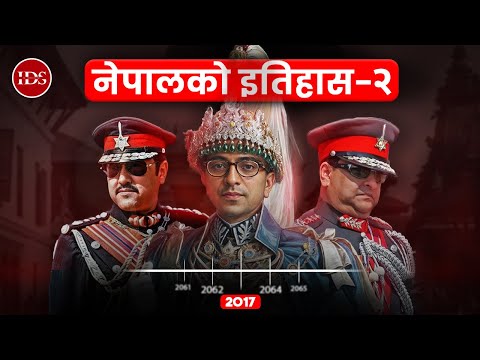
History Of Nepal -2 (2017-2063)
The Political Turmoil of Nepal: A Historical Overview
Introduction to Key Events
- The video opens with a series of significant incidents in Nepal's history, including attempted murder of the king and the royal massacre, highlighting a tumultuous period marked by political upheaval.
- It mentions various movements and the emergence of new leaders, setting the stage for an exploration of whether the post-2017 era was a "golden age" or a "dictatorial age."
The Establishment of Democracy
- The narrative begins with the historic agreement on Falgun 4, 2007 B.S., which ended over a century of autocratic rule under the Rana regime and established democracy in Nepal.
- Despite widespread joy among many figures like King Tribhuvan and B.P. Koirala, Crown Prince Mahendra expressed dissatisfaction with these changes.
Mahendra's Ascendancy to Power
- Following King Tribhuvan's death in 2011, Mahendra ascended to the throne as King Mahendra Bir Bikram Shah Dev, shifting from indifference towards political parties to actively undermining them.
- His concern grew after B.P. Koirala became Prime Minister following the 2015 elections, leading him to prioritize autocratic governance.
Imposition of Autocracy
- On Poush 1, 2017, King Mahendra dissolved all political parties and initiated a partyless Panchayat system while imprisoning then Prime Minister BP Koirala.
- This marked a significant shift towards consolidating power within the monarchy as he sought to restore his popularity among citizens.
Strategies Under Panchayat System
- To legitimize his rule, Mahendra introduced village Panchayat elections in 2018 and employed various strategies to promote this system at grassroots levels.
- Despite banning political parties, underground operations persisted; notably by Nepali Congress members who organized community efforts against his regime.
Resistance Against Authoritarian Rule
- As opposition grew during Mahendra’s tours across Nepal, exiled leaders convened in India to strategize against his authoritarian rule through armed conflict.
- Durganand Jha emerged as a pivotal figure planning an assassination attempt on King Mahendra with support from various political factions.
Assassination Attempt on King Mahendra
The Plot and Execution
- Durganand Jha, Dal Singh Thapa, and Arvind Thakur conspire to assassinate King Mahendra during his visit to Janakpur for the "Nagarik Abhinandan" program.
- Despite heavy security, Jha detonates a bomb in Mahendra's car; however, the king remains unharmed while some damage occurs to the vehicle.
Aftermath of the Assassination Attempt
- Following the incident, all three conspirators are arrested; Jha receives a death sentence and is executed on Magh 25, 2020. The other two receive life imprisonment.
- Historically, Brahmins had not faced the death penalty for rebellion charges until this case prompted a change in law.
Impact on King Mahendra's Image
- The assassination attempt further entrenches King Mahendra's reputation as a dictator among the public. This leads to intensified movements against the Panchayat system.
- In response to unrest, Mahendra introduces a new constitution in 2019 that decentralizes power but inadvertently empowers feudal lords and landlords.
Socioeconomic Changes Under King Mahendra
Transformation of Local Governance
- Elected village chiefs evolve into landlords who exploit peasants with low wages and limited access to resources like food and shelter. This breeds dissatisfaction among citizens towards the Panchayat system.
Land Reform Initiatives
- To counteract youth emigration abroad, King Mahendra launches the Land Reform Act and Village Return Campaign in 2021 aimed at encouraging agricultural settlement in Terai jungles.
- Permissions for land cultivation are granted alongside infrastructure projects like East-West Highway and various industrial zones; however, many industries fall prey to mafia control leading to closures.
Political Repression and Resistance
Political Prisoners Released
- As part of his campaign to improve his image, Mahendra releases political prisoners including B.P. Koirala which helps him gain some popularity among citizens despite ongoing issues with policy implementation due to corruption.
Growing Opposition Movements
- Discontent grows as opposition parties like Congress voice concerns over ineffective policies while Pushpa Lal Shrestha’s Nepal Communist Party leads anti-Panchayat movements across districts such as Pyuthan and Salyan. Protests escalate significantly during this period.
Violence Against Landlords: The Jhapa Revolts
Escalation of Peasant Movements
- Leaders like Mohan Bikram Singh organize peasant movements using intimidation tactics against landlords resulting in violent confrontations where several prominent landlords are murdered by revolutionaries from Jhapa district.
Government Crackdown
- In retaliation for these uprisings, key leaders of the Jhapa Revolts face severe consequences; many are arrested under murder accusations leading up to events known as the Sukhani massacre where they are killed by government forces under dubious circumstances on Falgun 21, 2029.
The Legacy of Violence: Consequences for Leadership
Arrested Leaders' Fate
- Ram Chandra Poudel later claims that one victim from these revolts was killed by KP Sharma Oli who subsequently faces imprisonment for fourteen years following these allegations amidst growing tensions within political factions after King Birendra ascends the throne post-Mahendra’s death.(717)
Exile of Opposition Leaders
Nepali Congress: Struggles and Revolutionary Acts
Financial Struggles of the Nepali Congress
- Despite limited resources, the Nepali Congress continued to operate under significant challenges. The party faced a critical decision: either dissolve or find ways to replenish its finances.
Underground Politics in Biratnagar
- A group of young activists led by Durga Subedi engaged in underground politics, occasionally meeting with prominent leaders like Sushil Koirala and Girija Prasad Koirala. They planned a hijacking to secure funds for the party amidst financial decline.
The Plane Hijacking Incident
- On Jestha 28, 2030, members of the Nepali Congress executed a successful hijacking of a Saahi Nepali airline carrying 30 lakh rupees from Biratnagar to Kathmandu, significantly boosting the party's morale and finances. Key figures included Durga Subedi and Basanta Bhattarai.
Impact on Political Landscape
- This unprecedented act was perceived as revolutionary during a time of financial constraints for the Congress. Shortly after this event, a fire at Singha Durbar destroyed crucial government documents, prompting political upheaval that forced Prime Minister Kritinidhi Bista to resign.
Government Crackdown on Dissent
- Following these events, the Panchayati government intensified its authoritarian measures against political opposition, leading to widespread arrests and violence against dissenters associated with various parties including armed groups within the Nepali Congress.
Escalation of Repression
- The regime's crackdown resulted in severe consequences for political activists; notable incidents included death sentences for involved military personnel and extrajudicial killings of opposition leaders like Ratnakumar Bantawa by government forces. This highlighted systemic repression under King Birendra’s rule reminiscent of his father Mahendra’s policies.
Student Movements Against Authoritarianism
- Despite governmental restrictions, student unions began addressing broader social issues beyond education and organized protests that often clashed with authorities leading to violent confrontations and nationwide strikes against repression from the state apparatus.
Referendum on Monarchy vs Multiparty Democracy
- Amidst growing public discontent reflected through protests, King Birendra announced a referendum on Baisakh 20, 2037, offering citizens a choice between reformed Panchayat governance or multiparty democracy; however, results favored Panchayat despite allegations of electoral rigging which were acknowledged even by some opposition leaders like BP Koirala.
Post-referendum Situation
The Struggle for Democracy in Nepal
Violence and Political Turmoil
- A tragic incident involving a group of 200 people resulted in the indiscriminate firing of shots, leading to the death of innocent youths, highlighting ongoing violence in various parts of the country.
- The political landscape was marked by autocratic rule under the king's leadership, with divided political parties failing to enact substantial change.
The Satyagraha and Political Alliances
- In 2042, the Satyagraha led by the Nepali Congress did not yield significant achievements despite initial hopes; cooperation between Congress and Communist parties was deemed necessary for meaningful change.
- Dissatisfaction grew among groups benefiting from the Panchayat system over four years, prompting a shift towards collaboration between Congress and Communists.
Jan Andolan: A Movement for Change
- The reduced gap between Congress and Communists evolved into coalition-building that led to the Jan Andolan of 2046, with participation from various factions including professionals.
- The government responded with repression during this movement, issuing orders for security forces to use extreme measures against protestors who were determined to fight for multiparty democracy.
Proclamation of Democracy
- On Chaitra 26, 2046, King Birendra announced the "Abolition of the Partyless Panchayat System," marking a pivotal moment broadcasted on national media. This proclamation followed discussions with representatives from political parties aimed at lifting bans on political activities.
- The culmination of Jan Andolan led to establishing a multiparty democratic system in Nepal after decades under autocratic rule; however, BP Koirala passed away before witnessing this change.
King Birendra's Legacy and Development Initiatives
- Following the establishment of democracy, King Birendra regained popularity through development projects like road construction and launching Nepal's first television channel (Nepal Television). These initiatives aimed at improving welfare despite his previous regime's limitations.
Transitioning Governments Post-Democracy
- An interim government formed under Krishna Prasad Bhattarai in Baishakh 2047 set the stage for elections after 33 years; Nepali Congress won a majority but faced internal disputes leading to instability.
- Midterm elections resulted in no party achieving a majority; coalition governments emerged amidst power struggles between Nepali Congress and CPN-UML while Maoist-led insurgency began escalating tensions across regions starting Falgun 2052 B.S.
Armed Conflict and Government Response
- As armed conflict intensified due to Maoist insurgency establishing control over districts like Rolpa and Rukum, government responses included granting security forces permission to shoot insurgents on sight amid concerns about police capabilities against them.
Royal Tragedy and Gyanendra’s Ascension
Crisis and Change in Nepal: The Rise of Maoist Insurgency
State of Emergency and Censorship
- Following a coup, King Gyanendra's government declared a state of emergency, leading to widespread censorship of communication channels including telephones and mobile networks.
- Media outlets such as radio, television, and newspapers faced strict censorship, with political leaders under surveillance.
- This period marked the beginning of direct rule by King Gyanendra under the "Shree 5" system.
Casualties in the Maoist Conflict
- By 2062 BS, casualties from the Maoist conflict reached approximately 17,000 compared to around 2,400 deaths before the Royal Massacre when military involvement was minimal.
- In the first five years of conflict, about 2,400 deaths occurred; this number surged to over 14,000 in the subsequent five years as insurgency spread.
Political Protests Against Autocracy
- Various political parties began protesting against King Gyanendra's autocratic rule; however, initial street protests yielded little significant result until Falgun.
- The Maoists joined forces with other political factions forming an alliance that culminated in a pivotal 12-point agreement advocating for a republic.
Expansion of Protests and Public Support
- Following the agreement on Chaitra 2062, support for the Maoist movement surged among various societal groups including government employees and students.
- Slogans like "Gyane Chor, Yo desh xod" gained traction during protests as public discontent grew against King Gyanendra’s regime.
Restoration of Democracy and Aftermath
- Facing backlash from widespread protests, King Gyanendra announced a restoration of democracy. A comprehensive peace agreement was signed on Mangsir 2063 BS marking an end to the decade-long armed conflict.
- Post-agreement Nepal experienced significant political upheaval characterized by frequent changes in government and slow progress in constitution drafting amidst controversies like the Wide Body scandal.
Looking Ahead: Future Discussions