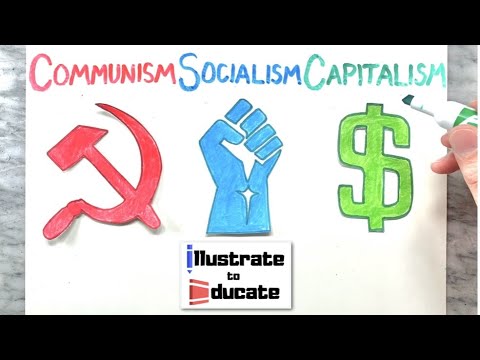
Communism Vs Socialism Vs Capitalism | What's the difference between Communism Socialism Capitalism?

Communism Vs Socialism Vs Capitalism | What's the difference between Communism Socialism Capitalism?

Comparing Communism, Socialism, and Capitalism

Overview of Economic Ideologies

  • Dan Zimmerman introduces the video, focusing on a brief comparison of communism, socialism, and capitalism.
  • Communism is defined as an economic and political ideology advocating for a classless system with communal ownership of production means; private property is either non-existent or severely limited.

Key Characteristics of Communism

  • The ideology opposes liberal democracy and capitalism, rooted in the theories developed by Karl Marx and Friedrich Engels.
  • Despite various nations claiming to be communist (e.g., Soviet Union, China, Cuba), no state has fully achieved pure communism that eliminates personal property and class systems.

Understanding Socialism

  • Socialism emphasizes collective ownership of production means; all legal decisions regarding production and distribution are government-controlled.
  • In socialist systems, the government dictates output levels and pricing while providing essential services like food and healthcare to citizens.

Capitalism Explained

  • Capitalism contrasts with socialism through its belief in private ownership aimed at maximizing profits; it relies on individual enterprises owning production means.
  • The enforcement of private property rights incentivizes investment in productive capital. Historically evolved from feudalism and mercantilism in Europe, capitalism expanded significantly during industrialization.

Critique of Economic Systems

  • Both communism and socialism seek to address issues arising from capitalism's free market system, such as worker exploitation and wealth inequality.
  • The video concludes by inviting viewers to share their thoughts on these ideologies.
Video description

In this video, we look at a brief and simple explanation of the difference between Communism, Socialism, and Capitalism.​​ Communism is an economic and political ideology that advocates for a classless system in which the means of production are owned communally and private property is nonexistent or severely diminished. Communism positions itself in opposition to liberal democracy and capitalism, Karl Marx and Friedrich Engels developed and laid the groundwork for the theory and practice of communism. Although the former Soviet Union, China, and Cuba (among other nations) have had nominally communist governments, there’s never actually been a purely communist state that has completely eliminated personal property, money, and class systems. Socialism is an economic and political system based on collective ownership of the means of production. All legal production and distribution decisions are made by the government in a socialist system. The government also determines all output and pricing levels and supplies its citizens with everything from food to healthcare. Socialist ideals include production for use, rather than for profit; an equitable distribution of wealth and material resources among all people; no more competitive buying and selling in the market; and free access to goods and services. Capitalism, with its belief in private ownership and the goal to maximize profits, stands in contrast to socialism, but most capitalist economies today have some socialist aspects. Communism and socialism oppose capitalism, an economic system where private individuals and enterprises own the means of production and the right to profit from them. Capitalism depends on the enforcement of private property rights, which provide incentives for investment in and productive use of productive capital or goods which are used in further production of wealth. Capitalism developed historically out of previous systems of feudalism and mercantilism in Europe, and dramatically expanded industrialization and the large-scale availability of mass-market consumer goods. Communism and socialism aim to right the wrongs of capitalism’s free-market system. These include worker exploitation and inequities between rich and poor. Sources: https://www.investopedia.com/terms/m/marxism.asp https://www.investopedia.com/terms/c/communism.asp https://www.investopedia.com/terms/s/socialism.asp https://www.investopedia.com/terms/c/capitalism.asp #Communism #Socialism #Capitalism