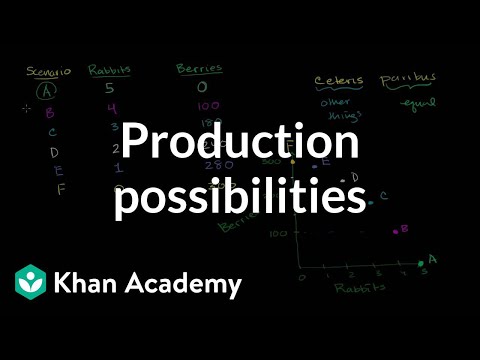
Production possibilities frontier | Microeconomics | Khan Academy
Understanding Trade-offs in Hunting and Gathering
Introduction to Scenarios
- The discussion begins with a hypothetical scenario involving a hunter-gatherer deciding how to allocate time between hunting rabbits and gathering berries.
- The simplicity of the model is established by limiting the focus to only two resources: rabbits for hunting and berries for gathering.
Scenario Analysis
Scenario A
- In Scenario A, dedicating an entire day to hunting yields 5 rabbits but results in 0 berries due to no time allocated for gathering.
Scenario B
- Allocating some time to gather allows for catching 4 rabbits and collecting 100 berries, demonstrating a trade-off between the two activities.
Ceteris Paribus Principle
- The term "ceteris paribus" is introduced, meaning "all other things being equal," emphasizing that factors like sleep or techniques remain constant while changing time allocation between hunting and gathering.
Further Scenarios
Scenario C
- In this scenario, spending less time on hunting (3 rabbits) allows for gathering 180 berries, illustrating increased efficiency in resource collection.
Scenario D & E
- Reducing rabbit hunting further (2 rabbits) enables the collection of 240 berries.
- If only one rabbit is hunted, it leads to an increase in berry collection up to 280.
Scenario F
- Spending all available time on gathering results in no rabbits but maximizes berry collection at 300.
Production Possibilities Frontier
Understanding Production Possibilities Frontier
Exploring Trade-offs Between Resources
- The discussion begins with the concept of trade-offs between two resources: rabbits and berries. A visual representation is created using a dotted line to illustrate the production possibilities frontier (PPF), which encompasses all possible combinations of these two resources.
Scenarios on the Production Possibilities Frontier
- An example scenario, referred to as Scenario G, illustrates an average yield of 4.5 rabbits and 50 berries, emphasizing that various combinations are achievable within the PPF framework.
- The speaker highlights that time allocation can vary significantly; for instance, one could spend slightly more or less than a whole hour on each resource, indicating flexibility in achieving different outcomes along the curve.
Defining Feasible and Infeasible Points
- The PPF delineates feasible scenarios from infeasible ones. For example, obtaining 3 rabbits and 180 berries is possible, while acquiring 5 rabbits and 200 berries is deemed impossible due to time constraints.
- Any point beyond the curve represents unattainable production levels. If all time is spent on one resource (e.g., five rabbits), there’s no capacity left for producing the other (e.g., berries).
Understanding Efficiency Within Resource Allocation
- Points located inside or below the PPF indicate inefficiency; for instance, getting only 1 rabbit and 200 berries suggests suboptimal use of resources since better combinations exist.
- While points within this area are possible, they do not represent optimal efficiency. This inefficiency may stem from poor resource management or lack of focus in production strategies.
Characteristics of Efficient Production Points
Turn any video into a summary like this
YouTube links, meetings, lectures — with transcripts, search, and chat.