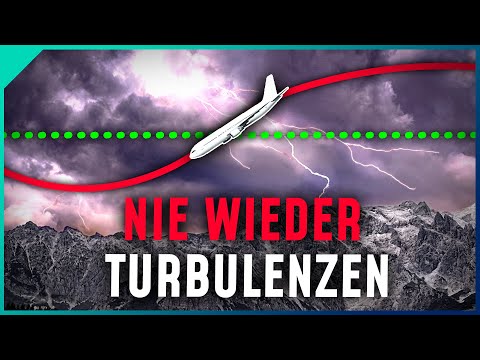
Nie wieder Turbulenzen dank neuer Technologie!
Turbulence in Flugzeugen
The video discusses the dangers of turbulence during flights, the different types of turbulence, and how airlines are working to protect their passengers from it.
Types of Turbulence
- There are four different intensities of turbulence: light, moderate, severe, and extreme.
- Light turbulence causes minimal movement in the aircraft and is barely noticeable to passengers.
- Moderate turbulence causes more noticeable movement in the aircraft and can cause unsecured items to move around.
- Severe turbulence can cause abrupt changes in flight position and even cause passengers to be thrown from their seats.
- Extreme turbulence is rare but can cause complete loss of control over the aircraft.
Causes of Turbulence
- Turbulence can be caused by friction with terrain or artificial obstacles such as buildings or trees.
- Near mountains, mountain waves or lee waves can create turbulent conditions on both sides of a mountain range.
- Special weather conditions such as thunderstorms can also create turbulent conditions.
- Clear-air turbulence occurs at high altitudes where there are no clouds. It is often found near jet streams.
Impact on Passengers
- Turbulence is a leading cause of injuries during flights.
- Airlines are working to protect their passengers from injury by researching new technologies that will help prevent turbulence-related accidents.
- Airlines have been hesitant to invest in these technologies due to cost concerns.
Turbulence and Climate Change
This section discusses the impact of climate change on turbulence during flights, as well as a new technology called turbulence cancelling.
Turbulence and Climate Change
- Clear air turbulence is responsible for most severe incidents during flights.
- The increase in temperature in the upper troposphere and decrease in temperature in the lower stratosphere due to climate change affects atmospheric circulation, causing more turbulence in mid-latitudes where most planes fly.
- By 2050-2080, there will be a 160% increase in severe turbulence compared to pre-industrialization levels.
- Turbulence causes an additional 10% of CO2 emissions from airplanes.
Turbulence Cancelling
- Inspired by birds' feathers that act as sensors, turbulence cancelling uses high-dynamic pressure sensors mounted on poles attached to airplane wings to detect changes in air pressure caused by turbulence before it reaches the wings.
- The direct lift control system then adjusts movable wing flaps within 0.1 seconds to counteract the effects of turbulence.
- This technology can reduce turbulence during flights by up to 80% and is being tested for use on commercial flights.
LIDAR Detection
- LIDAR (Light Detection and Ranging) detection uses short laser pulses that bounce off aerosols (small particles) in the air to detect changes in frequency caused by movement of these particles due to turbulence.
- Boeing has been testing this system for several years and can detect turbulence up to 16 km away.
Traveland Solution's Turbulence Cancelling Technology
This section discusses how Traveland Solution's turbulence cancelling technology is currently only focused on small planes due to their low altitude, which makes them more susceptible to turbulence. The startup plans to eventually expand the technology to larger planes, but this may take up to 10 years. However, the cost of implementing this technology is currently a major obstacle.
Focus on Small Planes
- Traveland Solution's turbulence cancelling technology is currently only being used for small planes due to their low altitude and susceptibility to turbulence.
- Experts from Trouble and Scansling have noted that small planes are particularly affected by turbulence.
Expansion Plans
- Traveland Solution plans to eventually expand its turbulence cancelling technology to larger planes as well.
- However, it may take up to 10 years for this expansion plan to come into effect due to issues with ensuring operational safety in large planes.
Cost Obstacles
- The cost of implementing the turbulence cancelling technology in large planes is a major obstacle at present.
- Currently, using Differenzdrucksensoren sensors is about ten times cheaper than using the turbulence cancelling system developed by Traveland Solution.
- Research has shown that installing the system would actually cost more money than it would save in the long run, making it unfeasible for many airlines.
Turbulence-related Injuries and Future Developments
This section discusses how turbulence can lead to injuries and financial losses for airlines, as well as future developments that could improve flight safety.
Turbulence-related Injuries and Costs
- Turbulence can lead to injuries and financial losses for airlines. According to Luft hat Unternehmen, turbulence costs airlines millions of dollars annually and results in over 7,000 hours of injury-related employee absences.
- The idea behind Traveland Solution's turbulence cancelling technology is to reduce these costs and improve safety on flights.
Future Developments
- Technologies like turbulence cancelling could help make flights more fuel-efficient and safer in the future.
- However, such technologies need to become more affordable before they can be widely implemented.
- Hydrogen-powered planes may be a promising development for the future of air travel. A video on this topic will be available on the channel next week.