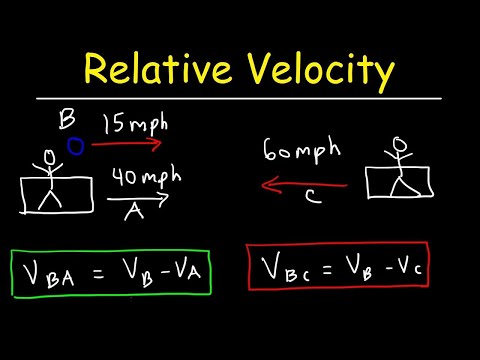
Relative Velocity - Basic Introduction
Introduction to Relative Velocity
In this video, we learn about relative velocity and how to calculate it. We also go over some examples that illustrate the concept.
Understanding Relative Velocity
- Relative velocity is the difference between the velocities of two objects.
- The formula for calculating relative velocity is vba = vb - va, where vba is the velocity of object b with respect to object a.
- The subscript "a" refers to the reference frame or frame of reference.
Examples of Relative Velocity
- To find vca, which is the velocity of c with respect to a, subtract vc from va.
- To find vafc, which is the velocity of a with respect to c, subtract va from vc.
- To find vcb, which is the velocity of c with respect to b, subtract vb from vc.
- To find vbc, which is the velocity of b with respect to c, subtract vc from vb.
Example Problem
- If train A is moving at 50 mph and train B is moving at 60 mph in the same direction as train A, then their relative velocity can be calculated as follows:
- The velocity of B with respect to A is 10 mph because B is moving 10 mph faster than A.
- The velocity of A with respect to B is -10 mph because A is moving 10 mph slower than B.
Understanding Relative Motion
- When two objects are moving in different directions or at different speeds, their relative motion can be calculated using relative velocity.
- For example, if Train A and Train B are moving in opposite directions on parallel tracks and Train A has a speed of 50 mph while Train B has a speed of 60 mph then their relative motion can be calculated using the formula vba = vb + va.
Conclusion
- Relative velocity is an important concept in physics that helps us understand how objects move relative to each other.
- By calculating relative velocity, we can determine the motion of one object with respect to another object or reference frame.
Understanding Relative Velocity
In this section, we learn about relative velocity and how it is calculated. We also understand the sign of relative velocity and what it means.
Moving towards left or right
- Train A appears to be moving towards the left with respect to B.
- Person on train A sees person on train B moving 10 miles per hour away from them towards the right.
- The relative velocity of B with respect to A is positive because the person on B is moving towards the right away from person A.
- The relative velocity of A with respect to B should be a positive answer as time progresses, A keeps moving to the right.
Calculating Relative Velocity
- If there's a person on train A moving east at 50 miles per hour and another person on train B moving west at 40 miles per hour, then:
- The relative velocity of A with respect to B is 90 miles per hour (50 mph - (-40 mph)).
- The distance between them will decrease by 90 miles every hour.
- The velocity of B with respect to A is negative 90 mph (-40 mph - 50 mph).
Practice Problem
- If a car moves at 40 mph with respect to Earth and throws a ball east at 15 mph with respect to the car while another car approaches it at 60 mph towards west:
- Find the velocity of the ball with respect to this person.
Finding the Velocity of an Object with Respect to Another Object
In this section, we learn how to find the velocity of an object with respect to another object using equations and relative velocity concepts.
Finding Velocity of Ball B with Respect to Car C
- To find the velocity of ball B with respect to car C, we use the equation vb - vc.
- We know that vc is -60 mph because car C is moving towards the left.
- We need to find vb, which is the velocity of ball B with respect to car A.
- We use vba = ve - va, where vba is the velocity of ball B with respect to car A, ve is the velocity of ball B with respect to earth (which is 15 mph towards right), and va is the velocity of car A (which is 40 mph towards right).
- Solving for vb, we get vb = 55 mph.
- Therefore, the velocity of ball B with respect to car C is 115 mph (55 + (-60)).
Understanding Relative Velocity
- If two objects are moving in different directions or at different speeds, their relative motion can be described using relative velocity concepts.
- The distance between two objects changes based on their velocities and direction of motion.
- By understanding relative velocities, we can calculate how fast one object appears to be moving from another object's perspective.
Turn any video into a summary like this
YouTube links, meetings, lectures. With transcripts, search, and chat.