A energia solar: como utilizar em reações químicas?
Introdução à Energia Solar em Reações Químicas
Contexto e Importância das Reações Químicas
- A apresentação inicia com uma introdução sobre reações químicas, destacando sua presença no cotidiano e a importância de compreendê-las.
- Um trecho musical é utilizado para ilustrar como a transformação da matéria ocorre, mencionando exemplos como madeira se tornando carvão e trigo se transformando em pão.
Energia Solar como Catalisador
- A energia solar é apresentada como um recurso natural que pode ser utilizado para promover reações químicas, enfatizando a capacidade humana de controlar essas reações.
- Exemplos naturais são citados, como folhas que mudam de cor no outono e o processo de fotossíntese nas plantas, mostrando a dependência da luz solar.
Espectro Solar e Eficácia nas Reações
- O espectro solar é discutido, abrangendo as radiações ultravioleta, visível e infravermelha, com ênfase na variação da incidência conforme a altitude.
- Dados específicos do espectro solar são apresentados: 5% na região ultravioleta, 43% no visível e 52% no infravermelho.
Desafios na Utilização da Radiação Solar
Eficiência das Reações Químicas
- Muitas reações químicas poderiam ser mais eficientes se ocorressem na região do espectro visível; porém, muitas delas acontecem na região ultravioleta onde a incidência é menor.
Exemplo Prático: Bronzeamento da Pele
- O processo de bronzeamento é explicado através dos raios UVB que estimulam a produção de melanina na pele.
- A produção de melanina tem um efeito protetivo até certo ponto; intensidades excessivas podem causar queimaduras ou câncer.
Fotossíntese: Um Modelo Natural
Processo de Conversão
- A fotossíntese é descrita como uma reação química onde CO2 e água se convertem em glicose com o auxílio da clorofila.
Impacto da Intensidade Solar
- A intensidade da luz solar afeta diretamente a produção de clorofila nas plantas; menos luz resulta em folhas amareladas devido à diminuição dessa pigmentação.
Aplicação Laboratorial das Reações Naturais
Imitação da Fotossíntese
- Há um interesse crescente em replicar o processo natural da fotossíntese em laboratório para reduzir poluição ambiental e produzir compostos orgânicos úteis.
Uso Eficiente da Luz Solar
- Discussão sobre métodos para aproveitar a luz solar em ambientes laboratoriais ou sistemas aplicados visando produtos desejáveis como calor ou energia elétrica.
Sistemas Fotovoltaicos e Processos Fotoquímicos
Transformação Energética
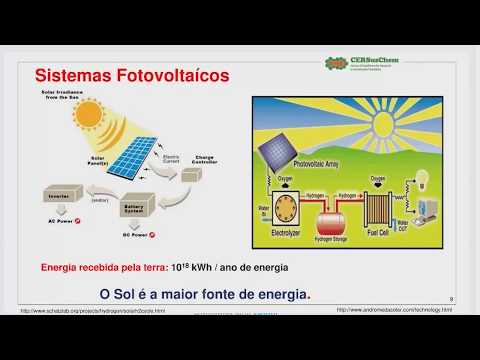
- Os sistemas fotovoltaicos utilizam radiação solar para gerar eletricidade através do movimento de cargas elétricas geradas pela luz.
Processos Fotoquímicos vs. Fotoeletroquímicos
- Diferença entre processos fotoquímicos (uso exclusivo da luz para transformação química com fotocatalizadores), enquanto os fotoeletroquímicos combinam energia solar com elétrica para maior eficiência.
Conclusão sobre Conversão de Energia Solar
Tipos de Conversão Energética
- Resumo das formas principais de conversão: desde geração elétrica via sistemas fotovoltaicos até processos térmicos que podem resultar em energia mecânica.
Understanding Photovoltaic Systems
Energy Storage and Conversion
- The electrical energy generated is sent to a charge controller, which charges a battery for various applications in industrial, residential, or agricultural settings.
- This stored energy is typically in direct current (DC), necessitating conversion to alternating current (AC) for broader usability.
- Photovoltaic systems can also be integrated with fuel cells, where the solar energy aids in producing fuel rather than directly supplying electricity.
Hydrogen Production via Electrolysis
- Using saline water and electrolysis powered by photovoltaic systems generates hydrogen gas.
- The produced hydrogen is then injected into a fuel cell, where it reacts with oxygen to generate electricity, water, and heat.
- This process creates a self-sustaining cycle; the generated water can be reused within the system.
Solar Energy Potential
- Solar energy offers an immense potential of 10 to 18 kWh per year globally, presenting solutions for many of the planet's energy challenges.
Challenges in Photovoltaic Technology
- A significant issue remains regarding the materials used in photovoltaic systems and their efficiency levels, which are still relatively low.
Applications of Photovoltaic Systems
Remote Energy Solutions
- Key applications include providing electricity in remote areas lacking conventional power grids and supporting autonomous systems like telecommunications and emergency signaling.
Historical Context of Photovoltaics
Origins of Photovoltaic Technology
- The term "photovoltaic" derives from Greek "photo" meaning light and honors Alessandro Volta, a pioneer in electrochemistry.
Early Discoveries
- In 1800, Volta initiated studies on electrochemical processes leading to the discovery of the photovoltaic effect by Alexandre Edmond Becquerel in 1839.
Development Milestones
- In 1876, selenium was identified as having photoconductive properties capable of generating electricity when exposed to sunlight—marking early solar cell development.
Advancements in Solar Cell Technology
Evolution Over Time
- Initial solar cells were expensive and inefficient until advancements during the mid-to-late 20th century spurred development due to space exploration needs.
Key Innovations
- The first silicon PN junction solar cells emerged around 1941; improvements followed through better control over these junction efficiencies by the 1970s.
Classifications of Solar Cells
Generational Differences
- Solar cells are categorized into three generations:
- First Generation: Silicon-based cells with low efficiency (4%-6%).
- Second Generation: Cadmium telluride and copper indium selenide technologies achieving higher efficiencies (up to 25%).
- Third Generation: Flexible organic polymer-based cells that utilize nanocrystals for improved performance.
Efficiency Improvements
- Recent developments have led second-generation cells close to achieving efficiencies between 22% and 25%, showcasing significant technological progress.
Understanding Intrinsic and Extrinsic Semiconductors
Intrinsic Semiconductors
- Intrinsic semiconductors are elements from group 4, such as germanium and silicon. They possess a perfect crystal structure without defects or impurities.
- In their valence band, intrinsic semiconductors have free electrons. When solar radiation hits them, these electrons move through the material, conducting electricity.
- The movement of electrons creates electron-hole pairs; as an electron moves, it leaves behind a positive charge near the nucleus of the atom.
Extrinsic Semiconductors
- Extrinsic semiconductors are created by doping intrinsic materials with other elements to alter their electrical properties.
- For example, when silicon is doped with phosphorus (which has five valence electrons), it results in an excess of one electron, creating an N-type semiconductor.
- Conversely, doping silicon with boron (three valence electrons) leads to a deficiency of one electron, resulting in a P-type semiconductor.
PN Junction and Current Generation
- A combination of N-type and P-type semiconductors forms a PN junction. This junction allows for the flow of electrons in one direction when they meet.
- The interaction between these two types generates electric current due to the movement of charges across the junction when light strikes the cell.
Structure and Functionality of Photovoltaic Cells
Basic Structure
- A photovoltaic cell consists of a PN junction that facilitates electron flow upon exposure to light. This process generates electric current.
- The structure includes electrical contacts that collect current generated by positive and negative charges directed towards external loads like lamps.
Comparison with Batteries
- Similar to batteries which have cathodes and anodes generating electric flow when connected externally, photovoltaic cells operate on analogous principles but utilize solar energy instead.
Components Enhancing Efficiency
Material Composition
- Photovoltaic cells typically use conductive materials like aluminum or copper for electrical contacts alongside P-type and N-type semiconductors.
- The absorption layer excites valence band electrons into conduction bands upon sunlight exposure, initiating charge separation.
Efficiency Factors
- Multiple PM layers can enhance efficiency by increasing charge separation while minimizing recombination rates between excited electrons and holes.
Challenges in Photovoltaic Technology
Recombination Issues
- High efficiency is achieved if excited electrons reach electrodes without recombining locally; otherwise, energy loss occurs.
Structural Integrity
- Monocrystalline silicon offers higher efficiency due to fewer defects allowing free movement of charge carriers compared to other materials.
Global Adoption Trends in Solar Energy
Current Usage Statistics
- While Brazil has limited photovoltaic systems currently installed compared to countries like Germany or China, global adoption is rising significantly.
Economic Considerations
- Costs associated with solar installations vary; for instance, residential setups can range around R$25 thousand for adequate coverage.
Future Prospects
- Large-scale solar farms are becoming more common globally; examples include facilities capable of powering hundreds of homes while reducing reliance on less environmentally friendly energy sources.
This structured overview captures key insights from the transcript regarding semiconductor technology's role in photovoltaics while highlighting trends in global adoption.
Overview of Photovoltaic Energy Systems
Key Locations and Capacities
- The first three photovoltaic plants are located in the United States, with one in China and another in India.
- These plants generate between 550 to 579 megawatts and occupy approximately 3,200 acres.
Efficiency and Scale
- A second plant has reduced its area from 320 acres to 640 acres while utilizing around 9 million solar panels. This plant can supply energy to about 160,000 homes.
- In contrast, a Brazilian system is significantly less powerful, highlighting the disparity in scale between these installations.
Land Use Concerns
Area Utilization Issues
- The extensive land required for solar farms raises concerns about potential competition with agricultural land that could be used for food production.
Advantages of Photovoltaic Cells
Renewable Energy Benefits
- Photovoltaic cells provide renewable, clean energy without greenhouse gas emissions and can supply electricity to remote areas.
Economic Considerations
- Despite their benefits, the high cost of equipment remains a significant barrier to widespread adoption. Additionally, solar energy generation is limited to daylight hours, necessitating storage solutions like batteries for nighttime use.
Environmental Impact
Material Sourcing Concerns
- The environmental impact arises not from electricity generation but from sourcing materials for photovoltaic panels and their eventual disposal or recycling challenges.
Habitat Disruption
- Large-scale installations can lead to habitat loss, degradation of local environments, noise pollution during installation, visual impacts on landscapes, and glare issues due to sunlight reflection off panels.
Advancements in Photoelectrochemical Systems
Chemical Reactions Using Solar Energy
- Photoelectrochemical systems utilize solar energy for chemical reactions by generating electron-hole pairs through semiconductor materials when exposed to light.
Types of Semiconductor Cells
- Three types of cells are discussed:
- N-type semiconductors act as photonodes facilitating oxidation reactions.
- P-type semiconductors promote reduction reactions.
- Combined systems enable both anodic and cathodic reactions under light exposure using photocatalysts.
Applications of Photocatalysts
Hydrogen Production
- Photocatalysts are crucial for hydrogen production via water splitting processes and organic synthesis applications such as converting alcohol into aldehydes or ketones while also removing organic pollutants by transforming them into CO2 and water.
Mechanism Insights
- When light hits a semiconductor material's valence band (VB), it generates electron-hole pairs that facilitate oxidation or reduction reactions necessary for various chemical transformations including hydrogen production from water splitting processes.
Material Selection for Effective Systems
Band Gap Importance
- Selecting materials with appropriate band gaps is essential; they must allow efficient charge transfer during oxidation-reduction processes when exposed to light sources while ensuring effective proton reduction or water oxidation occurs efficiently at the semiconductor interface.
Examples of Materials Used
- Various semiconductor materials can be synthesized differently; an example includes bismuth vanadate created through polyethylene glycol synthesis followed by calcination at high temperatures before being coated onto conductive glass substrates for photoelectrochemical applications.
Performance Evaluation
Current Generation Analysis
- Light exposure leads to current generation within these systems; absence of light results in no current flow indicating no ongoing chemical reaction—demonstrating the direct correlation between illumination intensity and electrochemical activity within the cell structure utilized during experiments conducted over specific time frames showing measurable current outputs under varying conditions including darkness versus illuminated states.(2737).
Degradation Studies
- Experiments show that combining electric currents with light significantly enhances degradation rates of colored compounds compared to using either method alone—indicating synergistic effects leading towards higher efficiency in pollutant removal processes.(2927).
Synergism Between Light and Electric Current
Photocatalytic Degradation Processes
- The discussion highlights the synergistic effect observed between light action and electric current in material degradation, specifically focusing on the performance of materials like copper oxide modified with molybdenum sulfide.
- The speaker clarifies that the previous mention of copper oxide was incorrect; instead, they refer to a modification involving molybdenum sulfide to enhance efficiency.
Methylene Blue Degradation
- A system utilizing bismuth vanadate within a molecular sieve demonstrates significant photocatalytic properties, achieving approximately 90% degradation of methylene blue solely through light exposure.
- The process involves generating electron-hole pairs leading to oxidation reactions, showcasing the dual capability of the material for both reduction and oxidation processes.
Challenges in Photovoltaic Systems Maintenance
Importance of Clean Panels
- Dust accumulation on photovoltaic panels can significantly reduce energy generation efficiency; thus, maintaining clean surfaces is crucial for optimal performance.
- A reflective coating is suggested to minimize dust deposition while ensuring safety for individuals nearby. The design aims for smooth surfaces to prevent dirt accumulation.
Maintenance Strategies
- Regular cleaning and maintenance are essential; neglecting these can drastically shorten panel lifespan and efficiency. Materials should be chosen to minimize dirt accumulation.
- Corrosion poses a major challenge for metallic components supporting solar panels, often leading to reduced durability compared to other materials designed for longevity.
Experimental Limitations in Research
Laboratory vs. Industrial Scale
- There are no inherent experimental limitations specific to research types; however, practical challenges arise when scaling from laboratory setups (e.g., small cell measurements).
- Transitioning from small-scale experiments (like 3x3 cm cells) to larger industrial applications requires careful consideration of uniformity across multiple panels connected in series.
Advancements in Material Synthesis
- Research centers focus on developing methods for large-scale production while maintaining control over critical parameters such as film thickness and crystallinity during synthesis processes.
Recent Developments in Bismuth Vanadate Research
Novel Applications
- Bismuth vanadate's use as a photocatalyst has gained traction over the past decade, particularly when supported by zeolites; however, literature remains limited regarding its application.
- Historically used primarily in dyes and paints due to its color properties, bismuth vanadate is now recognized for its simple synthesis process with low toxicity implications.
Recombination and Charge Separation in Semiconductors
Temperature Effects on Film Formation
- A temperature of 400 degrees Celsius is required for approximately 20 minutes to an hour to form films, allowing work with powders in both photoelectrolysis and photocatalysis.
Addressing Recombination Issues
- Domingos Sérgio raises a question about reducing recombination problems. Modifications to the semiconductor, such as using alumina, are suggested as potential solutions.
Strategies for Reducing Recombination
- Several methods can decrease recombination effects:
- Adding a layer that captures electrons or holes can help direct charges away from the semiconductor.
- When charge separation occurs in the semiconductor, this additional layer will either capture electrons or facilitate hole movement.
Specific Examples of Charge Capture
- In reactions involving iron (Fe2+/Fe3+), the capturing of electrons prevents recombination by utilizing generated electrons effectively.
- The use of co-catalysts like molybdenum sulfide promotes oxidation or reduction processes, generating hydrogen while extracting electrons from the semiconductor.
Heterostructures and Energy Diagrams
- Creating heterostructures with favorable band distribution allows for controlled electron decay between layers, minimizing local recombination by directing electron flow.
- The energy diagram of the system plays a crucial role; decorating semiconductors with co-catalysts enhances species reduction/oxidation while promoting charge separation.
Material Quality and Defect Minimization
- Maintaining minimal defects within materials is essential. High-quality nanocrystalline materials enhance electronic conduction and reduce recombination rates.
- Emphasizing crystal quality ensures better electronic conduction properties, further aiding in reducing recombination issues within semiconductors.
Conclusion and Further Engagement
- The speaker expresses gratitude towards participants and invites further questions via messages for continued discussion on these topics.